
Last Updated on March 29, 2026
There’s a common doubt that keeps popping up in forums like r/bodyweightfitness: Can you really build muscle using just your body weight?
The short answer—yes, you can. But the real answer is more nuanced, and that’s where most people get stuck or misled.
Let’s break it down properly so you can actually decide if bodyweight training fits your goals.
The Real Problem: People Think “No Weights = No Muscle”
Most beginners—and even some experienced lifters—assume muscle growth depends on lifting heavy external weights. That belief comes from traditional gym culture: barbells, dumbbells, machines.
Bodyweight training looks “lighter” in comparison. Push-ups don’t seem as serious as bench presses. Squats without a bar don’t look as intense.
So the assumption becomes:
No external load = no real muscle growth
That’s where the misunderstanding starts.
The Core Truth: Muscle Doesn’t Care About Equipment
Your muscles don’t know whether you’re lifting a barbell or pushing your own body off the floor.
They respond to one thing: tension.
When a muscle is forced to work hard enough—through resistance, effort, and fatigue—it adapts by growing stronger and, in many cases, bigger.
This principle is called progressive overload (a key concept in Strength Training). It simply means:
You must gradually make an exercise harder over time.
And here’s the key point:
Bodyweight training can absolutely provide progressive overload.
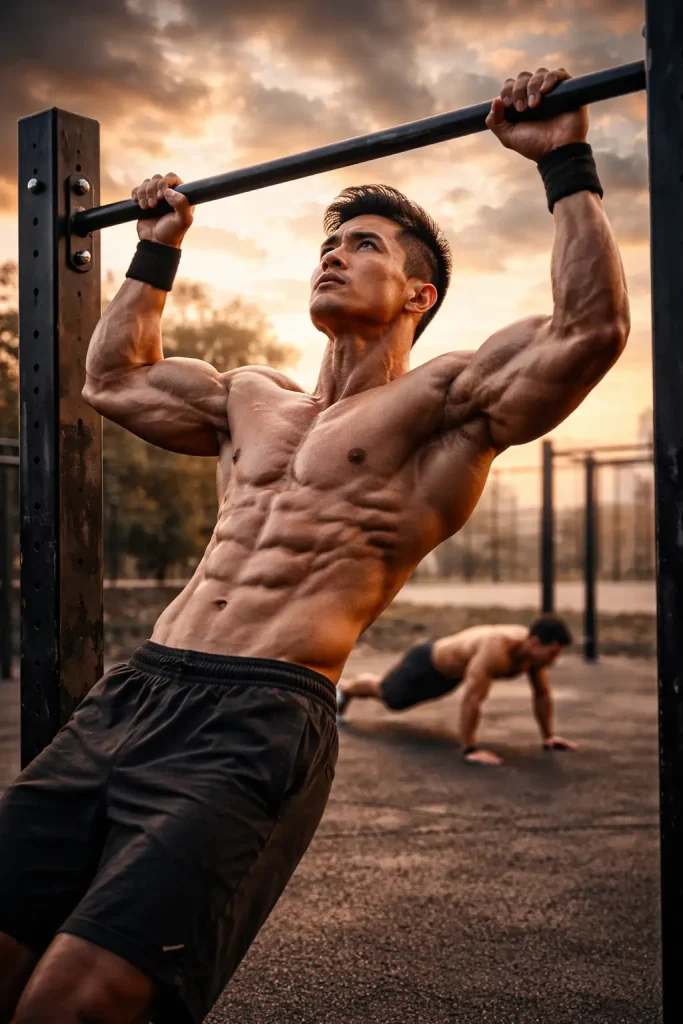
What Bodyweight Training Actually Does Well
Bodyweight training excels in areas that most people overlook.
First, it builds relative strength—your strength compared to your body size. That’s why gymnasts, who rely almost entirely on bodyweight, are incredibly strong and muscular without looking bulky.
Second, it forces full-body control. Every rep requires coordination, balance, and stability. You’re not just moving weight—you’re controlling your entire body.
Third, it improves joint strength and mobility. Movements like deep squats, hanging exercises, and push variations build durability over time.
This is why systems like Calisthenics have been used for decades—not just by fitness enthusiasts, but by athletes and military training programs.
Can You Really Build Visible Muscle?
Yes—but it depends on how you train.
A basic push-up might not be enough forever. But that doesn’t mean bodyweight training fails—it just means you need progression.
Think about this:
- Regular push-ups → Decline push-ups
- Decline push-ups → Diamond push-ups
- Diamond push-ups → Archer push-ups
- Archer push-ups → One-arm push-ups
Each step increases difficulty and muscle demand.
The same goes for legs:
- Bodyweight squats → Bulgarian split squats
- Split squats → Pistol squats
- Pistol squats → Weighted pistols or slow tempo variations
If you keep progressing, your muscles keep adapting.
Why Some People Fail With Bodyweight Training
Here’s the reality: most people don’t fail because bodyweight training doesn’t work.
They fail because they don’t make it harder.
They stay stuck doing:
- 3 sets of 10 push-ups
- 3 sets of 10 squats
- Same routine for months
No increase in difficulty, no variation, no intensity.
That’s not a limitation of bodyweight training—that’s poor programming.
The Intensity Factor: Where Growth Actually Happens
Muscle growth happens when you push close to failure.
If your set feels easy, your body has no reason to adapt.
With weights, increasing intensity is simple—you add plates.
With bodyweight, you increase intensity through:
- Harder variations
- Slower tempo
- More reps (to a point)
- Longer time under tension
- Reduced rest
For example:
A slow push-up (5 seconds down, 2 seconds up) can be more challenging than a fast one—even without adding weight.
Upper Body vs Lower Body: The Big Difference
Bodyweight training works extremely well for the upper body.
Push-ups, pull-ups, dips—these can build serious muscle in the chest, shoulders, back, and arms.
In fact, exercises like pull-ups rival heavy lat pulldowns in effectiveness.
But the lower body is where things get tricky.
Your legs are naturally stronger and can handle more load. Bodyweight squats alone often aren’t enough for long-term growth.
That’s why advanced leg training includes:
- Single-leg work (pistol squats)
- Explosive movements (jump squats)
- Added resistance (holding weights or using bands)
So yes, bodyweight works—but legs usually need more creativity or added load.
The Physique Question: Lean vs Bulky
Here’s something most people don’t say clearly:
Bodyweight training tends to build a lean, athletic physique, not a bulky one.
Think:
- Defined muscles
- Low body fat
- Strong but not oversized
This is the typical look of calisthenics athletes.
If your goal is to look like a bodybuilder, heavy weight training may be more efficient.
If your goal is strength, aesthetics, and function, bodyweight training is more than enough.
The Role of Nutrition (This Is Where Most People Mess Up)
Even perfect training won’t build muscle without proper nutrition.
Muscle growth requires:
- Enough protein
- Enough calories
- Consistency over time
If you’re training hard but not eating enough, your body won’t build muscle—it’ll just maintain or even lose weight.
This applies to all training styles, not just bodyweight.
Time Under Tension: The Hidden Advantage
Bodyweight exercises often involve longer time under tension.
For example:
- Holding a plank
- Pausing at the bottom of a squat
- Slow push-ups
This increases muscle stress and can stimulate growth even without heavy loads.
This is one reason why bodyweight training can be surprisingly effective.
Advanced Bodyweight Training Is Not Easy
People often underestimate how hard bodyweight training can get.
Try these:
- One-arm push-ups
- Handstand push-ups
- Front lever
- Muscle-ups
These aren’t beginner exercises—they require serious strength and control.
And yes, they can build muscle.
When Bodyweight Training Might Not Be Enough
Let’s be honest—there are limits.
If your goal is:
- Maximum muscle size (bodybuilding level)
- Very fast muscle gain
- Targeting very specific muscles in isolation
Then adding weights is more efficient.
Bodyweight training can still get you far, but it may not be the fastest route to extreme size.
The Hybrid Approach: What Actually Works Best
Here’s what experienced lifters eventually figure out:
You don’t have to choose.
Combining bodyweight and weights often gives the best results.
For example:
- Use pull-ups and dips for upper body
- Use weights for heavy leg work
- Mix both for variety and progression
This approach keeps training effective and sustainable.
Real-World Example: Why Gymnasts Look the Way They Do
Gymnasts are one of the best proofs that bodyweight training works.
They train almost entirely using their body weight, yet they develop:
- Thick shoulders
- Strong arms
- Solid core
- Lean muscle mass
They don’t rely on heavy barbells, but they apply extreme intensity and progression.
That’s the key difference.
The Mental Shift You Need
If you want bodyweight training to work, you need to stop thinking in terms of “easy vs hard.”
Instead, think:
- Am I progressing?
- Am I pushing close to failure?
- Am I improving over time?
If the answer is yes, you will build muscle.
The Bottom Line
Bodyweight training is enough to build muscle. That’s not a debate.
But it only works if you treat it seriously.
You need:
- Progressive overload
- Proper intensity
- Consistent effort
- Solid nutrition
If you treat it casually, results will be limited.
If you treat it like real training, it delivers real results.
Final Take
The question isn’t whether bodyweight training works.
The real question is:
Are you willing to train hard enough to make it work?
Because at the end of the day, the method matters less than the effort behind it.