


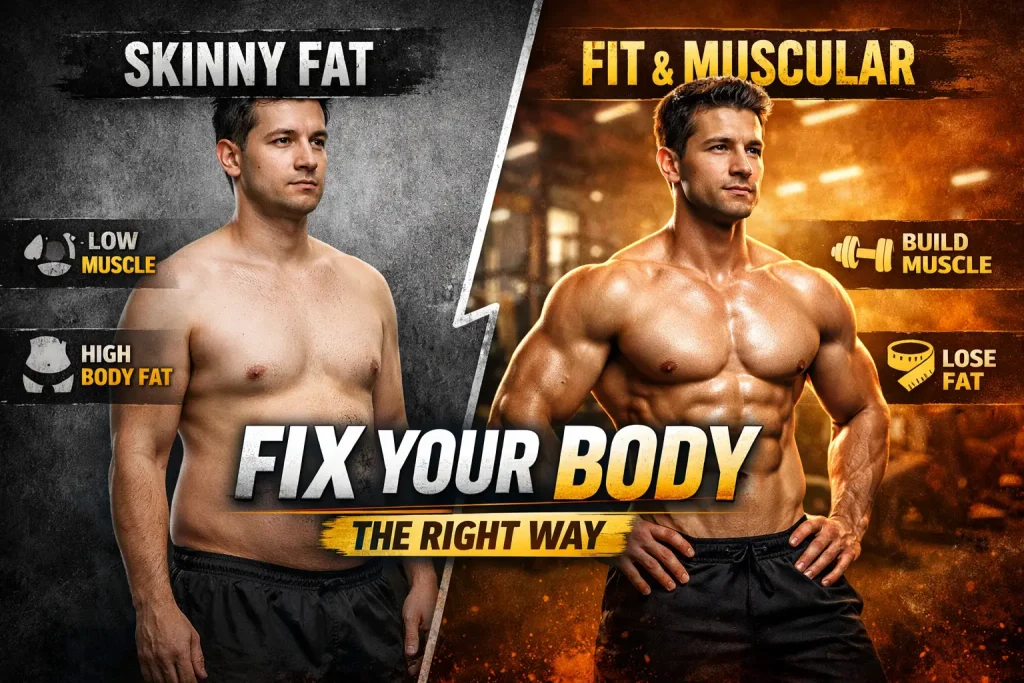
The problem with being “skinny fat” is that it doesn’t feel like a clear problem. You’re not overweight, so you don’t feel the urgency to lose weight. But you’re also not lean or muscular, so you’re not confident either. You look fine in clothes, but once the shirt comes off, the lack of definition becomes obvious. Soft arms, a bit of belly, flat chest—no real shape. That’s where most people get stuck, and worse, they often try to fix it the wrong way.
The solution isn’t about just losing weight or just eating more. It’s about fixing your body composition—building muscle while managing fat. That’s the only way out of the skinny fat trap.
At its core, being skinny fat means you have low muscle mass and relatively high body fat. You may weigh within a normal range, but your body lacks the muscle needed to create a firm, defined look.
This is why two people can weigh the same but look completely different. One has muscle, the other doesn’t. Muscle gives shape. Without it, your body looks soft no matter how light you are.
This condition usually develops slowly. It’s not the result of one bad habit—it’s the accumulation of several.
How People End Up Skinny Fat?
Most skinny fat individuals don’t realize they’ve been working against themselves.
One of the biggest causes is relying too much on cardio. Running, cycling, or spending long hours on the treadmill can burn calories, but it doesn’t build muscle. Without resistance training, your body has no reason to maintain muscle tissue. Over time, you end up losing both fat and muscle, leaving you smaller but still soft.
Another common issue is eating too little. Crash dieting is often seen as a shortcut to getting lean, but it backfires. When you drastically cut calories, your body doesn’t just burn fat—it also breaks down muscle. Your metabolism slows, your strength drops, and your body holds onto fat as a survival mechanism. The result is a weaker, softer version of yourself.
Protein intake is also a major factor. Muscle is built from protein, yet many people barely get enough of it. Without sufficient protein, your body can’t repair or grow muscle effectively, especially if you’re training.
Then there’s lifestyle. Sitting all day, minimal movement, and lack of physical stress on the body all contribute to muscle loss over time. Even if your diet isn’t terrible, inactivity alone can lead to a skinny fat physique.
Finally, some people try to “bulk” their way out of it—but do it poorly. Instead of structured eating, they just consume more calories without regard for quality. This leads to rapid fat gain without meaningful muscle development.
Why Weight Loss Isn’t the Answer?
This is where most people go wrong.
They look at their soft physique and assume the solution is to lose weight. So they eat less, do more cardio, and try to get lighter. But if you’re already low on muscle, losing more weight just makes the problem worse.
You don’t need to be lighter—you need to be better built.
The real goal is body recomposition. That means increasing muscle while keeping fat under control. It’s a slower process than simple weight loss, but it produces the results people actually want: a lean, defined body.
Building the Right Foundation: Strength Training
If there’s one thing that fixes the skinny fat problem, it’s strength training.
Lifting weights forces your body to adapt. It builds muscle, improves strength, and changes how your body looks and functions. Without it, there’s no real transformation—just weight fluctuation.
The focus should be on compound movements. These are exercises that work multiple muscle groups at once and allow you to lift heavier weights. Squats, deadlifts, presses, and rows should form the backbone of your routine.
Training three to five times per week is enough. What matters more than frequency is consistency and progression. You need to gradually increase the weight, reps, or intensity over time. That’s how muscle is built.
This doesn’t need to be complicated. A simple upper-lower split or full-body program works perfectly well. What matters is that you stick to it and push yourself to improve.
Nutrition: The Missing Piece for Most People
Training alone won’t fix anything if your nutrition is off.
Protein should be your priority. Aim for around 1.6 to 2.2 grams per kilogram of body weight. This supports muscle growth and helps preserve muscle even if you’re in a slight calorie deficit.
Calories need to be controlled, but not extreme. Most skinny fat individuals do best eating around maintenance or in a small deficit. This allows the body to build muscle while gradually reducing fat.
Going too low in calories will stall progress. Going too high will add unnecessary fat. The balance is key.
Food quality also matters. Whole, nutrient-dense foods support recovery, energy, and overall health. You don’t need a perfect diet, but you do need a consistent one.
The Role of Cardio
Cardio isn’t useless—it’s just overused.
It’s good for heart health, endurance, and burning extra calories. But it’s not the main tool for fixing a skinny fat physique.
Two to three sessions per week, around 20 to 30 minutes, is enough. Keep it moderate. The goal is to support your overall fitness, not to exhaust yourself.
Too much cardio can interfere with recovery and even limit muscle growth if it replaces strength training.
Tracking Progress the Right Way
One of the biggest mistakes people make is relying only on the scale.
Your weight might not change much during body recomposition. You could be gaining muscle and losing fat at the same time, which balances out on the scale.
Instead, track what actually matters.
Strength is a big indicator. If you’re getting stronger, your body is adapting in the right direction.
Photos are another reliable tool. Take them regularly and compare over time. The mirror often shows progress that the scale doesn’t.
Measurements can also help, especially around the waist, chest, and arms.
Lifestyle Factors That Matter More Than You Think
Training and diet get most of the attention, but lifestyle plays a major role.
Sleep is critical. Without enough sleep, your body struggles to recover and build muscle. Hormones that regulate hunger, fat storage, and muscle growth are affected. Six to eight hours per night should be the minimum.
Stress also matters. High stress levels can lead to increased fat storage, especially around the midsection. It can also reduce your ability to recover from workouts.
Managing stress doesn’t require anything complicated. Simple habits like walking, taking breaks, and maintaining a balanced routine can make a difference.
Common Mistakes That Keep You Stuck
A lot of people stay skinny fat not because they lack effort, but because they apply that effort in the wrong direction.
Switching programs too often is a common issue. Progress takes time, and constantly changing workouts prevents your body from adapting.
Avoiding weights is another. Some beginners feel intimidated or unsure, so they stick to machines or cardio. But real progress comes from resistance training with progressive overload.
Over-reliance on supplements is also a distraction. Fat burners, detox products, and trendy supplements don’t fix the underlying problem. They’re optional at best.
Finally, unrealistic expectations can lead to frustration. Body recomposition takes time. It’s not a quick fix, but it’s a permanent one if done right.
What Real Progress Looks Like
In the early weeks, changes are subtle. You might feel stronger, more energetic, and slightly tighter, but not dramatically different.
After a couple of months, the changes become more noticeable. Your muscles start to show, your waist tightens, and your overall shape improves.
After several months of consistency, the transformation is clear. You no longer look skinny fat. You look trained.
A Practical Day-to-Day Approach
A simple routine works best.
Start your day with a protein-focused meal. Keep your meals balanced with protein, carbs, and healthy fats. Don’t overcomplicate it—consistency matters more than variety.
Train for about an hour, focusing on strength. Add light cardio if needed, but don’t overdo it.
Stay active throughout the day. Small movements add up.
Get enough rest at night so your body can recover and grow.
The Real Fix
The skinny fat problem exists because of imbalance—too little muscle, too much fat, and habits that support neither strength nor structure.
The fix is straightforward but requires discipline.
Lift weights consistently. Eat enough protein. Control your calories. Get proper rest. Stay patient.
That’s it.
No shortcuts, no hacks, no extremes.
Do the basics well and stick to them long enough, and your body will change—not just temporarily, but in a way that actually lasts.