

Last Updated on April 2, 2026
Gym anxiety is one of those problems people don’t talk about enough—but it quietly stops thousands from ever starting or sticking with fitness. You know the feeling: walking into a gym and suddenly becoming hyper-aware of everything. The mirrors, the people, the noise, the fear of doing something wrong. It’s uncomfortable, and for many, it’s enough to turn around and leave.
Here’s the truth: gym anxiety is real, common, and fixable. But it won’t fix itself. You need a clear approach, and you need to act on it.
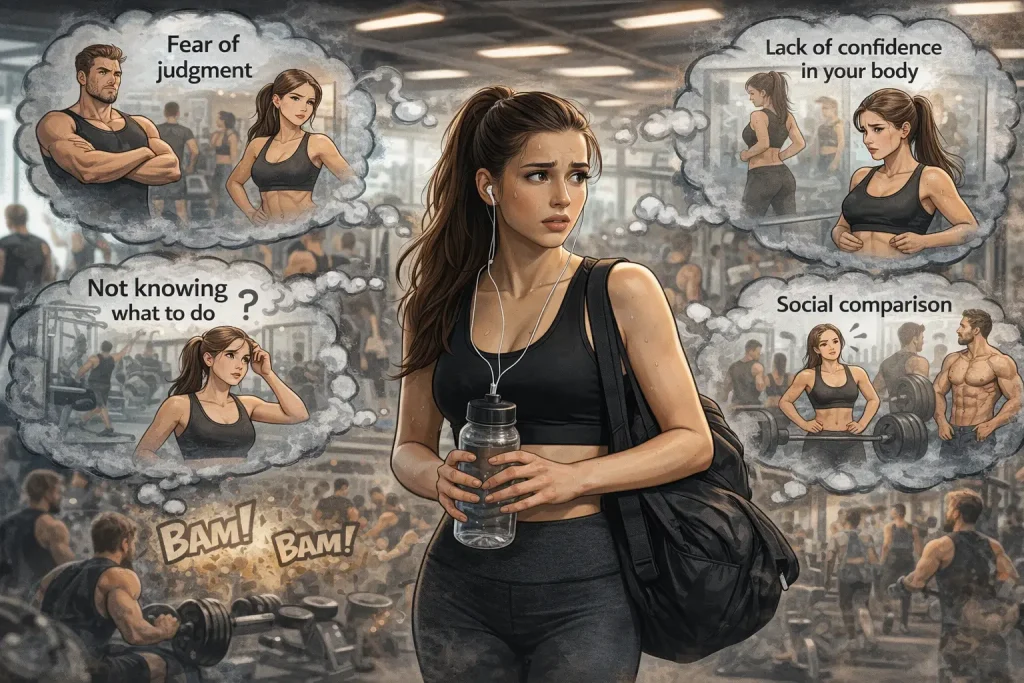
At its core, gym anxiety comes from a few predictable triggers. You’re worried about being judged, unsure of what to do, comparing yourself to others, and dealing with a space that feels intense and unfamiliar. Your brain reads all of that as a threat. That’s why your body reacts with tension, nervousness, and the urge to escape. This is also why so many people sign up for gym memberships and never actually go. The problem isn’t desire—it’s perception. Once you understand that, you can start to take control.
This article breaks down exactly why gym anxiety happens and what to do about it—fast.
The Problem: Why Gym Anxiety Hits So Hard
Gym anxiety isn’t just “being shy.” It’s a mix of psychological triggers that all hit at once:
- Fear of judgment
- Lack of confidence in your body
- Not knowing what to do
- Social comparison
- Overstimulation (noise, crowds, mirrors)
Put all that together, and your brain treats the gym like a threat.
Your body reacts accordingly:
- Increased heart rate
- Sweaty palms
- Avoidance behavior
- Negative self-talk
This is why people sign up for memberships and never go.
The problem isn’t motivation. It’s environment + perception.
The Reality Check: Nobody Cares About You at the Gym
Here’s the reality most people need to hear: nobody is paying attention to you. It sounds blunt, but it’s freeing. Everyone in the gym is focused on themselves—their sets, their progress, their own insecurities. Even experienced lifters are not watching beginners. They’re thinking about their next exercise or trying to get through their workout. You only feel like the center of attention because your brain is amplifying the situation. Once you accept that you’re not being watched the way you think you are, a big chunk of that anxiety disappears.
Everyone is focused on:
- Their own workout
- Their own body
- Their own insecurities
Even the most experienced gym-goers are usually thinking about:
- Their next set
- Their form
- Their progress
You are not the center of attention. You only feel like it.
Understanding this removes about 50% of the anxiety right away.
The Biggest Trigger: Not Knowing What You’re Doing
The biggest reason gym anxiety hits so hard is simple—you don’t know what you’re doing. When you walk into a space without a plan, everything feels chaotic. You’re trying to figure out machines, exercises, and where to go, all while feeling self-conscious. That uncertainty creates stress fast. The fix is straightforward: never go in without a plan. Before stepping into the gym, decide exactly what you’re going to do. Pick a handful of exercises, know how many sets and reps you’ll do, and have a rough idea of where everything is. When you remove guesswork, you reduce anxiety immediately.
When you don’t know:
- Which exercises to do
- How to use machines
- Where to go
Your brain goes into panic mode.
Uncertainty creates anxiety.
Solution: Go in With a Plan
Another mistake people make is trying to look impressive instead of being effective. They lift weights that are too heavy, rush through exercises, or copy advanced routines they don’t understand. This only increases anxiety and leads to poor form or even injury. The smarter move is to start small. Use lighter weights, focus on doing movements correctly, and take your time. You’re not there to perform for anyone—you’re there to improve. Confidence builds from doing things right, not from trying to impress strangers.
Before you go:
- Choose 4–6 exercises
- Know your sets and reps
- Know where those machines are (look online if needed)
Example beginner plan:
- Treadmill – 10 minutes
- Leg press – 3 sets
- Chest press machine – 3 sets
- Lat pulldown – 3 sets
- Dumbbell curls – 3 sets
Simple. Clear. No guesswork.
Confidence comes from structure.
Start Small—Not Impressive
A common mistake is trying to “look like you belong.”
So people:
- Lift heavier than they should
- Try advanced exercises
- Rush through workouts
This backfires fast.
You don’t build confidence by impressing others. You build it by executing correctly.
What to do instead:
- Use lighter weights
- Focus on form
- Take your time
You’re not there to perform. You’re there to improve.
Timing Matters More Than You Think
Timing also plays a big role. Walking into a crowded gym during peak hours when you’re already anxious is setting yourself up to struggle. The environment feels more intense, and the pressure increases. A better approach is to go during quieter hours when the gym is less crowded. Early mornings, late evenings, or off-peak times give you more space to move, think, and learn without feeling overwhelmed. Controlling your environment makes a big difference in how you experience the gym.
Peak hours:
- After work (5 PM–8 PM)
- Weekends
These are high-pressure environments.
Solution:
Go during low-traffic hours:
- Early morning
- Late evening
- Midday if possible
A quieter gym:
- Reduces overstimulation
- Gives you space to learn
- Lowers perceived judgment
Control your environment first. Then build your confidence.
The Mirror Problem
Mirrors are another hidden trigger. They’re everywhere, and they can make you overly aware of how you look. Instead of helping, they can push you into constant self-judgment. The key is to change how you use them. Use mirrors to check your form, not your appearance. Shift your focus from how you look to how you move. That small mindset shift reduces pressure and keeps you grounded in the workout itself.
You start thinking:
- “I look awkward.”
- “Everyone can see me.”
- “My body doesn’t belong here.”
This leads to self-conscious movement.
Fix:
Stop checking yourself constantly.
Use mirrors for:
- Form correction
Not: - Self-judgment
Shift your focus from appearance to function.
Headphones Are Not Optional
One simple tool that helps more than people realize is wearing headphones. It creates a buffer between you and the environment. The noise fades, distractions drop, and you feel more in your own space. Music also helps regulate your mood and improve focus. It turns the gym from a public setting into something more personal and manageable.
They:
- Block out noise
- Create a personal space
- Reduce social interaction
Music also:
- Regulates mood
- Improves focus
- Lowers stress
Think of headphones as a psychological shield.
Exposure Is the Only Real Cure
That said, the only real way to get over gym anxiety is exposure. You can’t think your way out of it—you have to go through it. Start small. Show up, even if it’s just for a short session. Do a quick workout, leave, and come back again. Gradually increase your time and your comfort level. Each visit chips away at the anxiety. Avoiding the gym only makes the fear stronger, while consistent exposure weakens it.
You have to face it.
But do it gradually.
Step-by-step exposure:
- Visit the gym just to look around
- Do a 10-minute workout
- Increase to 20–30 minutes
- Add more exercises over time
Consistency beats intensity here.
Avoidance makes anxiety stronger. Exposure weakens it.
Stop Comparing Yourself—It’s Killing Your Progress
Comparison is another major issue that feeds gym anxiety. You look around and see people who are stronger, leaner, or more experienced, and it makes you feel like you don’t belong. That thinking is flawed. Every single person in that gym started somewhere. The difference is they kept going. You’re just earlier in the process. Staying focused on your own progress instead of measuring yourself against others is critical if you want to move forward.
You see:
- Someone stronger
- Someone leaner
- Someone more experienced
Then your brain says:
“I don’t belong here.”
Wrong.
Everyone you see started somewhere.
Reality:
- That fit person was once a beginner
- That confident lifter was once unsure
- That strong guy once lifted light weights
You’re just earlier in the timeline.
Stay in your lane.
Social Anxiety vs Gym Anxiety
There’s also a difference between gym anxiety and general social anxiety. If being around people is the main issue, you may need to adjust your approach. That could mean choosing a smaller gym, working out during off-hours, or even starting with home workouts. But the goal should still be gradual exposure. Avoiding people completely won’t solve the problem—it just delays it.
That’s a deeper issue.
Workarounds:
- Choose less crowded gyms
- Use smaller fitness studios
- Try home workouts first
- Go with a trusted friend
But don’t isolate forever.
You still need exposure to improve.
The “Everyone Is Judging Me” Illusion
A lot of this anxiety is driven by what’s called the spotlight effect. You feel like everyone is watching you more than they actually are. In reality, people might glance at you for a second and then move on. Nobody is tracking your workout or analyzing what you’re doing. Even if someone notices you, it’s brief and meaningless. You’re not as visible as you think, and that’s a good thing.
In reality:
- People glance, then move on
- Nobody tracks your workout
- Nobody cares about your mistakes
Even if someone notices you—it lasts seconds.
You’re not that important in their world.
That’s not an insult. It’s freedom.
Gym Staff and Trainers Are There to Help
It’s also worth remembering that gym staff and trainers are there to help. If you’re unsure how to use a machine or perform an exercise, ask. That’s part of what you’re paying for. Most staff would rather show you how to do something properly than watch you struggle. Ignoring that resource just keeps you stuck longer.
Staff exist for a reason.
If you’re unsure:
- Ask how to use a machine
- Ask for a quick demo
- Ask basic questions
You’re paying for access. Use it.
Most staff:
- Respect beginners
- Prefer helping over watching mistakes
Ignoring help keeps you stuck.
The First 5 Visits Are the Hardest
The first few visits are always the hardest. This is where most people give up. Everything feels unfamiliar, and the anxiety is at its peak. But after a few sessions, things start to change. You recognize the layout, you get used to the equipment, and the environment feels less intimidating. What was once uncomfortable becomes routine. That’s why it’s important to commit to at least a handful of visits before judging your experience.
The anxiety is strongest at the start.
After a few visits:
- You recognize the layout
- You see familiar faces
- You build routine
The unknown becomes familiar.
Rule:
Commit to 5 sessions minimum.
Don’t evaluate your feelings until after that.
Build a “Safe Routine”
Building a consistent routine also helps reduce anxiety. Going at the same time, doing the same exercises, and using the same areas of the gym creates familiarity. Your brain starts to relax because it knows what to expect. Over time, you can expand your routine, but in the beginning, repetition is your advantage.
Pick:
- The same time
- The same exercises
- The same area
This creates predictability.
Your brain relaxes when things feel familiar.
Over time, expand slowly.
Avoid Overcomplicating Fitness
Another mistake is overcomplicating everything. People think they need the perfect program, the best supplements, or advanced techniques to get started. That kind of thinking leads to hesitation and inaction. The reality is much simpler. Basic exercises, done consistently, are enough to make progress. Keeping things simple removes pressure and makes it easier to show up.
People think they need:
- Perfect programs
- Advanced techniques
- Supplements
You don’t.
Keep it simple:
- Basic movements
- Consistent schedule
- Gradual progress
Complexity creates hesitation.
Simplicity creates action.
Clothing Matters More Than You Think
Even small details like what you wear can affect how you feel. If your clothes are uncomfortable or make you self-conscious, your anxiety increases. Wear something that fits well, feels good, and allows you to move freely. You’re not dressing for anyone else—you’re setting yourself up to feel at ease.
Choose:
- Comfortable fit
- Breathable material
- Clothes you feel confident in
You’re not dressing for others. You’re dressing for ease of movement.
Remove unnecessary stressors.
Bring a Friend (But Don’t Depend on It)
Training with a friend can also help, especially in the beginning. It makes the environment feel less intimidating and adds a layer of support. But it’s important not to depend on it completely. You should still be able to train on your own. Use it as a stepping stone, not a crutch.
Having a friend:
- Reduces anxiety
- Makes the gym feel safer
- Adds accountability
But don’t rely on it forever.
You need to be able to train alone eventually.
Use support—but build independence.
Track Progress—Not Feelings
Tracking your progress is another powerful tool. If you rely on how you feel, you’ll quit. Feelings change day to day. Progress, on the other hand, is measurable. When you see that you’re getting stronger or lasting longer in workouts, your confidence builds naturally. That’s what keeps you going.
Feelings fluctuate.
Progress doesn’t lie.
Track:
- Weights lifted
- Reps completed
- Workouts done
Seeing improvement builds confidence faster than motivation ever will.
The Hard Truth: Confidence Comes After Action
The hard truth is that confidence doesn’t come before action—it comes after. Waiting until you feel ready is a mistake. You become confident by showing up, doing the work, and repeating the process. There’s no shortcut around that.
Confidence comes from:
- Showing up
- Completing workouts
- Repeating the process
You earn confidence. You don’t wait for it.
What Happens If You Don’t Address Gym Anxiety
If you avoid the gym because of anxiety, there are real consequences. Your health suffers, your confidence takes a hit, and you miss out on the benefits of training. Avoidance might feel comfortable in the moment, but it holds you back in the long run. There’s no neutral outcome here.
If you avoid the gym because of anxiety:
- Your health suffers
- Your confidence drops
- Your options shrink
Avoidance feels good short-term. It costs you long-term.
There’s no neutral outcome.
Fast Action Plan to Beat Gym Anxiety
If you want a simple system, follow this:
Day 1–2
- Visit gym
- Stay 10–15 minutes
- Do basic cardio
Day 3–5
- Add 2–3 machines
- Keep it light
Week 2
- Follow a simple routine
- Increase duration
Week 3+
- Expand exercises
- Increase intensity
No overthinking. Just progression.
Final Reality Check
A simple way to approach this is to follow a basic progression. Start with short visits and simple workouts, then gradually increase your time and intensity. Don’t overthink it. Just focus on showing up and doing something. That consistency is what breaks the cycle.
But staying stuck because of it—that’s the real problem.
You don’t need:
- Perfect confidence
- Perfect knowledge
- Perfect body
You need:
- A plan
- Repetition
- Willingness to be uncomfortable
That’s it.
Bottom Line
In the end, gym anxiety is normal, but it’s not permanent. It comes from uncertainty, overthinking, and fear of judgment, and it fades with structure, repetition, and exposure. You don’t need to feel fully confident to start. You just need to take action. Walk in, follow your plan, and keep going. That’s how you get past it.
It comes from:
- Uncertainty
- Overthinking
- Fear of judgment
And it goes away with:
- Structure
- Exposure
- Consistency
You don’t eliminate anxiety by avoiding the gym.
You eliminate it by walking in anyway—and doing the work.
Start small. Stay consistent. Stop waiting.
That’s how you fix it.