
Last Updated on April 23, 2026
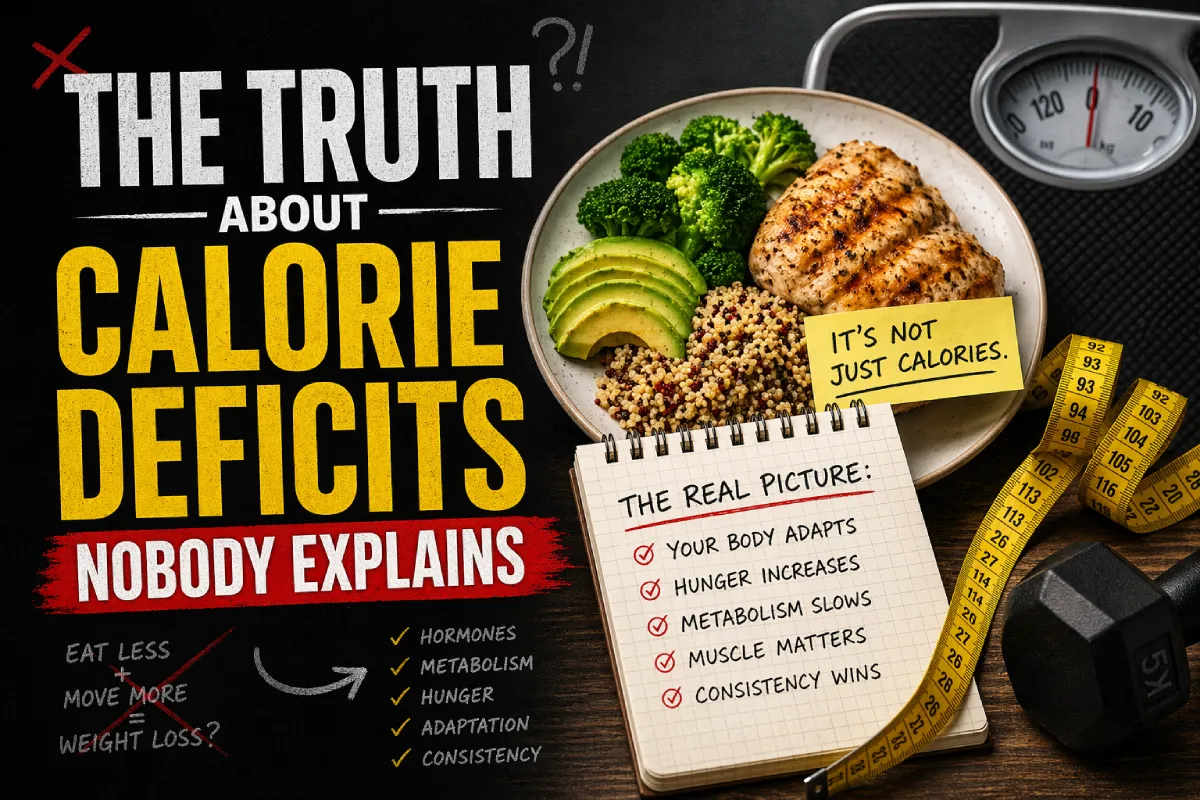
Most people think a calorie deficit is simple: eat less, move more, lose weight. That sounds clean on paper, but in reality, it breaks down fast. People stall, regain weight, feel exhausted, or never see results at all. The problem isn’t the concept—it’s what gets ignored.
Here’s the truth: a calorie deficit works, but not the way most people think. Once you understand what’s really happening in your body, you stop guessing and start making progress.
What a Calorie Deficit Actually Means
A calorie deficit happens when you burn more energy than you consume. Your body needs energy (calories) to function—breathing, moving, thinking, digesting. When you don’t give it enough from food, it pulls from stored energy, mostly body fat.
That’s the foundation of fat loss. No deficit, no fat loss. Simple.
But here’s where people get it wrong: they assume it’s just math. It’s not.
Your body is not a calculator. It adapts.
Why “Eat Less, Move More” Fails Most People
On paper, dropping calories should lead to steady weight loss. In reality, your body fights back.
When you reduce calories, several things happen:
- Your metabolism slows down
- Your hunger hormones increase
- Your energy levels drop
- Your movement decreases without you noticing
This is called metabolic adaptation. Your body is trying to survive, not help you get lean.
So while you think you’re in a 500-calorie deficit, your body quietly adjusts and reduces how much you burn. That deficit shrinks over time.
This is why progress slows or stops—even if you’re “doing everything right.”
The Biggest Lie: All Calories Are Equal
Technically, a calorie is a unit of energy. But your body doesn’t treat all calories the same.
100 calories from protein behaves very differently from 100 calories from sugar.
Here’s how:
- Protein has a higher thermic effect (your body burns more calories digesting it)
- Carbs affect insulin and energy levels
- Fats are calorie-dense and easy to overeat
More importantly, food quality affects hunger. Highly processed foods make you hungrier, which leads to overeating—even in a planned deficit.
So yes, calories matter. But what those calories are made of matters just as much.
Why You Feel Hungrier in a Deficit
This is one of the biggest frustrations.
You start eating less, and suddenly you’re thinking about food all the time.
That’s not weakness. That’s biology.
When you’re in a calorie deficit:
- Ghrelin (hunger hormone) goes up
- Leptin (satiety hormone) goes down
- Your brain becomes more focused on food
This is your body trying to protect you from starvation.
That’s why extreme diets fail. They push hunger too high, and eventually, you break.
The Hidden Factor: NEAT (Non-Exercise Activity)
You might think your workouts are the main driver of calorie burn. They’re not.
A huge part of your daily calorie burn comes from something called NEAT—non-exercise activity thermogenesis.
This includes:
- Walking
- Standing
- Fidgeting
- Daily movement
When you eat less, your NEAT drops. You move less without realizing it.
You sit more. You take fewer steps. You conserve energy.
That alone can erase your deficit.
This is why two people eating the same calories can get completely different results.
Why Weight Loss Isn’t Linear
People expect steady results: lose 0.5–1 kg every week.
That rarely happens.
Your weight fluctuates daily because of:
- Water retention
- Sodium intake
- Glycogen levels
- Hormones
- Digestion
You can be losing fat and still see the scale go up.
That’s why relying only on the scale is a mistake. It doesn’t show fat loss clearly in the short term.
The Muscle Loss Problem Nobody Talks About
If you’re in a calorie deficit without proper training and nutrition, you won’t just lose fat—you’ll lose muscle too.
That’s a problem.
Muscle helps:
- Maintain metabolism
- Improve body shape
- Keep strength and performance
Lose too much muscle, and your metabolism slows even more. Fat loss becomes harder, and your body looks worse, not better.
To avoid this:
- Eat enough protein
- Do resistance training
- Avoid extreme deficits
How Big Should Your Calorie Deficit Be?
This is where most people mess up.
They go too aggressive.
A large deficit (like 800–1000 calories per day) might give fast results at first, but it leads to:
- Muscle loss
- Hormonal issues
- Burnout
- Binge eating
A moderate deficit works better.
Ideal range:
- 300–500 calorie deficit per day
It’s slower, but sustainable. And that’s what actually gets results long-term.

Why “Eating Too Little” Can Stall Fat Loss
It sounds backward, but it happens.
If you eat too little for too long:
- Your metabolism adapts heavily
- Your hormones shift
- Your performance drops
- Your recovery suffers
Eventually, your body becomes extremely efficient at conserving energy.
You feel stuck.
This is why some people need to increase calories (reverse dieting) before they can lose fat again.
The Role of Protein in a Calorie Deficit
Protein is not optional. It’s critical.
When you’re in a deficit, protein helps:
- Preserve muscle mass
- Reduce hunger
- Increase calorie burn through digestion
A good target:
- 1.6 to 2.2 grams of protein per kg of body weight
This alone can make a huge difference in how your body responds to a deficit.
Why Cardio Alone Doesn’t Work
A lot of people try to “out-cardio” a bad diet.
It doesn’t work long-term.
Cardio burns calories, but:
- It’s easy to eat those calories back
- Your body adapts and becomes more efficient
- Too much cardio increases fatigue
Cardio should support your deficit, not create it entirely.
Focus on diet first. Use cardio as a tool, not a crutch.
The Psychological Side of a Calorie Deficit
This is where most people fail.
Being in a deficit is mentally hard:
- You feel restricted
- You think about food more
- Social situations become difficult
If your approach is too strict, you won’t stick to it.
That’s why flexibility matters.
You don’t need a perfect diet. You need a consistent one.
Why Cheat Days Can Backfire
Cheat days sound good, but they often undo progress.
If your weekly deficit is 3500 calories, one uncontrolled cheat day can wipe it out.
Instead of cheat days, a better approach is:
- Planned higher-calorie days (refeeds)
- Controlled portions
- Staying within a weekly calorie target
This keeps progress steady without extremes.
The Truth About “Fat-Burning Foods”
There are no foods that magically burn fat.
Some foods can help with fat loss because they:
- Keep you full longer
- Are lower in calories
- Require more energy to digest
But they don’t override a calorie surplus.
Fat loss always comes back to a deficit.
How Long Should You Stay in a Deficit?
Not forever.
Staying in a deficit too long leads to:
- Hormonal imbalance
- Low energy
- Plateau
A better approach is to cycle:
- Fat loss phase (8–16 weeks)
- Maintenance phase (2–4 weeks)
This helps your body reset and makes long-term progress easier.
The Real Key: Consistency Over Perfection
You don’t need the perfect diet.
You need something you can follow consistently.
That means:
- Eating foods you actually enjoy
- Managing hunger
- Keeping your deficit realistic
The people who succeed aren’t the most disciplined. They’re the most consistent.
Final Takeaway
A calorie deficit works. That part is not up for debate.
But the real challenge is managing everything that comes with it—hunger, metabolism, energy, habits, and psychology.
If you treat it like simple math, you’ll struggle.
If you treat it like a system your body adapts to, you’ll get results.
Keep your deficit moderate. Prioritize protein. Train properly. Stay consistent.
That’s how you actually lose fat—and keep it off.