Last Updated on November 8, 2026
You already know protein matters for building muscle. The confusing part is how much you should eat protein per meal. Is 20 g enough? Is 40 g too much? And is anything above 30 g just wasted?
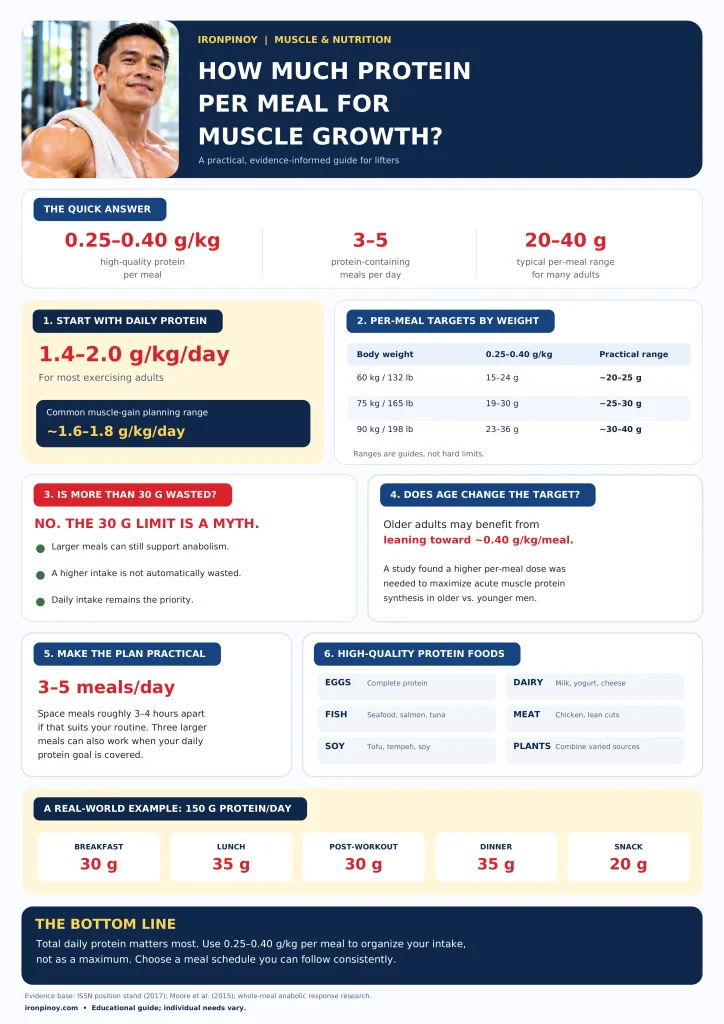
For most lifters, a practical target is about 0.25 to 0.40 g of high-quality protein per kilogram of body weight per meal, usually spread across 3 to 5 meals per day. For many adults, that works out to roughly 20 to 40 g per meal. That recommendation lines up with the International Society of Sports Nutrition position stand on protein and exercise and its broader sports nutrition guidance.
The key point, though, is simple: daily protein intake matters most. Meal size and timing help, but they are secondary to getting enough total protein across the day.
Start with your daily protein target
If you lift weights and want to build or keep muscle, the evidence in the ISSN position stand supports 1.4 to 2.0 g of protein per kg of body weight per day for most exercising people. Many sports nutrition recommendations aiming to optimize muscle gain land around 1.6 to 1.8 g/kg/day.
That means meal planning is really a practical way to hit your daily number consistently. If your intake is too low overall, perfect timing will not rescue your progress.
If you want a broader primer on setting total intake, IronPinoy also has a related guide on how much protein you really need.
How much protein per meal for muscle growth?
A useful evidence-based range is 0.25 to 0.40 g/kg per meal. The lower end is a solid starting point for younger adults eating high-quality protein. The upper end is a practical target when you are bigger, older, or simply prefer fewer meals.
Here is what that looks like in real numbers:
| Body weight | Per-meal target | Practical range |
|---|---|---|
| 60 kg (132 lb) | 15–24 g | About 20–25 g |
| 75 kg (165 lb) | 19–30 g | About 25–30 g |
| 90 kg (198 lb) | 23–36 g | About 30–40 g |
These are not individualized prescriptions. They are practical ranges based on the evidence-backed per-meal guideline rather than a one-size-fits-all rule.
Protein Intake Calculator
Protein Calculator with Meal Planner
Is more than 30 g of protein wasted?
No. That idea is too simplistic.
Part of the confusion comes from acute muscle protein synthesis research. A classic post-workout study in young men found that 20 g of egg protein strongly stimulated muscle protein synthesis, while 40 g increased amino acid oxidation more. That is one reason 20 g became such a popular benchmark. But it does not prove that 20 to 30 g is a universal hard cap for everyone, every meal, and every goal.
A later complete-meal study found that the anabolic response to a meal was not limited simply by the dose that maximally stimulates acute muscle protein synthesis. In other words, larger meals can still have value for whole-body anabolism and are not automatically wasted. You can read that study here: The anabolic response to a meal containing different amounts of protein is not limited by maximal stimulation of protein synthesis.
The practical takeaway is better than the myth: aim for a strong per-meal dose, but do not panic if one meal is bigger than usual.
Does age change the target?
Probably, yes.
A controlled study in healthy men found that muscle protein synthesis appeared to plateau at about 0.24 g/kg in younger men and around 0.40 g/kg in older men. That suggests older adults may need a larger per-meal dose to get a similar anabolic response. The study is available on PubMed here.
So if you are training in your 40s, 50s, or beyond, leaning toward the upper end of the per-meal range is a sensible move, especially if muscle retention is a priority.
How many meals should you split protein into?
A practical structure is 3 to 5 protein-containing meals per day, often spaced roughly every 3 to 4 hours. That fits the ISSN guidance well and works for most lifestyles.
But do not turn that into a rigid rule. More recent long-term evidence suggests meal frequency is less magical than many lifters think. In a 2025 randomized trial in resistance-trained men, eating optimal-protein meals 3 times per day versus 5 times per day led to similar gains in lean mass and strength when total protein was similar. Another 2025 trial found that changing protein timing around training did not meaningfully change body composition or performance outcomes in resistance-trained men following a high-protein diet.
That supports a simple message: hit your daily protein, distribute it sensibly, and choose a meal pattern you can actually stick to.
What counts as a high-quality protein meal?
The per-meal guidance is based on high-quality protein, meaning protein sources rich in essential amino acids. In practice, that usually means foods like:
- Eggs
- Dairy foods such as milk, yogurt, and cheese
- Fish and seafood
- Chicken and other lean meats
- Soy foods
- Mixed plant-based meals that combine protein sources well
You do not need to obsess over amino acid jargon at every meal. For most readers, the useful habit is making sure each meal contains a clear protein source instead of leaving protein for dinner only.
A simple way to apply this
If your target is 150 g of protein per day, you do not need six tiny meals or a stopwatch after every workout. You could spread that intake like this:
- Breakfast: 30 g
- Lunch: 35 g
- Post-training or afternoon meal: 30 g
- Dinner: 35 g
- Optional snack: 20 g
That is enough structure to support muscle gain without making eating feel like a full-time job.
If you prefer three larger meals, that can also work well, especially if each meal reaches a meaningful protein dose. If you prefer more frequent meals because of appetite or schedule, that is fine too.
Bottom line
If your goal is muscle growth, a smart target is 0.25 to 0.40 g of protein per kg of body weight per meal, usually across 3 to 5 meals per day. For many adults, that means roughly 20 to 40 g per meal.
Just remember the bigger picture: total daily protein is still the priority. Per-meal targets help you organize your intake, not replace the basics. So skip the myth that anything above 30 g is wasted, stop chasing a perfect anabolic window, and focus on a meal pattern you can repeat consistently.
Sources
- International Society of Sports Nutrition Position Stand: protein and exercise
- The anabolic response to a meal containing different amounts of protein is not limited by the maximal stimulation of protein synthesis in healthy young adults
- International Society of Sports Nutrition Position Stand: protein and exercise
- Protein ingestion to stimulate myofibrillar protein synthesis requires greater relative protein intakes in healthy older versus younger men
- Ingested protein dose response of muscle and albumin protein synthesis after resistance exercise in young men
- Effects of daily protein intake frequency during 8 weeks of resistance training on lean mass and strength adaptations: a randomized non-controlled clinical trial.
- Timing matters? The effects of two different timing of high protein diets on body composition, muscular performance, and biochemical markers in resistance-trained males
- ISSN exercise & sports nutrition review update: research & recommendations