

Last Updated on November 7, 2026
Some lifters swear you need marathon workouts and 20-plus sets for every body part. Others say a few hard sets are enough. If your goal is muscle growth, the practical answer sits in the middle.
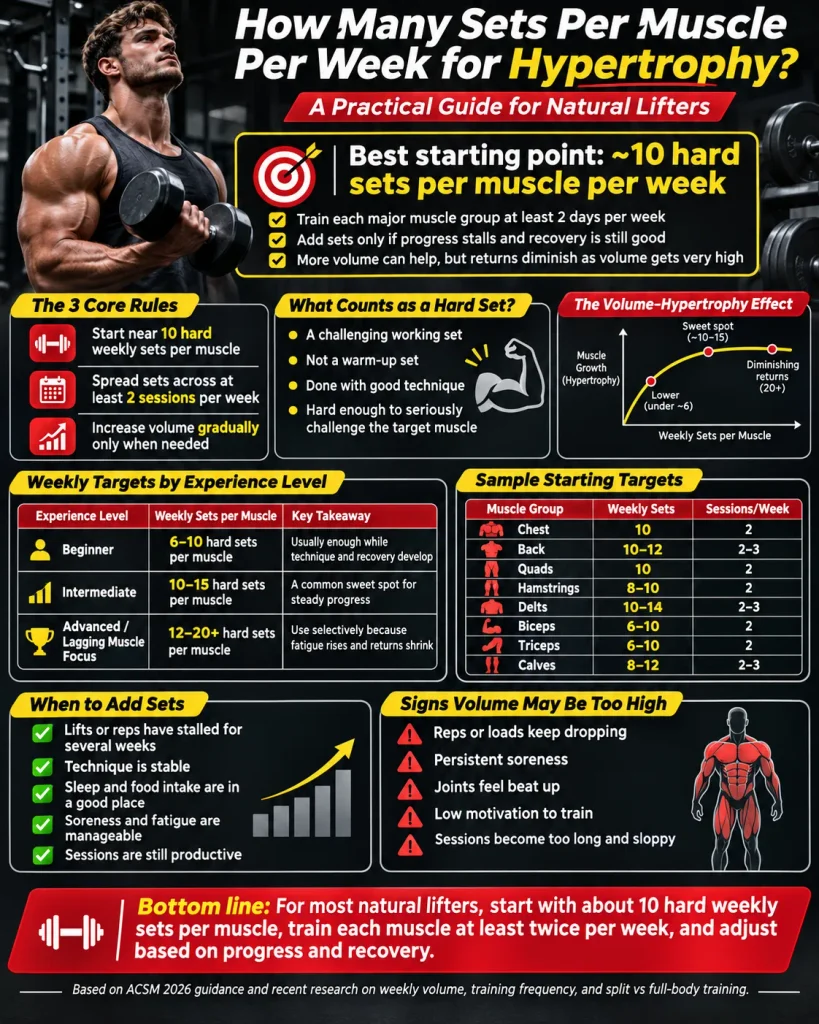
For most natural lifters, a good starting point is around 10 hard sets per muscle group per week, then adjusting based on progress, recovery and training age. That lines up with the latest ACSM resistance training summary, which recommends higher weekly volume for hypertrophy at about 10 sets per muscle group, while also training major muscle groups at least two days per week.
The short answer
If you are trying to build muscle, weekly training volume matters more than chasing the perfect split.
Current evidence supports a simple approach:
- Start near 10 hard weekly sets per muscle.
- Spread those sets across at least 2 sessions per week.
- Add sets only if progress stalls and recovery is still good.
A newer dose-response review also found that more weekly sets generally lead to more hypertrophy and strength, but with diminishing returns as volume climbs higher. In other words, more can help, but more is not automatically better forever. The same review found that training frequency itself may have a negligible effect on hypertrophy when weekly work is already matched. You can see that in the 2026 meta-regression on weekly volume and frequency.
What counts as a hard set?
A hard set is not a warm-up and not an easy throwaway set. It is a working set done with enough effort to seriously challenge the target muscle.
That matters because “10 sets” only means something if those sets are productive. Five lazy sets with plenty left in the tank do not equal five focused sets performed with good technique and meaningful effort.
You also need to count exercises honestly. A bench press set mainly trains chest, but it also involves the triceps and front delts. A row mainly trains the back, but the biceps help. Those indirect contributions count to some extent, but they are not always the same as direct isolation work. That exact direct-versus-indirect issue is one reason volume research is useful, but not perfectly precise in the real world.
Why weekly volume matters more than the perfect split
Many lifters spend too much time arguing about full-body, upper/lower or push-pull-legs. The better question is whether your weekly plan gives each muscle enough quality work.
That is why split choice is mostly a tool for organizing volume, not a magic muscle-building advantage by itself. A 2024 meta-analysis comparing split and full-body resistance training found similar hypertrophy and strength gains when training volume was equated.
So if you can recover well and perform better on an upper/lower split, use it. If full-body fits your schedule better, that can work too. The winning plan is usually the one that lets you hit enough hard weekly sets consistently.
A practical weekly set target by experience level
There is no universal magic number, but this is a useful starting framework for natural lifters:
| Training level | Practical weekly target | How to use it |
|---|---|---|
| Beginner | 6-10 hard sets per muscle | Usually enough to grow while technique and recovery are still developing |
| Intermediate | 10-15 hard sets per muscle | A common sweet spot for steady progress |
| Advanced or lagging-muscle focus | 12-20+ hard sets per muscle | Use selectively, because fatigue rises and returns usually shrink |
This is a practical template, not a strict law. The evidence supports moderate weekly volume well, but exact “optimal” volume still depends on factors like exercise selection, effort, recovery and how indirect sets are counted.
It is also worth remembering that, according to ACSM, one of the biggest jumps in results happens when someone goes from doing no resistance training to doing some resistance training consistently. Beginners do not need extreme volume to start growing.
How to spread your sets across the week
For hypertrophy, a simple rule is to divide your weekly sets across at least two sessions.
Examples:
- Chest: 10 weekly sets = 5 sets on Monday and 5 on Thursday
- Quads: 12 weekly sets = 6 sets on Tuesday and 6 on Friday
- Back: 12 weekly sets = 4 sets across three sessions
This fits both the ACSM guidance and the broader public-health recommendation from the World Health Organization, which says adults should perform muscle-strengthening activities involving all major muscle groups on two or more days per week.
If your schedule is busy, that is good news. You do not need a six-day bro split to build muscle. Two to four lifting days per week can cover the basics very well if weekly volume is in place.
Sample weekly set targets by muscle group
Here is a practical starting template you can adjust over time:
| Muscle group | Weekly sets | Sessions per week |
|---|---|---|
| Chest | 10 | 2 |
| Back | 10-12 | 2-3 |
| Quads | 10 | 2 |
| Hamstrings | 8-10 | 2 |
| Delts | 10-14 | 2-3 |
| Biceps | 6-10 | 2 |
| Triceps | 6-10 | 2 |
| Calves | 8-12 | 2-3 |

Think of these as starting points rather than fixed quotas. If your pressing volume is already high, you may not need as much direct triceps work. If your back is lagging, you may need to push higher within the range.
When to add sets
Do not add volume just because social media says more is better. Add sets when:
- your lifts or reps have stalled for several weeks
- your technique is stable
- sleep and food intake are in a good place
- soreness and fatigue are manageable
- your sessions are still productive, not sloppy
A small increase works best. Try adding 2 weekly sets for one muscle group and reassess after a few weeks.
Signs you may be doing too much
Volume becomes a problem when recovery cannot keep up. Watch for signs like:
- reps or loads dropping week to week
- persistent soreness that never settles
- joints feeling beat up
- low motivation to train
- sessions becoming too long to maintain quality
This does not mean high volume never works. It means high volume has a cost, and natural lifters usually do better when they earn extra sets instead of starting with them.
The bottom line
If you want a practical answer to the question of sets per muscle per week, start with about 10 hard sets weekly per muscle, train each major muscle group at least twice per week, and adjust based on results.
That approach matches current guidance, respects the evidence that more volume can help with diminishing returns, and keeps your training realistic enough to recover from. For most lifters, consistency beats complexity.
Sources
- The Resistance Training Dose Response: Meta-Regressions Exploring the Effects of Weekly Volume and Frequency on Muscle Hypertrophy and Strength Gains – PubMed
- Efficacy of Split Versus Full-Body Resistance Training on Strength and Muscle Growth: A Systematic Review With Meta-Analysis – PubMed
- WHO GUIDELINES ON PHYSICAL ACTIVITY AND SEDENTARY BEHAVIOUR
- ACSM Publishes Updated Resistance Training Guidelines
- A Systematic Review of The Effects of Different Resistance Training Volumes on Muscle Hypertrophy.