
Last Updated on November 6, 2026
If you have ever heard that 30 to 60 seconds is the “best” rest between sets for muscle growth, the current evidence says that advice is too simplistic.
The practical answer is this: for strength, longer rest periods usually work better. For muscle growth, very short rests are not automatically superior, and resting long enough to keep your reps, load, and technique strong is often the smarter choice. A recent American College of Sports Medicine Position Stand and a targeted 2024 systematic review and Bayesian meta-analysis both point in that direction.
The short answer
Use these ranges as practical starting points:
- Strength work: usually 2 to 5 minutes
- Hypertrophy on compound lifts: usually 90 seconds to 2 minutes, sometimes longer
- Hypertrophy on isolation lifts: often 60 to 90 seconds
- Circuit or conditioning-style lifting: shorter rests can be fine, but they are not automatically better for building muscle
These are not hard rules. They are useful ranges based on what the evidence currently supports and on what lets you perform the next set well.
Why rest between sets matters
Rest periods change what you can do on the next set.
If you cut rest too short, you may lose reps, use less load, or let your technique slip. That matters because total training work across the session is one of the main drivers of progress, especially for hypertrophy-oriented training.
The current evidence suggests that short rest periods of 60 seconds or less can reduce repetition performance across sets, which may lower total volume load. The hypertrophy review available in full text explains that this is one likely reason longer rests can sometimes produce slightly better growth outcomes in practice. You are not just “recovering” for comfort. You are protecting performance.
What the latest evidence actually says
The biggest high-level update is the 2026 ACSM Position Stand, which reviewed 137 systematic reviews involving more than 30,000 participants. It concluded that strength is enhanced by heavier loads, 2 to 3 sets, prioritizing key lifts early in the session, and training at least twice per week. For hypertrophy, weekly training volume appeared more consistently important than many smaller programming variables, including rest interval details in isolation.
Just as important, the ACSM paper did not find strong, consistent evidence that inter-set rest length clearly changes hypertrophy outcomes. In fact, it noted that the available data were insufficient for a strong hypertrophy-specific conclusion about rest intervals. That matters because older advice often treated short rests as automatically “more anabolic.” Current review-level evidence does not support that blanket claim.
The 2024 review adds useful nuance. It suggested there may be a small hypertrophy benefit to resting more than 60 seconds, likely because longer rests help preserve volume load. But once rest exceeds about 90 seconds, the same review did not find an appreciable additional hypertrophy advantage for most situations, and it described parts of the evidence as uncertain.
So the current picture is not “short is best” or “long is best.” It is closer to this: rest long enough to keep the quality of work high.
Best rest times by training goal
For strength
If you are lifting heavy and trying to maintain force output across hard sets, longer rests are the safer bet. Think barbell squat, deadlift, bench press, overhead press, and other demanding compound lifts performed with lower reps and heavier loads.
A good working range is 2 to 5 minutes. On very hard sets of 3 to 5 reps, many lifters will perform better closer to the upper end of that range.
Example: if you are squatting 5 reps per set, resting 3 to 5 minutes is usually more productive than rushing back in at 60 seconds and watching your reps collapse.
For muscle growth on compound lifts
For hypertrophy, the evidence does not show that forcing ultra-short rests improves muscle gain. On bigger exercises, a rest period of 90 seconds to 2 minutes is a strong default, and sometimes 2 to 3 minutes makes sense if the set was hard or the exercise is especially taxing.
Example: on bench press for 6 to 10 reps, 2 to 3 minutes often makes it easier to keep load and rep quality more consistent across working sets.
For smaller isolation movements
Smaller movements usually create less whole-body fatigue, so shorter rests are often enough. For lateral raises, curls, triceps pushdowns, leg extensions, and similar exercises, 60 to 90 seconds will often work well.
That said, if your reps fall off sharply or the target muscle stops being the limiting factor, add more rest.
For supersets and time-crunched sessions
If you are short on time, supersets can be useful. Just understand the trade-off: shorter effective rest can reduce performance, especially if the exercises compete for the same muscles or tax your breathing.
If your goal is general fitness or getting a solid session done fast, that may be acceptable. If your goal is maximizing performance on heavy compound lifts, supersets and very short rests are usually not ideal.
A useful study that explains the real issue
A 2022 trial compared 60-second and 180-second rest periods during high-intensity leg training over 10 weeks. The longer-rest condition produced greater quadriceps growth when the short-rest condition also led to lower training volume. But when volume load was equalized, hypertrophy was similar. You can read the study summary here.
That is a practical takeaway every lifter can use: rest itself may matter less than what it allows you to perform.
How to know if you are resting too little
You probably need more rest if:
- Your reps crash early from set to set
- Your load drops more than planned
- Your form gets sloppy on later sets
- Your breathing gives out before the target muscle does
- You feel rushed rather than ready
If that happens, add 30 to 60 seconds next session and see whether your performance improves.
A simple rule for real lifters
Rest until you can attack the next set with the intended load, rep target, and technique.
That is a better rule than copying a stopwatch number from an old bodybuilding myth.
For heavy compounds, that often means longer recovery. For machine and isolation work, it often means shorter but still purposeful rest. And for muscle growth, do not assume that a brutal burn from short rests is automatically more effective than slightly longer recovery that lets you do more quality work.
If you want the simplest gym-floor version, use this:
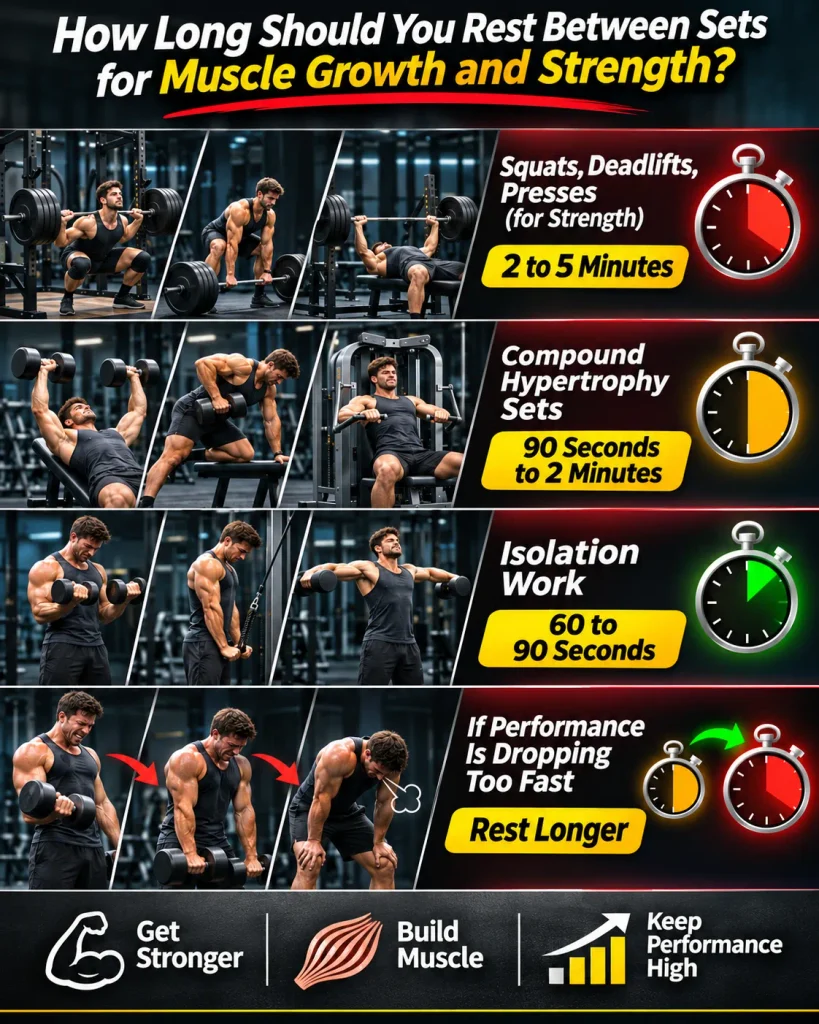
- Squats, deadlifts, presses for strength: 2 to 5 minutes
- Compound hypertrophy sets: 90 seconds to 2 minutes
- Isolation work: 60 to 90 seconds
- If performance is dropping too fast: rest longer
That approach fits the best available evidence and gives you something practical you can use today.
Sources
- American College of Sports Medicine Position Stand. Resistance Training Prescription for Muscle Function, Hypertrophy, and Physical Performance in Healthy Adults: An Overview of Reviews – PMC
- American College of Sports Medicine Position Stand. Resistance Training Prescription for Muscle Function, Hypertrophy, and Physical Performance in Healthy Adults: An Overview of Reviews – PubMed
- Give it a rest: a systematic review with Bayesian meta-analysis on the effect of inter-set rest interval duration on muscle hypertrophy – PubMed
- Give it a rest: a systematic review with Bayesian meta-analysis on the effect of inter-set rest interval duration on muscle hypertrophy – PMC
- Volume Load Rather Than Resting Interval Influences Muscle Hypertrophy During High-Intensity Resistance Training – PubMed
- Longer Interset Rest Periods Enhance Muscle Strength and Hypertrophy in Resistance-Trained Men – PubMed
Researched on November 6, 2026. Verify time-sensitive details with the original sources.