Last Updated on November 6, 2026
If you have ever finished a set and wondered, “Was that hard enough to grow?” you are exactly who RIR and RPE are for.
Many lifters train too easy without realizing it. Others take too many sets to all-out failure, pile up fatigue, and make progression harder than it needs to be. A better middle ground is to use effort targets. That is where RIR and RPE can help.
In simple terms, RIR tells you how many good reps you had left, while RPE rates how hard the set felt. Used well, they help you train hard enough for results without turning every workout into a grind.
What RIR and RPE actually mean
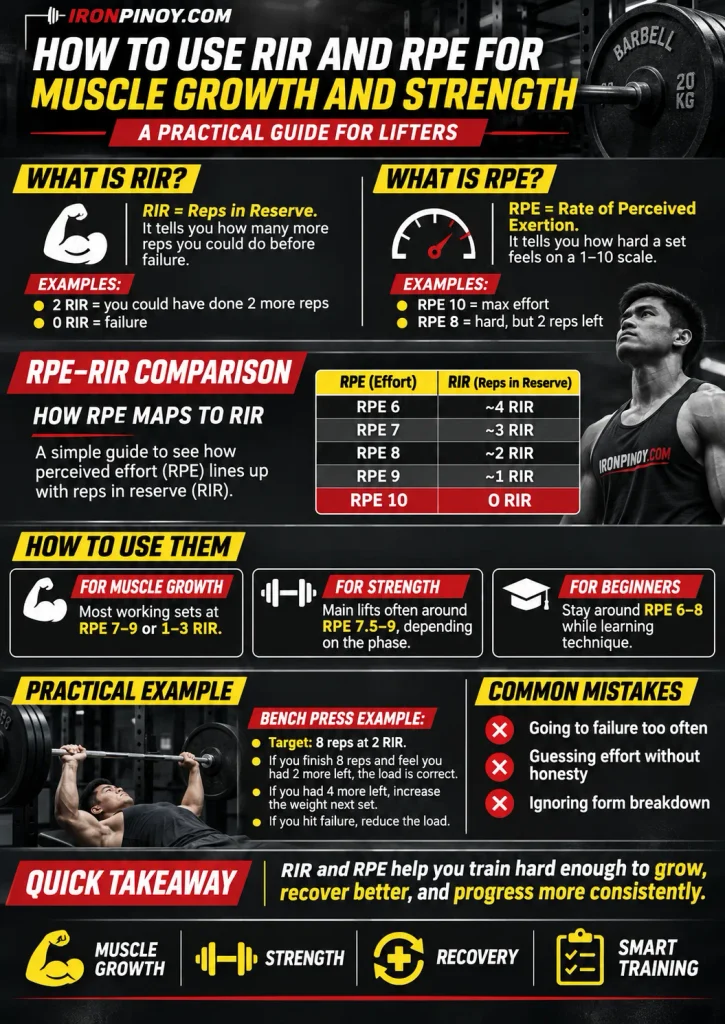
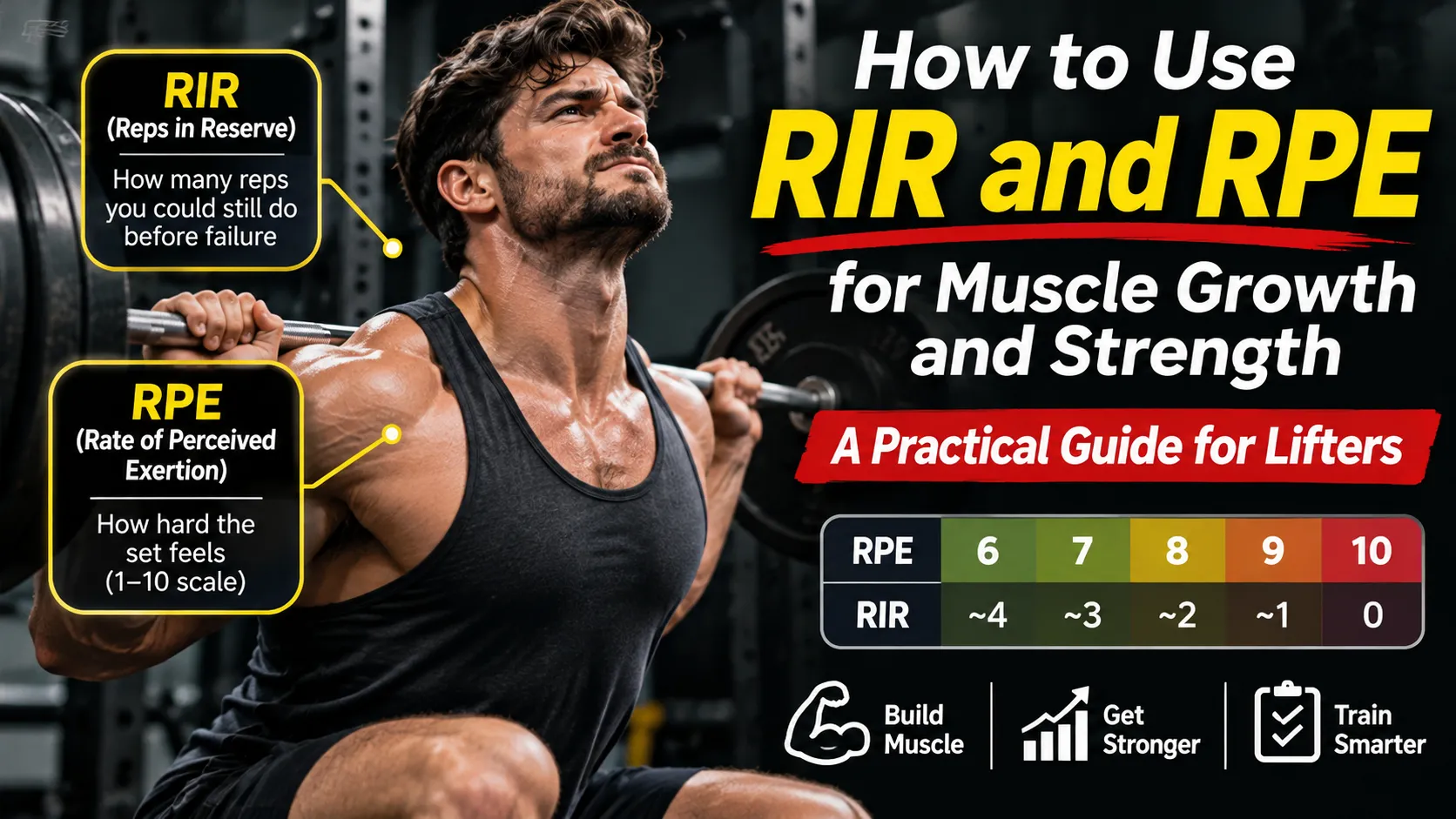
RIR stands for reps in reserve. It is your estimate of how many more reps you could have completed with solid technique before reaching failure.
RPE stands for rating of perceived exertion. In resistance training, it is commonly used on a 1 to 10 scale to describe set difficulty.
A practical mapping often used in lifting looks like this, based on the RIR-based RPE model described by Helms and colleagues:
- RPE 10 = 0 RIR — no reps left
- RPE 9 = 1 RIR — maybe one more rep
- RPE 8 = 2 RIR — around two reps left
You can see that framework in the original paper on the topic at PMC.
Why most lifters benefit from using them
Percent-based programs can work well, but your body does not perform exactly the same every day. Sleep, stress, food, and accumulated fatigue all affect how a given load feels.
That is why autoregulation is useful. Instead of forcing the exact same effort on good days and bad days, RIR and RPE let you adjust while still training with intent. A recent network meta-analysis found autoregulated resistance training methods outperformed percentage-based training for maximal strength overall, though the advantage was not unique to RPE alone and other approaches such as APRE also performed well. You can read that review here.
How hard should you train for muscle growth?
For hypertrophy, the evidence supports training reasonably close to failure, but not necessarily to failure on every set.
ACSM’s 2026 resistance training guidance highlights that hypertrophy is supported by sufficient weekly volume, around 10 sets per muscle group, and appropriate load selection. The same update also notes that training to fatigue or momentary muscle failure did not consistently improve outcomes for the average healthy adult. In other words, failure is a tool, not a rule. See the ACSM summary here.
That fits with a systematic review and meta-analysis showing similar hypertrophy from failure and non-failure training when volume is equated. The PubMed record is here.
In practice, a useful target for most muscle-building work is:
- Most working sets: 1–3 RIR
- Some final isolation or machine sets: 0–1 RIR
This gives you hard, productive sets without making every exercise maximally fatiguing.
How hard should you train for strength?
Strength is a little different. Proximity to failure still matters, but load matters a lot too.
ACSM’s update highlights heavier loading, around 80% of 1RM, for strength-focused work, commonly for 2–3 sets per exercise. A 2024 meta-regression also suggests that proximity to failure may matter more for hypertrophy than for strength. That supports a practical approach: strength work should be heavy enough, but not every set needs to be pushed to the limit. The PubMed entry for that analysis is here.
For most lifters, that means keeping big compound lifts around 1–3 RIR most of the time, and sometimes even more conservative when technique quality is the priority.
How to use RIR and RPE in a real program
Here is a practical way to apply it. This is coaching guidance based on the evidence above, not a universal law.
Main barbell lifts
For squats, bench presses, deadlift variations, and overhead presses:
- 3–5 sets of 3–6 reps
- Target roughly RPE 7–9 or 1–3 RIR
- Rest about 2–4 minutes between sets
This lets you train hard with enough quality to improve both technique and force output.
Secondary compound lifts
For rows, Romanian deadlifts, dumbbell presses, split squats, and machine presses:
- 2–4 sets of 6–10 reps
- Target 1–3 RIR
- Rest about 1.5–3 minutes
Isolation and machine work
For curls, lateral raises, leg extensions, leg curls, triceps pushdowns, and calf raises:
- 2–4 sets of 10–20 reps
- Target 0–2 RIR
- Rest about 1–2 minutes
If you want a broader overview of how effort fits into long-term progression, IronPinoy’s guide to progressive overload for muscle building is a useful companion read.
How to progress week to week
RIR and RPE are most useful when they guide progression rather than replace it.
A simple method is this:
- Pick a rep range, such as 6–8 reps
- Use a load that lands at your target effort, for example 2 RIR
- When you can hit the top of the rep range at the same effort, increase the load next session
Example: if you bench press 80 kg (176 lb) for 3 sets of 6 at about 2 RIR, keep the same weight until you can do 3 sets of 8 at about 2 RIR. Then go up slightly.
Common mistakes with RIR and RPE
Guessing wildly
RPE 8 should not mean “somewhere between easy and awful.” The more consistent you are, the more useful the system becomes.
Taking every set to failure
That usually creates more fatigue than necessary, especially on compounds.
Using it like a perfect science
RIR accuracy is not flawless. Research suggests lifters tend to estimate RIR more accurately at heavier loads, such as 85% of 1RM, than at lighter loads like 65–75% of 1RM. Predictions also tend to be more accurate closer to failure. See the study on common lifts here and the scoping review here.
Expecting beginner-level precision
If you are new, treat RIR as a skill. Your estimates will improve as you gain experience with honest, technically consistent sets.
That matters because many lifters think they are two reps from failure when they are actually much farther away. If muscle gain has stalled, that is often worth checking before changing your whole program. For a bigger-picture explanation of what drives growth, see IronPinoy’s article on what actually builds muscle.
Is RIR better than percentage-based training?
Not automatically. Percent-based loading still works, especially when your estimated max is current and your recovery is predictable.
But RIR and RPE are often more flexible in the real world. If 100 kg feels unusually heavy on a poor-recovery day, an RPE target can stop you from overshooting. If the same load feels sharp and fast on a great day, it can help you do enough work instead of undertraining.
The best answer for many lifters is not either-or. Use percentages or planned loads as a starting point, then use RIR or RPE to keep the effort where it should be.
The bottom line
RIR and RPE are practical tools for judging effort, not magic formulas. For most lifters, a good default is to keep compound lifts around 1–3 RIR, push safer isolation work a little closer when useful, and stop assuming failure is required for growth.
If you learn to estimate effort honestly, you will make your training more consistent, more adaptable, and usually more productive.
Sources
- ACSM Publishes Updated Resistance Training Guidelines
- Effects of resistance training performed to repetition failure or non-failure on muscular strength and hypertrophy: A systematic review and meta-analysis – PubMed
- Exploring the Dose-Response Relationship Between Estimated Resistance Training Proximity to Failure, Strength Gain, and Muscle Hypertrophy: A Series of Meta-Regressions.
- Autoregulated resistance training for maximal strength enhancement: A systematic review and network meta-analysis – PMC
- Application of the Repetitions in Reserve-Based Rating of Perceived Exertion Scale for Resistance Training – PMC
- Estimating Repetitions in Reserve in Four Commonly Used Resistance Exercises – PubMed
- Accuracy in Predicting Repetitions to Task Failure in Resistance Exercise: A Scoping Review and Exploratory Meta-analysis.
- Ability to predict repetitions to momentary failure is not perfectly accurate, though improves with resistance training experience – PMC
- Feasibility and Usefulness of Repetitions-In-Reserve Scales for Selecting Exercise Intensity: A Scoping Review – PubMed
- 5 Things to Know About Creating an Effective Resistance Training Plan
Researched on November 6, 2026. Verify time-sensitive details with the original sources.