

Last Updated on November 9, 2026
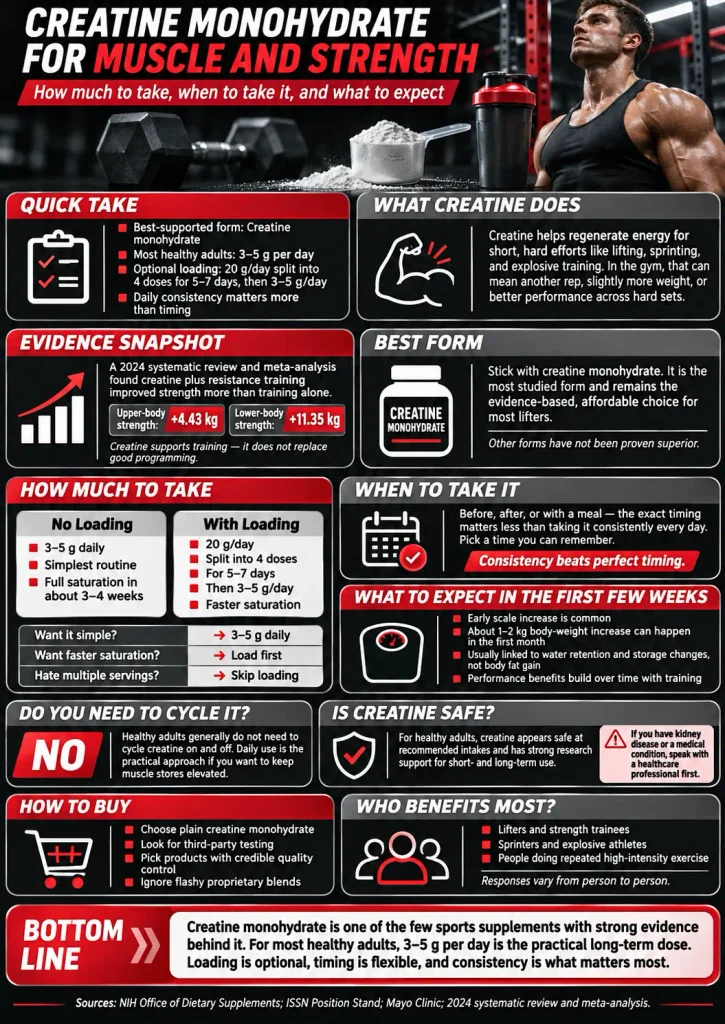
If you lift weights and want a supplement with real evidence behind it, creatine monohydrate is the obvious place to start. The practical answer is simple: for most healthy adults, take 3–5 g per day. If you want faster saturation, you can use a loading phase of 20 g per day split into 4 doses for 5–7 days, then continue with 3–5 g daily. Loading works faster, but it is not required.
That guidance is consistent with the NIH Office of Dietary Supplements, which also notes that creatine is one of the most studied sports supplements and is most useful for repeated short, high-intensity efforts such as lifting, sprinting, and similar training.
What creatine monohydrate actually does
Creatine helps your body regenerate energy during short bursts of hard effort. That is why it tends to help more with resistance training, repeated sprint work, and explosive efforts than with pure endurance exercise.
In real gym terms, that can mean a little more performance where it counts: another rep, slightly more load, or better quality across multiple hard sets. Over time, those small improvements can help support better strength and muscle-building training.
A 2024 systematic review and meta-analysis in adults under 50 found that creatine combined with resistance training improved strength more than training plus placebo, with pooled effects of 4.43 kg in upper-body strength and 11.35 kg in lower-body strength. The key point is not that creatine replaces good programming. It is that creatine appears to improve results when paired with resistance training.
Best form: stick with creatine monohydrate
If you are comparing labels and seeing expensive versions with flashy names, keep this simple. Creatine monohydrate is the default recommendation because it is the most widely studied form, and the NIH states that other forms have not been proven superior for muscle creatine levels, digestibility, stability, or safety.
That makes monohydrate the evidence-based choice for most readers: effective, established, and usually more affordable than specialty blends.
How much creatine should you take?
For most healthy adults, there are two evidence-based options:
- No loading: 3–5 g per day.
- With loading: 20 g per day, split into 4 doses, for 5–7 days, then 3–5 g per day.
The loading method raises muscle creatine stores faster. The no-loading method gets you there more gradually, usually over roughly 3–4 weeks according to the NIH guidance. In practice, that means loading is optional, not mandatory.
A simple way to choose
| Goal | Best approach |
|---|---|
| You want the simplest routine | Take 3–5 g daily |
| You want faster saturation | Load with 20 g daily in 4 doses for 5–7 days, then 3–5 g daily |
| You dislike taking multiple servings | Skip loading and stay consistent with 3–5 g daily |
When should you take creatine?
For most people, timing matters less than consistency. The main goal is to raise and maintain muscle creatine stores over time. The supplied evidence supports daily use far more clearly than any special pre-workout or post-workout rule.
So if you are asking whether to take it before training, after training, or with a meal, the practical answer is: pick a time you will remember and stick to it. A boring routine beats a perfect plan you forget after a week.
What should you expect in the first few weeks?
Do not be surprised if the scale goes up early. The NIH notes that creatine often leads to weight gain, and several studies found about 1–2 kg of body-weight increase in a month during a strength-training program. That early gain is not automatically fat gain. It is commonly explained by water retention and storage changes.
This matters because many lifters start creatine, see the scale jump, and assume something went wrong. Usually, it means the supplement is doing what it is supposed to do inside the muscle.
If your main goal is fat loss, that scale change can be psychologically annoying, but it does not mean creatine is making you gain body fat.
Do you need to cycle creatine?
There is no good reason in the supplied evidence for healthy adults to cycle creatine on and off. If your goal is to keep muscle creatine stores elevated, daily use at a standard dose is the practical approach.
In other words, creatine is not like a pre-workout stimulant that some people rotate because of tolerance concerns. For most healthy users, consistency is the point.
Is creatine safe?
The strongest wording supported by the evidence is this: creatine appears safe for healthy adults when used at recommended intakes, including over longer periods in the literature reviewed by major sources. The NIH describes creatine as safe for short-term use by healthy adults and notes evidence supporting safety over several years. The ISSN position stand also reports that short- and long-term supplementation has been safe and well tolerated in healthy individuals in the research it reviewed.
But “safe” does not mean “for everyone.” If you have kidney disease, the careful advice is to speak with a healthcare professional first. Mayo Clinic advises caution for people with kidney disease, and a 2025 meta-analysis reported higher serum creatinine with creatine use but no significant difference in urea or estimated glomerular filtration rate versus controls, while also noting that longer-term randomized trials are still needed.
That is a good example of how fitness advice should be framed: reassuring for healthy adults, but not careless about special populations.
How to buy a better creatine product
Creatine is simple, but the supplement market is not. Mayo Clinic advises choosing products that follow recommended manufacturing practices and use third-party testing. That is useful because quality can vary widely between brands.
What you are looking for is not a “proprietary matrix” or a fancy delivery system. You are looking for plain creatine monohydrate from a product with credible quality control.
Who is most likely to benefit?
Creatine makes the most sense for people doing resistance training, sprint work, or repeated high-intensity exercise. It is less compelling for someone focused only on steady-state endurance activity.
Response also varies. The NIH notes that not everyone responds equally, and factors such as diet and muscle fiber composition may play a role. So if your friend swears creatine changed everything and you notice only a modest difference, that does not mean the supplement is fake. It means human responses vary.
If you are new to training, remember the bigger picture: creatine can help, but it will not rescue a poor program, low effort, or inconsistent protein intake. If that is your weak point, fixing basics first will matter more. For example, readers trying to improve their nutrition foundation may also find this practical guide on protein per meal for muscle growth useful.
Bottom line
Creatine monohydrate is still the best-supported creatine supplement for lifters. For most healthy adults, 3–5 g per day is a sensible long-term dose. A loading phase can speed things up, but it is optional. Daily consistency matters more than exact timing, some early scale gain is normal, and monohydrate remains the form to beat.
If you want a supplement that is backed by far more evidence than most products in the fitness aisle, this is one of the few that earns its place.
Sources
- Dietary Supplements for Exercise and Athletic Performance – Health Professional Fact Sheet
- Effects of Creatine Supplementation and Resistance Training on Muscle Strength Gains in Adults <50 Years of Age: A Systematic Review and Meta-Analysis – PubMed
- Creatine – Mayo Clinic
- International Society of Sports Nutrition position stand: safety and efficacy of creatine supplementation in exercise, sport, and medicine – PMC
- The Effect of Creatine Supplementation on Kidney Function: A Systematic Review and Meta-Analysis of Randomized Controlled Trials.