
Last Updated on November 8, 2026
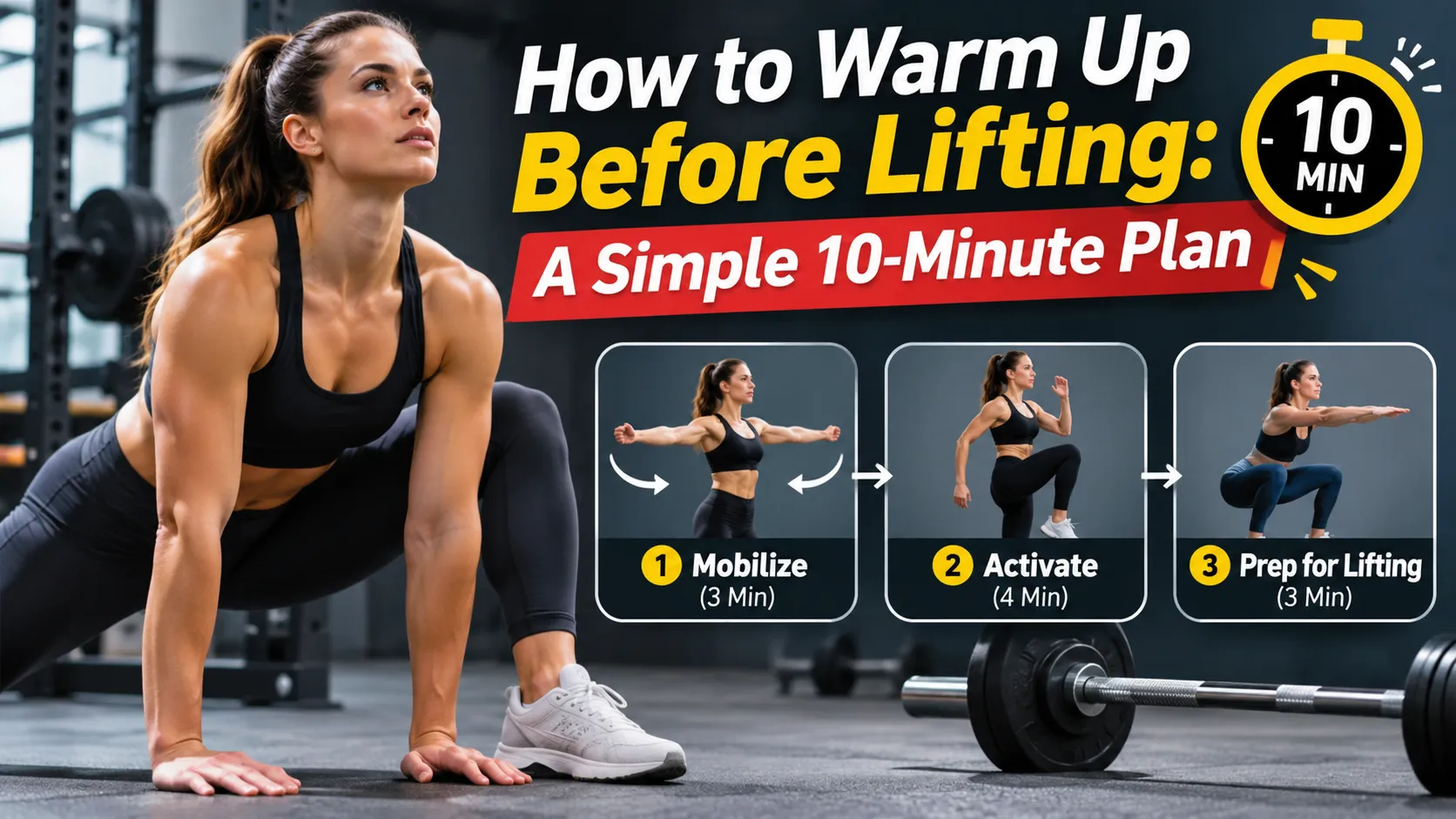
How to Warm Up Before Lifting: Skipping your warm-up can leave your first working sets feeling stiff and heavy. But turning it into a 20-minute mobility session is not the answer either.
For most gym sessions, the best approach is simple: spend a few minutes raising your body temperature, do a small amount of dynamic movement, then perform ramp-up sets for your first main lift. That gives you the main benefits of warming up without wasting time or energy.
This fits the bigger picture of resistance training as well. A 2026 American College of Sports Medicine position stand concluded that resistance training is effective for strength, hypertrophy, power, muscular endurance, and several physical-function outcomes in healthy adults. The goal of your warm-up is to help you train well, not to become a separate workout.
Why most lifters warm up the wrong way
Most people make one of two mistakes.
The first is doing nothing, then jumping straight into a heavy barbell or machine set. The second is doing too much: long static stretching, random band drills, or a warm-up that leaves them tired before the session even starts.
A more practical middle ground is supported by current guidance. The American Heart Association advises about 5 to 10 minutes for a general warm-up, with longer preparation for more intense activity. For lifting, that usually means a short general phase plus exercise-specific build-up sets.
What a good lifting warm-up should actually do
A useful warm-up has three jobs.
- Gradually raise heart rate and body temperature
- Rehearse the movement patterns you are about to train
- Improve readiness without creating unnecessary fatigue
That last point matters. If your warm-up makes you feel drained, it is probably too long, too hard, or too complicated.
Warm-ups also seem to help acute performance. A 2025 scoping review on resistance-training warm-ups reported improvements in 1-repetition maximum performance in exercises such as the squat and leg press, with some studies also showing better bar velocity or more repetitions completed at moderate loads.
That does not prove a warm-up directly increases long-term muscle growth. Most of the evidence is about immediate performance. But better performance during your session is still valuable, because your training quality depends on it.
A simple 10-minute warm-up before lifting
This template works well for most beginner and intermediate lifters.
1) Do 3 to 5 minutes of easy general movement
Pick any low-intensity option that gets you moving:
- Brisk walking on a treadmill
- Easy cycling
- Light rowing
- Gentle jump rope
You should feel warmer, looser, and slightly more alert, not out of breath.
2) Add 2 to 4 minutes of dynamic mobility
Use movements that match the session ahead. The idea is to move joints and muscles through useful ranges, not to hold long stretches.
Good options include:
- Bodyweight squats
- Hip hinges
- Leg swings
- Arm circles
- Band pull-aparts
- Scapular push-ups
This approach matches practical guidance from the NSCA on dynamic warm-ups, which emphasizes a short general phase followed by more specific movement preparation.
3) Perform 2 to 4 ramp-up sets for your first big lift
This is the part many lifters skip, even though it is usually the most specific and useful step.
If your first work set on squat is 100 kg (220 lb), a practical build-up could look like this:
- Empty bar x 8 reps
- 40 kg (88 lb) x 5 reps
- 60 kg (132 lb) x 3 reps
- 80 kg (176 lb) x 1 to 2 reps
- Then begin your work sets
This is not a universal formula. Stronger lifters, very heavy singles, cold environments, and technically demanding lifts may need more preparation. Easier machine work or lighter hypertrophy sessions may need less. The evidence supports specific warm-up sets improving performance, but not one fixed loading scheme for everybody.
Do you need static stretching before lifting?
Usually, no.
If your goal is strength or hypertrophy, long static stretching before lifting is generally not the best starting point. A recent consensus statement on stretching noted that previous systematic reviews support avoiding longer-duration static stretching before performance, especially when holds go beyond about 60 seconds per muscle group.
That does not mean every short stretch is harmful. A BJSM systematic review found strong evidence that high-load dynamic warm-ups improve power and strength performance, while short-duration static stretching did not harm power outcomes in the studies reviewed.
In practice, if a tight area is clearly limiting your lifting technique, a brief static stretch can make sense. Just do not make long passive stretching the centerpiece of your pre-lift routine. Follow it with dynamic movement and ramp-up sets.
How to adjust your warm-up for different workouts
Heavy strength day
Keep general cardio short, then spend more attention on ramp-up sets. If you are working up to heavy sets on squat, bench press, or deadlift, specific rehearsal matters more than extra mobility drills.
Hypertrophy day
You can usually keep the whole warm-up brief. A few minutes of easy movement, a couple of dynamic drills, and one to three build-up sets for the first exercise are often enough.
Upper-body session
Focus your dynamic work on the shoulders and upper back. Arm circles, band pull-aparts, and scapular push-ups can prepare you well before pressing or rowing.
Leg day
Many lifters benefit from spending a little more time on hips, knees, and ankles before squats, lunges, or hinges. Then use ramp-up sets to groove the actual pattern you will load heavily.
Will warming up prevent injuries?
It is smarter to be careful here.
Warm-ups clearly make sense for readiness and performance, and they may help reduce injury risk. But the injury-prevention evidence is not strong enough to promise protection in every setting. The research is more mixed than many gym clichés suggest, so it is better to treat a warm-up as helpful preparation, not as a guarantee.
The bottom line
If you are wondering how to warm up before lifting, do not overcomplicate it. For most workouts, a short and progressive plan is enough:
- 3 to 5 minutes of easy movement
- 2 to 4 minutes of dynamic mobility
- 2 to 4 ramp-up sets for your first main lift
That gives you the best-supported balance of readiness, specificity, and time efficiency. Save your energy for the actual training, because that is still what drives the results.
Sources
- Warm Up, Cool Down | American Heart Association
- American College of Sports Medicine Position Stand. Resistance Training Prescription for Muscle Function, Hypertrophy, and Physical Performance in Healthy Adults: An Overview of Reviews – PMC
- Acute Effects of Resistance Training Warm-Up and Re-Warm-Up on Dynamic Strength Performance: A Scoping Review
- Introduction to Dynamic Warm-Up
- Practical recommendations on stretching exercise: A Delphi consensus statement of international research experts
- A systematic review of the effects of upper body warm-up on performance and injury
- Exercise-Based Strategies from Warm-Up to Training: A Systematic Review of Performance Enhancement and Injury Prevention.