
Last Updated on November 13, 2026
If you have ever looked at your phone at 8:30 p.m., seen 6,200 steps, and felt like the whole day “didn’t count,” here is the short answer: no, you do not need 10,000 steps a day as a universal rule.
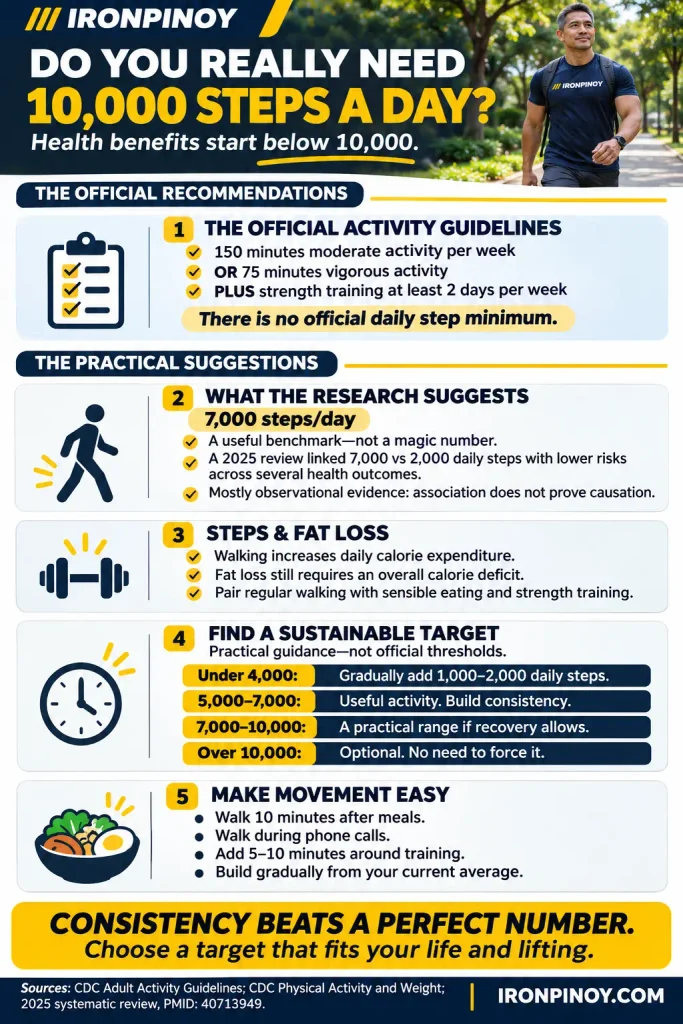
That number is popular, but it is not the official minimum for adult health. Public-health guidance is based on total activity time and intensity, not on hitting one exact daily step target. The CDC recommends that adults get at least 150 minutes of moderate-intensity aerobic activity per week or 75 minutes of vigorous activity, plus muscle-strengthening work on at least 2 days per week.
That matters because many lifters and busy adults assume anything under 10,000 is failure. Current evidence suggests a more useful view: some activity is better than none, meaningful benefits show up well below 10,000 steps, and your best target depends on your goal.
Do you really need 10,000 steps a day?
No. Ten thousand steps is a helpful benchmark for some people, but it is not an official medical requirement.
According to a brief piece in The BMJ, the 10,000-step idea was popularized by a Japanese pedometer marketing campaign in the mid-1960s. That does not make it useless. It just means the number did not begin as a formal public-health threshold.
For practical purposes, 10,000 steps can still be a good goal if it fits your schedule, recovery, and preferences. But if you walk 6,000 to 8,000 steps consistently, train hard, and eat appropriately for your goal, you are not somehow doing nothing.
What the official guidelines actually say
The CDC’s adult activity guidance is straightforward:
- At least 150 minutes per week of moderate-intensity aerobic activity, or 75 minutes per week of vigorous activity
- Muscle-strengthening activity at least 2 days per week
The same guidance also notes that some physical activity is better than none, and that benefits increase beyond the minimum. In other words, there is a floor to aim for, but not one magical step total that separates success from failure.
For IronPinoy readers, this is important. If you lift 3 to 5 days per week, your strength training already covers part of the weekly recommendation. Steps can then act as a simple way to add more low-stress movement without turning every week into a cardio block.
What current research says about step counts and health
A 2025 systematic review and dose-response meta-analysis looked at daily steps and several health outcomes in adults. Compared with 2,000 steps per day, 7,000 steps per day was associated with substantially lower risk of all-cause mortality, cardiovascular disease, cancer mortality, type 2 diabetes, dementia, and depressive symptoms.
That does not mean 7,000 is the one perfect target for everyone. It also does not prove that steps alone directly caused those better outcomes, because most of the evidence is observational. Still, it gives us a strong practical message: health benefits do not suddenly begin at 10,000 steps. They appear to rise meaningfully when people move from very low activity to a more moderate level.
That is good news for beginners, office workers, and lifters in a fat-loss phase who want something sustainable.
Are steps good for fat loss?
Yes, but not because steps are magic.
The CDC explains that physical activity increases calorie expenditure, and that weight loss requires a calorie deficit created by some combination of eating less and moving more. It also notes that most weight loss comes from reducing calorie intake, while physical activity is especially important for helping create the deficit and for weight maintenance over time. You can read that directly on the CDC page on physical activity and weight.
So yes, steps can help fat loss. They raise daily energy use, they are accessible for most people, and they usually come with less recovery cost than harder forms of cardio. But a step goal cannot override a diet that consistently wipes out your calorie deficit.
For lifters, that low recovery cost is the biggest advantage. A brisk walk usually will not interfere with leg training the way too much high-intensity cardio might. That makes steps a practical tool during a cut or during periods when you want better health without sacrificing gym performance.
A practical step goal for lifters and busy adults
There is no single perfect number, but this is a sensible framework based on the current evidence and public-health guidance:
| Average daily steps | Practical interpretation |
|---|---|
| Under 4,000 | A good first target is adding 1,000 to 2,000 steps per day and making that consistent. |
| 5,000 to 7,000 | Already useful for many adults. Focus on consistency before chasing a bigger number. |
| 7,000 to 10,000 | A strong general range for health and daily activity if your schedule and recovery allow. |
| Over 10,000 | Optional, not mandatory. Useful if you enjoy walking or need more activity for weight maintenance. |
This is practical guidance, not a formal rulebook. Your ideal target depends on your baseline activity, body size, diet, training volume, and whether your priority is health, fat loss, or simply staying active while working at a desk.
How to add more steps without hurting your lifting
The best step goal is the one you can repeat without turning it into another stressful task. Simple options usually work best:
- Take a 10-minute walk after 2 or 3 meals
- Use phone calls as walking time
- Park slightly farther away when practical
- Walk for 5 to 10 minutes before or after training
- Use an easy treadmill walk on rest days
If your current average is low, do not jump from 3,000 to 12,000 overnight. Add enough to notice a change, then hold that level until it feels normal.
The bottom line
You do not need 10,000 steps a day for your activity to count. Official guidelines are based on weekly minutes of activity and regular strength training, not on one universal step quota.
For general health, current evidence suggests that moving from very low step counts to more moderate daily activity can make a meaningful difference, and around 7,000 steps per day looks like a strong practical benchmark for many adults. For fat loss, steps help by increasing calorie expenditure, but they still need to fit into an overall calorie deficit.
If you are a lifter, think of steps as a useful support habit: easy to recover from, easy to track, and valuable for health. If 10,000 motivates you, great. If 6,000 to 8,000 is what you can sustain while lifting hard and managing real life, that can still be a very solid place to start.