

Last Updated on November 19, 2026
If you want the short answer first, here it is: for most healthy adults, the most common evidence-based pre-workout caffeine dose is about 3 to 6 mg per kg of body mass, usually taken around 60 minutes before training. A lower dose of roughly 1 to 3 mg/kg may still help some people, especially if you want better alertness with fewer side effects. The key is not chasing the highest dose. It is finding the lowest dose that helps your workout without wrecking your sleep later.
That practical range comes from the International Society of Sports Nutrition position stand on caffeine and exercise performance, which is one of the strongest sports-nutrition references on the topic.
Does caffeine actually help strength and muscle-building workouts?
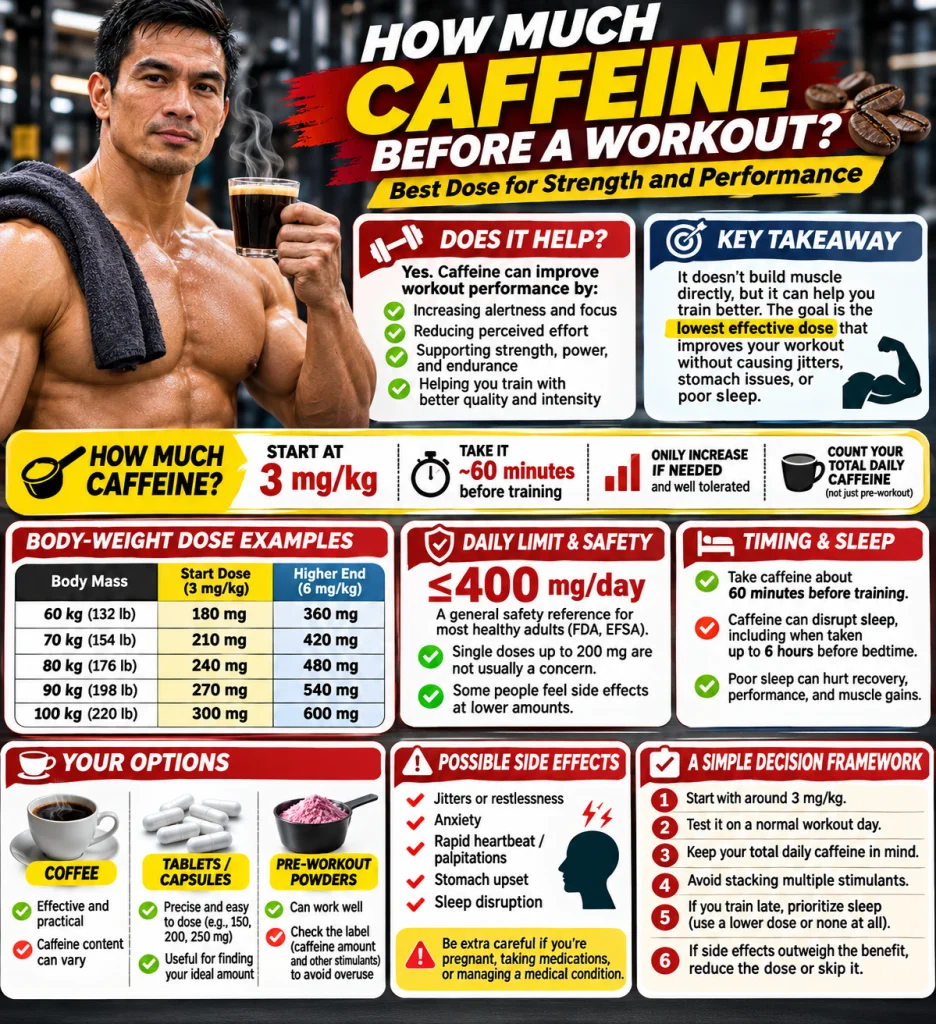
Yes, caffeine can improve exercise performance, but it is important to keep the claim realistic. It does not build muscle directly. What it may do is help you train better by improving alertness, reducing perceived effort, and supporting performance in some strength, power, endurance, and repeated-sprint tasks.
The big-picture support is strong. The IOC consensus statement on dietary supplements places caffeine among the better-supported performance supplements in sport. That said, the resistance-training evidence is not perfectly uniform. A 2024 meta-analysis of meta-analyses on caffeine and muscular strength/endurance suggests an overall benefit, but not every study or every person responds the same way.
For lifters, that matters. If caffeine helps you keep bar speed up, squeeze out an extra rep, or maintain training quality across a hard session, that can support better long-term progress. But it is not magic, and more is not automatically better.
How much caffeine before a workout?
A practical way to start is simple:
- Start at 3 mg/kg
- Take it about 60 minutes before training
- Only increase if needed and well tolerated
- Count your total daily caffeine intake, not just your pre-workout
Lower doses around 1 to 3 mg/kg may still be useful for alertness and sometimes performance, with a lower risk of jitters or stomach upset. That makes sense for beginners, smaller lifters, or anyone sensitive to stimulants.
Body-weight examples
These are practical examples based on a 3 mg/kg starting dose and the higher end of the common 6 mg/kg range. They are examples, not separate published recommendations.
| Body mass | Start-here dose at 3 mg/kg | Higher end at 6 mg/kg |
|---|---|---|
| 60 kg (132 lb) | 180 mg | 360 mg |
| 70 kg (154 lb) | 210 mg | 420 mg |
| 80 kg (176 lb) | 240 mg | 480 mg |
| 90 kg (198 lb) | 270 mg | 540 mg |
| 100 kg (220 lb) | 300 mg | 600 mg |
Notice the issue with the upper end: for larger lifters, 6 mg/kg can push total intake beyond what general safety guidance considers reasonable for many adults once the rest of the day is included.
What counts as too much?
Total daily intake matters. The FDA says up to 400 mg of caffeine per day is an amount not generally associated with negative effects for most adults. The EFSA caffeine explainer similarly states that up to 400 mg per day and single doses up to 200 mg do not generally raise safety concerns for healthy adults in the general population.
That does not mean 400 mg is the right target. It means staying under that amount is a useful general safety reference for many adults. Some people will feel unpleasant side effects far below it.
When should you take caffeine?
The standard practical rule is about 60 minutes before training. That is the timing most often used in the research summarized by the ISSN position stand.
Different forms may absorb a little differently, but for everyday gym use, an hour before your session is a solid starting point. If you train very early, that may be easy. If you train late in the afternoon or evening, timing becomes a bigger trade-off because caffeine can interfere with sleep.
Why sleep can be the deal-breaker
One of the most reliable downsides of caffeine is sleep disruption. A systematic review and meta-analysis on caffeine and sleep found that caffeine can reduce total sleep time and worsen sleep quality. The research summary in your supplied brief also notes that even caffeine taken 6 hours before bedtime may still impair sleep in some people.
That matters for lifters because recovery is part of performance. If a bigger pre-workout dose gives you a slightly better session today but leads to poor sleep tonight, the trade-off may not be worth it. If you want a deeper look at recovery, IronPinoy also recently covered how much sleep you need to build muscle.
Coffee, caffeine tablets, or pre-workout?
All three can work, but they are not equally precise.
Coffee
Coffee can improve performance, and it is a practical choice for many gym-goers. The downside is that caffeine content can vary, which makes accurate dosing harder. According to the ISSN position stand on coffee and sports performance, coffee can be useful, but standardizing intake is less straightforward than using measured caffeine products.
Tablets or capsules
These make it easier to match a target dose such as 150 mg, 200 mg, or 250 mg. That precision is useful if you are trying to find the minimum effective amount.
Pre-workout powders
These can work too, but they require more label-reading. Some include multiple stimulants or large caffeine doses per scoop, which makes accidental overuse easier.
Side effects and who should be careful
Common side effects can include:
- jitters
- anxiety
- rapid heartbeat or palpitations
- stomach upset
- sleep disruption
People who are especially caffeine-sensitive, prone to insomnia, or already dealing with anxiety symptoms may need lower doses or may decide caffeine is not worth it. The FDA also advises extra caution for people who are pregnant, taking medications, or managing medical conditions.
A simple decision framework
- Start with around 3 mg/kg.
- Test it on a normal workout day, not on a max-out or competition day.
- Keep the rest of your caffeine intake in mind for the day.
- Avoid stacking multiple stimulants without a clear reason.
- If you train late, prioritize sleep and consider a lower dose or none at all.
- If side effects outweigh the benefit, reduce the dose or skip it.
The bottom line
For most healthy adults, 3 mg/kg about 60 minutes before training is the best practical place to start. Some people do well with less. Some tolerate more. But the evidence does not support the idea that endlessly increasing the dose will keep improving performance.
If your goal is better lifting sessions, better consistency, and better recovery, the smartest move is usually the simplest one: use the lowest dose that noticeably helps your workout without causing jitters, stomach issues, or worse sleep.
Sources
- International society of sports nutrition position stand: caffeine and exercise performance
- International society of sports nutrition position stand: caffeine and exercise performance
- The effect of caffeine on subsequent sleep: A systematic review and meta-analysis
- Spilling the Beans: How Much Caffeine is Too Much? | FDA
- International society of sports nutrition position stand: coffee and sports performance
- IOC Consensus Statement: Dietary Supplements and the High-Performance Athlete
- The effect of caffeine supplementation on muscular strength and endurance: A meta-analysis of meta-analyses.
- How much caffeine is it safe to consume?