
Last Updated on November 21, 2026
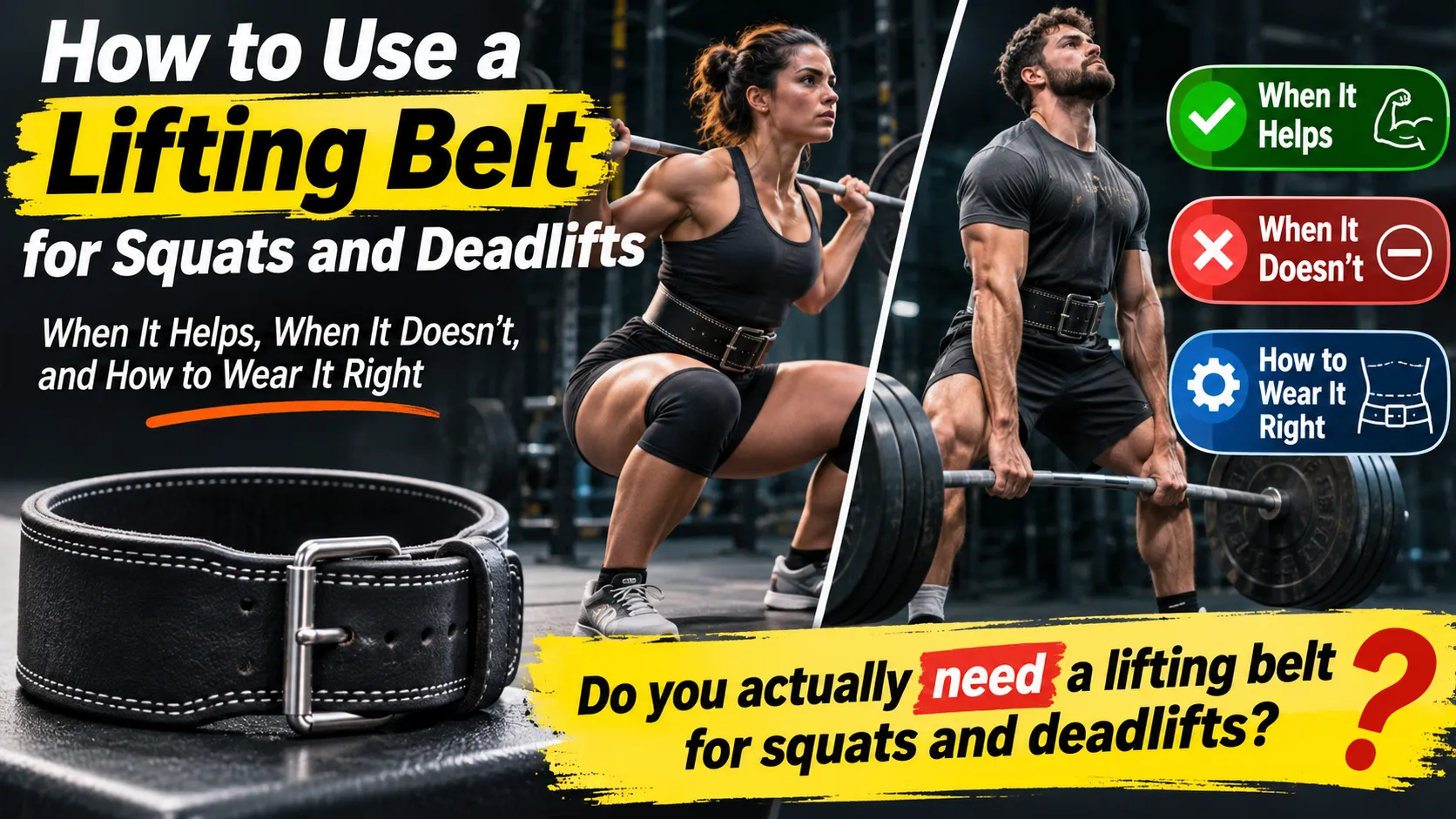
Do you actually need a lifting belt for squats and deadlifts?
For most lifters, no. You can build plenty of muscle and strength without one. But a belt can be useful when loads get heavy, especially on lifts that challenge your trunk and lower back the most. The key is understanding what a belt does, what it does not do, and how to use it without letting it replace good technique.
That matters because a lifting belt is often treated like either a magic shield or a sign that you have “leveled up.” The evidence supports a more practical middle ground. According to ACSM’s updated resistance training guidance, meaningful progress does not depend on any one piece of equipment. And NSCA guidance notes that belts make the most sense on exercises that heavily stress the trunk, including squats and deadlifts.
Do You Need a Lifting Belt?
Usually, only sometimes.
If you are a beginner learning to squat and hinge, your first priorities are stance, bracing, bar control, and sensible loading. A belt is optional. It is not required for lighter technique work, warm-up sets, machine exercises, or most isolation lifts.
Where belts become more relevant is during hard work sets on big compound lifts. The NSCA’s guidance on anaerobic and muscle endurance development specifically points to back squats, front squats, and deadlifts as the main lifts where belt use is appropriate, depending on the exercise and relative load.
In other words: a belt is a tool, not a requirement.
What a Lifting Belt Actually Does
A belt does not “hold your spine together.” It is better understood as something you brace against.
When you take a breath and tighten your trunk before a heavy squat or deadlift, you create pressure through the abdomen and torso. A systematic review of high-intensity resistance exercise found very high intra-abdominal pressure during heavy lifting, especially in squats and deadlifts, and some belted conditions produced higher values. That supports the usual coaching explanation that a belt can help a trained lifter create more trunk stiffness by giving the abdominal wall something firm to push into.
So the likely benefit is improved bracing efficiency, not spinal protection magic. That distinction matters. A belt may help you lift better under certain conditions, but it does not cancel out poor setup, poor bar path, or a load you are not ready to control.
When a Belt Helps Most
A belt is most worth considering when:
- you are doing heavy back squats, front squats, or deadlifts
- you are on top sets or hard work sets rather than warm-ups
- you are in a strength-focused training phase
- you already know how to brace reasonably well without a belt
Some research also suggests possible acute performance benefits. For example, small short-term studies have reported improvements in certain lifting outcomes with belt use, but the evidence base is still limited and does not show that belts automatically produce more long-term muscle growth or prevent injuries.
That makes the most realistic use case simple: save the belt for the lifts and sets where trunk rigidity is most valuable.
When a Belt Probably Does Not Help Much
For many gym sessions, you can leave it in your bag.
- warm-up sets
- light technical practice
- most machine exercises
- curls, lateral raises, pushdowns, and other isolation work
- every set of every exercise out of habit
There is also no official rule saying you must start using a belt at a certain percentage of your one-rep max or once the bar reaches a specific weight. That is gym folklore, not a universal evidence-based threshold.
How to Wear a Lifting Belt Properly
This part is best treated as practical coaching guidance rather than a rigid rulebook, because exact belt placement and tightness are not standardized by clinical guidelines.
1) Place it around your midsection
Wear the belt where you can press your abs into it hard. For many lifters, that means around the midsection rather than extremely high on the waist. The best position may vary slightly based on torso shape and whether you are squatting or deadlifting.
2) Tighten it enough to brace against
The belt should feel snug, but not so tight that you cannot take a solid breath into your trunk. If you feel trapped before you even unrack the bar, it is probably too tight.
3) Breathe, brace, then lift
Take a controlled breath, expand into your trunk, and create tension around the full circumference of the belt, not just by pushing your stomach forward. The goal is a firm 360-degree brace.
4) Use it mainly on hard sets
You do not need to belt up for every warm-up. Many lifters do better by practicing unbelted bracing on lighter sets, then using the belt on their heaviest work.
5) Do not use it to hide bad technique
If your squat folds forward, your deadlift starts out of position, or your spinal control falls apart, the answer is usually not “buy a tighter belt.” Fix the movement first. If you need help with session prep, this guide on how to warm up before lifting can help you get into better positions before the bar gets heavy.
Myth vs Fact
Myth: A belt makes your core weak
That claim is too simplistic. The available research does not show that sensible belt use automatically weakens the core. What is fair to say is that wearing a belt for everything is unnecessary, and unbelted training still has value for learning to brace well.
Myth: A belt prevents injuries
Not proven. Belts may improve trunk rigidity and possibly some lifting mechanics, but that is not the same as proving long-term injury prevention. Most of the evidence is acute and lab-based rather than long-term injury tracking.
Myth: Everyone should use a belt once the weight gets heavy
Also not proven. Some lifters benefit from one earlier, others later, and some never feel they need it outside maximal strength work.
A Note on Blood Pressure and Breath-Holding
Heavy lifting often involves strong bracing, and in advanced lifting that may include brief breath-holding. But this deserves context. ACSM notes that holding the breath during lifting can sharply raise blood pressure, which is especially relevant for people with hypertension or cardiovascular risk.
If you have high blood pressure, heart disease, or have been told to avoid straining, be cautious with aggressive bracing strategies and get individualized medical guidance before copying what competitive strength athletes do. General gym advice and near-maximal lifting practice are not the same thing.
If You Plan to Compete
Competition rules tell you what is allowed, not what is healthiest or best for everyone.
| Sport | Belt rule from supplied sources |
|---|---|
| IPF powerlifting | Maximum width 10 cm, maximum thickness 13 mm |
| IWF weightlifting | Maximum width 12 cm |
Those limits come from the current IPF technical rules and the IWF technical and competition rules.
The Bottom Line
A lifting belt can help on heavy squats and deadlifts by improving your ability to brace and create trunk stiffness. It is most useful for hard compound sets, not for every exercise in your program. It does not replace technique, smart programming, or basic bracing skill.
If you are still building your fundamentals, learn to squat, hinge, breathe, and brace well first. If you are pushing heavier loads and want more support on your top sets, a belt can be a useful tool. Just use it as an aid, not a shortcut.
Sources
- Anaerobic and Muscle Endurance Development
- ACSM Publishes Updated Resistance Training Guidelines
- Systematic review of intra-abdominal and intrathoracic pressures initiated by the Valsalva manoeuvre during high-intensity resistance exercises – PMC
- A Weight lifting Belt Increases Squat Performance and Subjectively Perceived But Not Objectively Measured Postural Stability
- Exercise for the Prevention and Treatment of Hypertension – Implications and Application
- The effects of a weight belt on trunk and leg muscle activity and joint kinematics during the squat exercise
- Technical Rules – International Powerlifting Federation IPF
- IWF TECHNICAL AND COMPETITION RULES & REGULATIONS 2025
- The influence of weightlifting belts and wrist straps on deadlift kinematics, time to complete a deadlift and rating of perceived exertion in male recreational weightlifters: An observational study – PMC
- Resistance Exercise Training in Individuals With and Without Cardiovascular Disease: 2023 Update: A Scientific Statement From the American Heart Association