
Last Updated on November 10, 2026
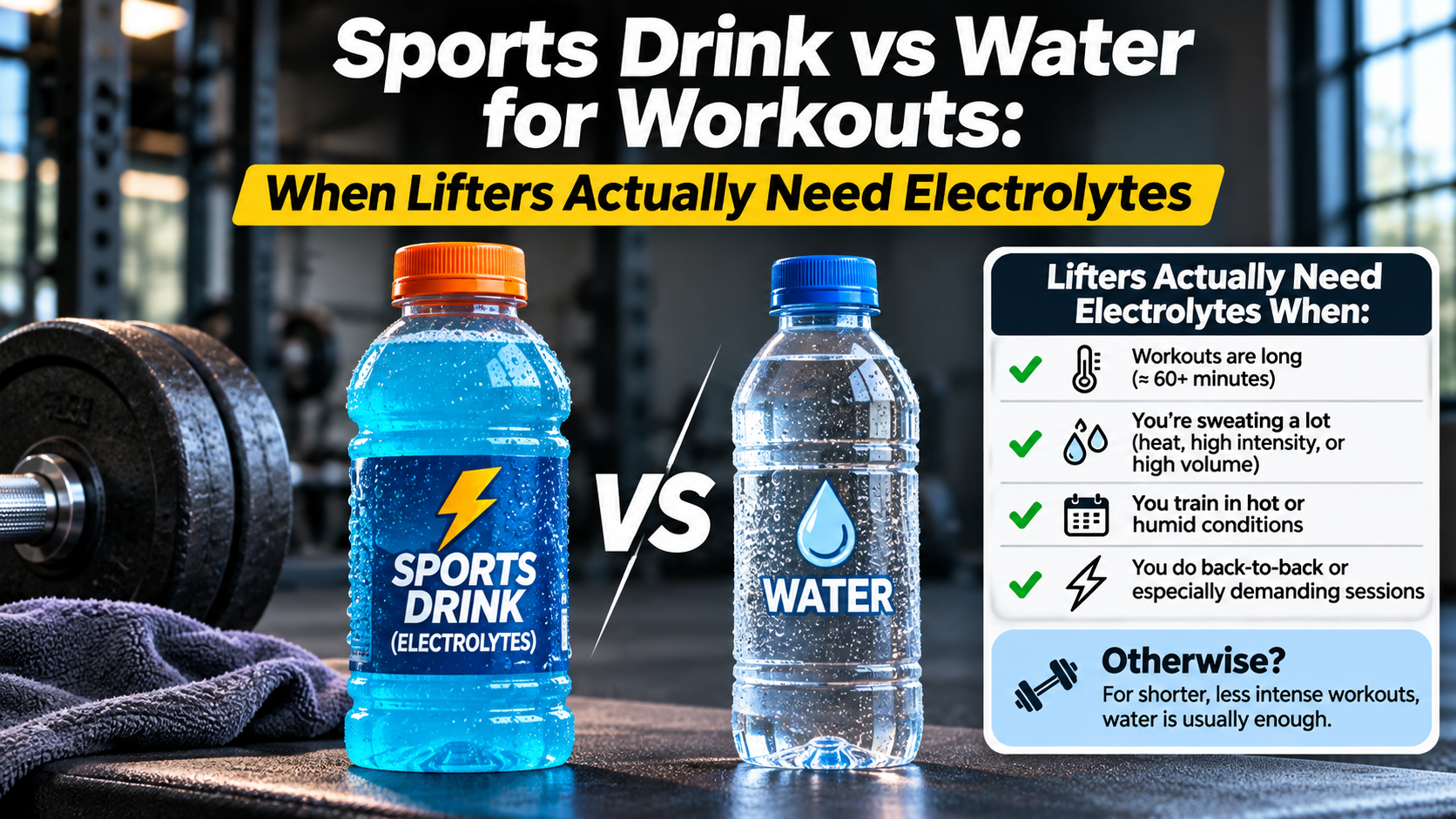
If your workout is a normal 45- to 60-minute lifting session, you probably do not need a sports drink. Plain water is usually enough. The answer changes when training runs longer, the environment is hot and humid, or you are losing a lot of sweat.
That is the practical takeaway from guidance on hydration in heat and sport. The CDC/NIOSH heat-stress hydration guide notes that water will almost always maintain hydration during heat exposure when regular meals replace salt losses. For longer exercise in the heat, the IOC consensus statement on sport in the heat says drinks containing carbohydrate and electrolytes can be useful.
Water or sports drink for workouts: the short answer
For most gym-goers, water should be the default choice.
A sports drink becomes more useful when one or more of these apply:
- Your session lasts more than about 1 hour
- You are training in hot or very humid conditions
- You are sweating heavily
- You have repeated sessions in the same day
- Your workout combines long conditioning work with lifting
That means the average air-conditioned gym workout and a long outdoor practice are not the same hydration problem.
When water is enough
Water is usually enough for:
- Standard resistance-training sessions
- Short home workouts
- Casual cardio
- Indoor training in cooler conditions
- Sessions where you have eaten normal meals before and after
This matters because many lifters assume every workout needs an electrolyte powder or sports drink. The evidence does not support that. According to NIOSH, water is generally sufficient as long as meals replace salt losses.
That also fits real gym life. If you train for 50 minutes, rest between sets, and go home for a meal, plain water is a sensible choice.
When a sports drink can help
Sports drinks make more sense when training is prolonged and sweaty, especially in the heat.
The IOC guidance says that during prolonged exercise over 1 hour in hot conditions, drinks with diluted carbohydrate and electrolytes may improve fluid intake and support performance. The same statement suggests roughly 30 to 60 g of carbohydrate per hour for exercise lasting more than 1 hour, and up to 90 g per hour in events lasting beyond 2.5 hours.
For sodium, the IOC notes that most athletes exercising longer than 1 hour should include a drink providing about 0.5 to 0.7 g sodium per litre, with higher amounts sometimes used in people who cramp in the heat or lose a lot of salt in sweat.
That does not mean every lifter needs a sports drink for a chest day. It means a sports drink can be a practical tool when the session is long, hot, and sweat-heavy.
Examples where a sports drink may be worth it
- A 90-minute basketball practice followed by accessory lifting
- A long outdoor conditioning session in tropical weather
- Two-a-day training where you need to recover for the next session
- A long weekend sport session where you are sweating through clothes and performance drops late in the workout
Do lifters actually need electrolytes?
Sometimes, not always.
Electrolytes matter most when sweat losses are high. Sodium is the main one to think about here. In a typical gym session, your usual meals will often cover what you need. In a long or very hot session, an electrolyte-containing drink can make more sense because you are replacing both fluid and sodium.
That is an important distinction. “Electrolytes” are not a magic muscle-building ingredient. They are mainly useful when the training situation creates larger fluid and salt losses than normal daily eating and drinking can comfortably cover during the session.
How much should you drink?
There is no perfect one-size-fits-all litre target for workouts. Sweat rates vary a lot based on body size, exercise intensity, clothing, heat, humidity, and acclimatization. The IOC statement explicitly notes that hydration strategies are often individualized.
A practical approach looks like this:
- Start training already hydrated
- Keep water available and sip during ordinary sessions
- Use a sports drink selectively for long, hot, or very sweaty training
- Replace fluids gradually after training, along with food
Starting well hydrated matters. NIOSH notes that if you begin dehydrated, it can be hard to catch up during the session.
After training, the goal is not just fluid. The IOC’s heat guidance also notes that recovery may involve replacing electrolytes, carbohydrate, and protein depending on the demands of the session.
Can dehydration hurt lifting performance?
Possibly, but the strength-training evidence is not as simple as many social-media posts make it sound.
A recent systematic review on acute dehydration and neuromuscular function found that dehydration appears to reduce maximal strength in some contexts and can impair fatigue resistance in endurance-type tasks, but the effects vary by test and protocol.
So the balanced takeaway is this: being underhydrated is not ideal, especially in the heat, but you also do not need dramatic rules like “a tiny drop in hydration ruins every workout.”
Why overdrinking is also a problem
More is not always better.
NIOSH warns against exceeding about 48 oz per hour, or roughly 1.4 L per hour, in heat-stress settings because very high fluid intake can contribute to low blood sodium. This is one reason “just drink as much as possible” is poor advice.
It is also why sports drinks are not a free pass. Drinking too much of any fluid can be a problem. The goal is to replace losses sensibly, not force fluid intake far beyond what the session calls for.
Sports drink vs energy drink: not the same thing
This is where many people get confused.
A sports drink is mainly about hydration, carbohydrate, and electrolytes. An energy drink is usually built around caffeine and often contains a lot of sugar. NIOSH specifically warns that many energy drinks can add strain in hot conditions.
So if your goal is hydration during training, do not assume an energy drink does the same job as a sports drink.
Daily water needs are only a starting point
The National Academies’ widely cited adequate intake figures for total daily water are 3.7 L per day for adult men and 2.7 L per day for adult women, including water from drinks and food. But those are baseline population-level figures for healthy adults, not a precise workout prescription.
Training, climate, body size, and sweat losses can all push your needs higher. That is why general daily hydration advice and workout hydration advice are related, but not identical.
A simple rule of thumb
- Water: best for most workouts
- Sports drink: useful for long, hot, very sweaty, or repeated sessions
- Energy drink: not your hydration plan
If your training is short to moderate and you eat normal meals, keep it simple and drink water. If your sessions stretch past an hour in serious heat and sweat, that is when electrolytes and some carbohydrate start to make more sense.
Sources
- Report Sets Dietary Intake Levels for Water, Salt, and Potassium To Maintain Health and Reduce Chronic Disease Risk
- Heat Stress: Hydration
- IOC consensus statement on recommendations and regulations for sport events in the heat
- IOC consensus statement on recommendations and regulations for sport events in the heat
- Does acute dehydration affect the neuromuscular function in healthy adults?-a systematic review.
- IOC consensus statement on recommendations and regulations for sport events in the heat