Last Updated on November 24, 2026
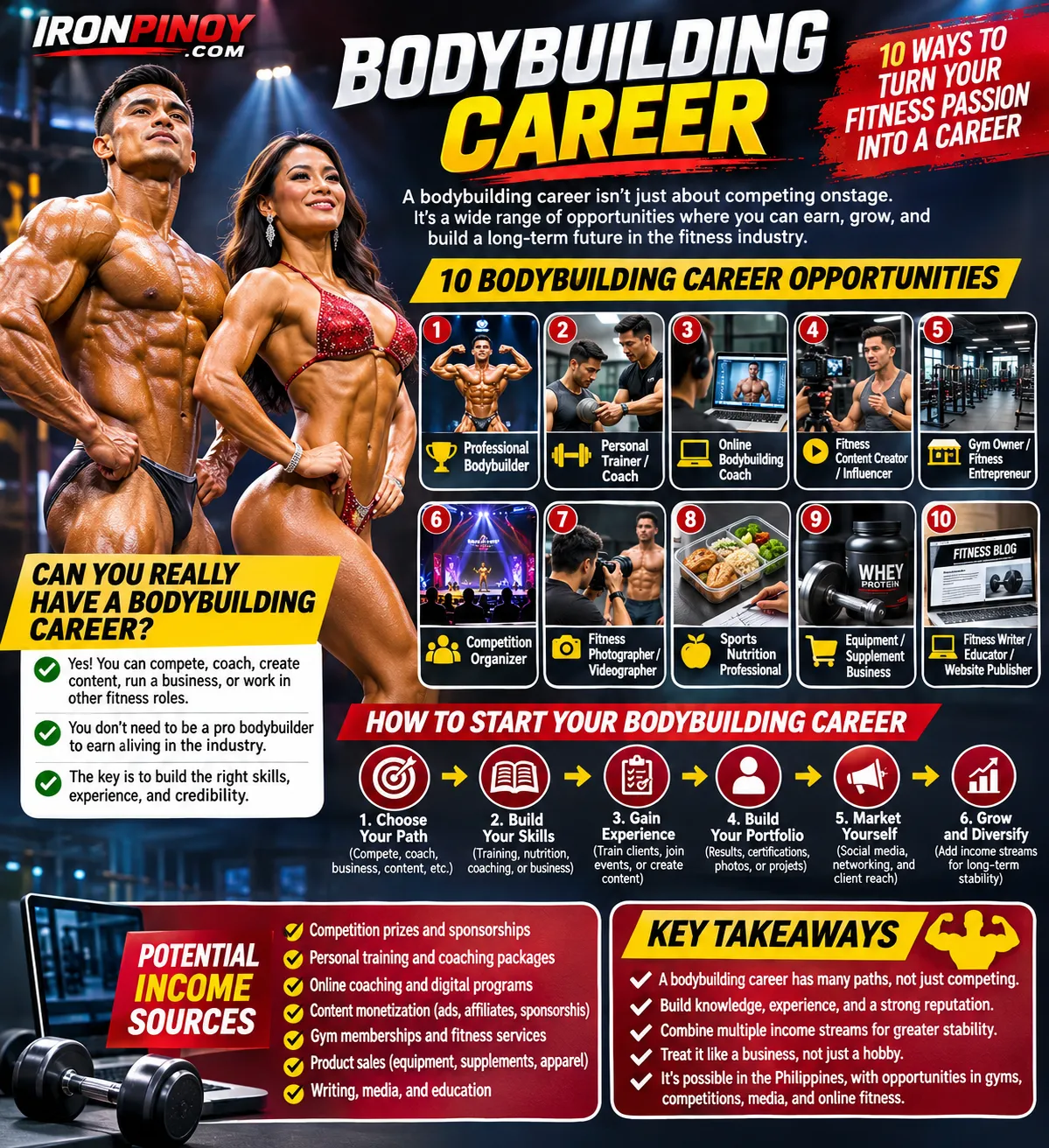
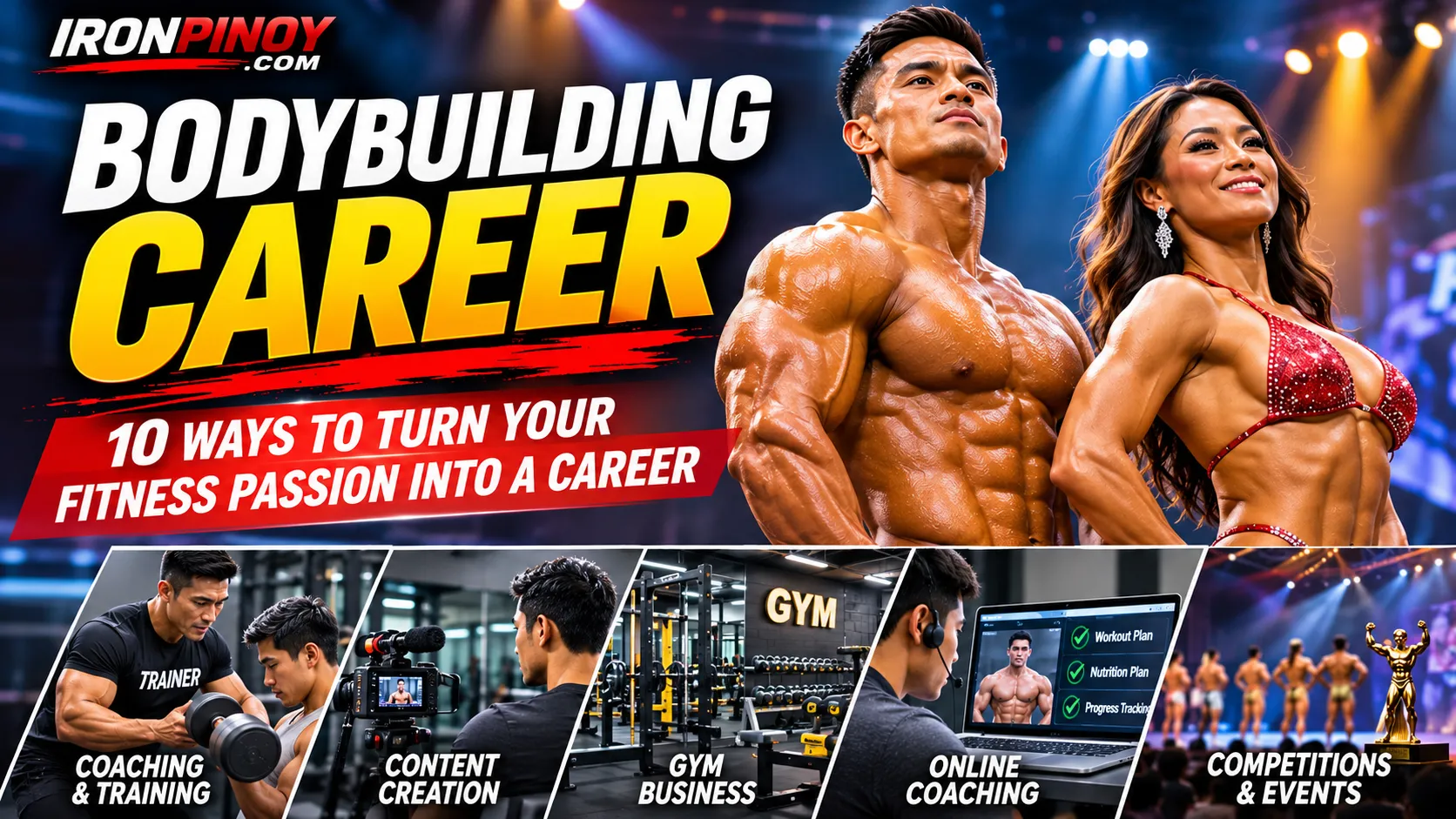
Can you really make a career out of bodybuilding? Yes. But becoming a professional bodybuilder is only one way to earn money from the sport.
A bodybuilding career can involve competing onstage, coaching clients, creating fitness content, running a gym, selling fitness products, or working with athletes. You don’t necessarily need a professional bodybuilding title or a massive physique to build a successful fitness career.
For aspiring Filipino bodybuilders, the opportunities extend beyond winning trophies. The key is knowing which career path fits your skills, experience, finances, and long-term goals.
In this guide, we’ll explain how to start a bodybuilding career, what professional bodybuilders actually do, how they earn money, and how you can enter the fitness industry even without competing.
Can Bodybuilding Be a Career?
Yes, bodybuilding can become a career, but there is an important difference between being a professional competitive bodybuilder and earning a living in the bodybuilding industry.
Professional competitive bodybuilding involves developing your physique, entering qualifying competitions, and potentially earning professional status through a recognized organization.
A career in the bodybuilding industry is broader. You might become a personal trainer, nutrition coach, gym owner, contest promoter, photographer, or fitness entrepreneur.
Some athletes combine several income streams. They compete, coach clients, promote brands, and create online content.
For most beginners, building marketable fitness skills while continuing to train is a more practical starting point than depending entirely on competition winnings.
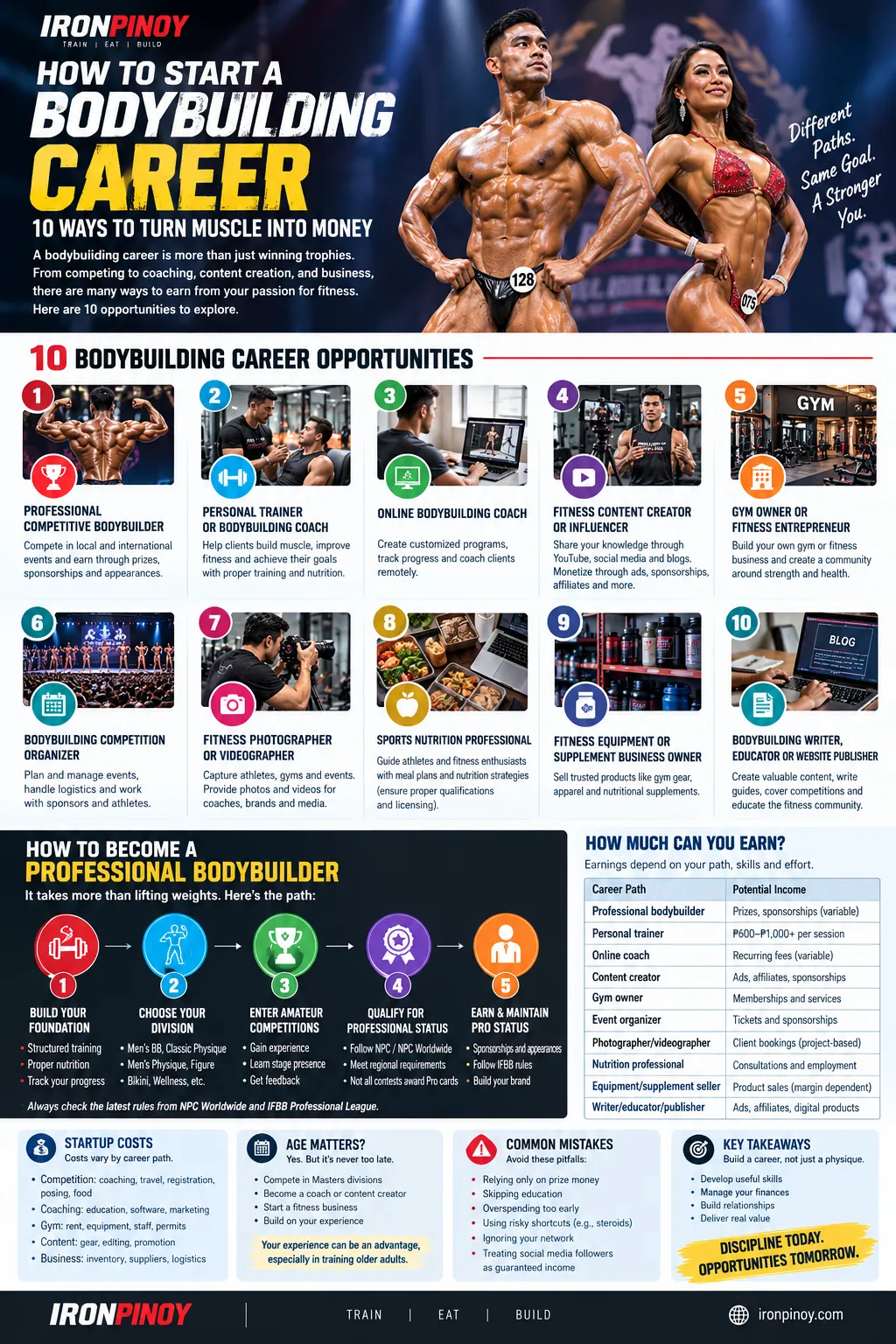
10 Bodybuilding Career Opportunities Worth Exploring
1. Professional Competitive Bodybuilder

Becoming a professional bodybuilder is the dream for many serious lifters.
Competitive bodybuilding rewards muscle development, symmetry, conditioning, proportions, and stage presentation. Athletes spend years building their physiques and preparing for competitions.
How to get started:
- Build a consistent resistance training program.
- Learn bodybuilding nutrition and recovery.
- Choose a competitive division that suits your physique.
- Attend local amateur bodybuilding events.
- Learn posing and contest preparation.
- Progress toward higher-level competitions.
If your goal is the IFBB Professional League, you must follow the qualifying route through NPC or NPC Worldwide competitions and earn eligibility for professional status at a designated qualifying event.
Winning a local contest does not automatically make you an IFBB Pro.
Income opportunities: Competition prizes, sponsorships, personal training, appearances, and brand partnerships.
Reality check: Competition expenses can exceed prize earnings. Most aspiring competitors need another income source while pursuing professional status.
2. Personal Trainer or Bodybuilding Coach
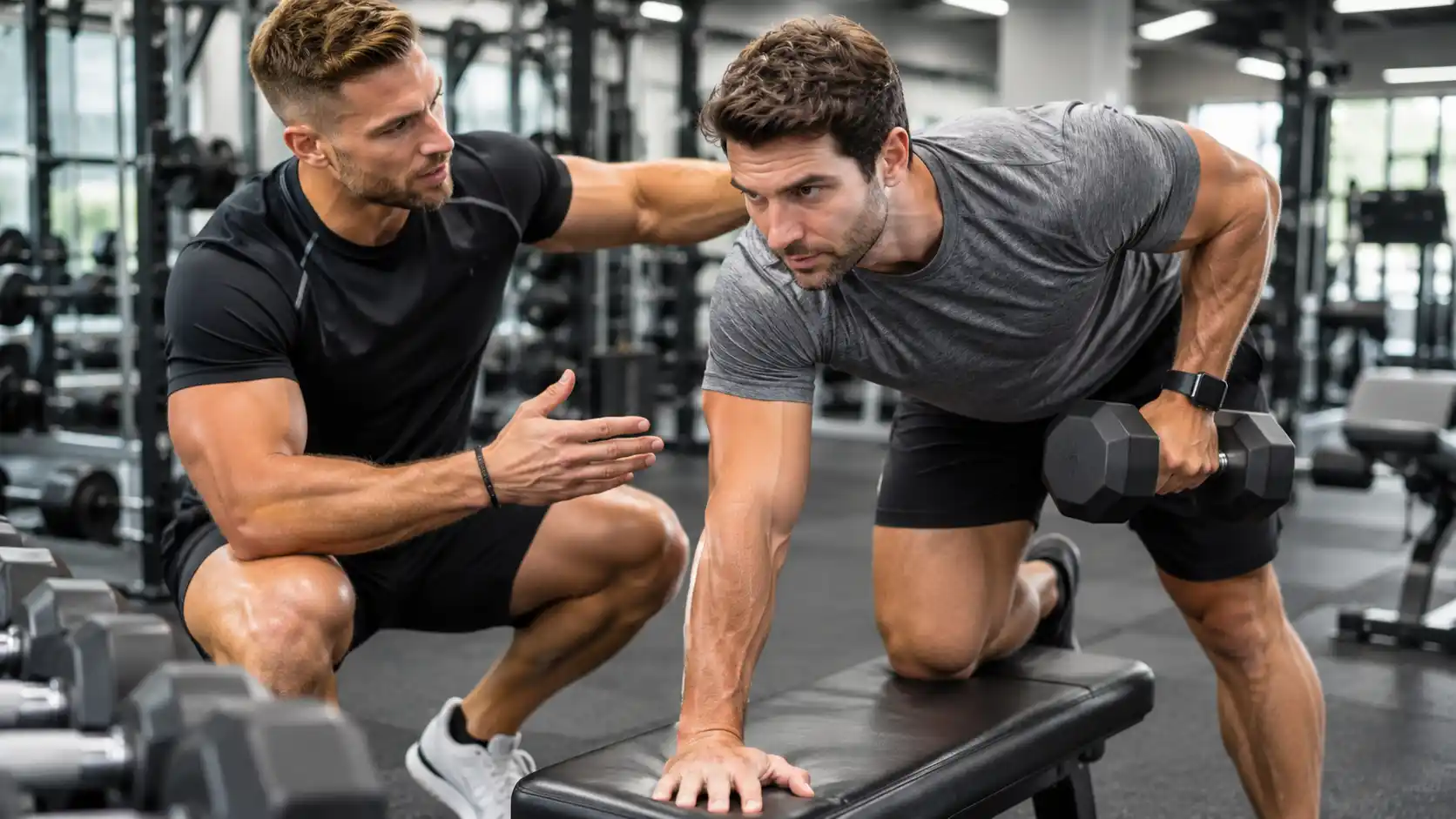
Personal training is one of the more accessible ways to turn bodybuilding knowledge into a business.
A qualified trainer helps clients develop strength, gain muscle, improve body composition, and train safely.
You can specialize in muscle hypertrophy, beginner strength training, bodybuilding preparation, or training for older adults.
How to start:
- Study anatomy, exercise technique, and program design.
- Obtain a reputable fitness certification.
- Learn client assessment and basic first aid.
- Gain supervised practical experience.
- Build a portfolio of genuine client results.
- Offer individual or small-group coaching.
A muscular physique can help demonstrate your commitment, but appearance alone does not establish coaching competence.
Income opportunities: One-on-one sessions, monthly coaching packages, online training, and group programs.
3. Online Bodybuilding Coach
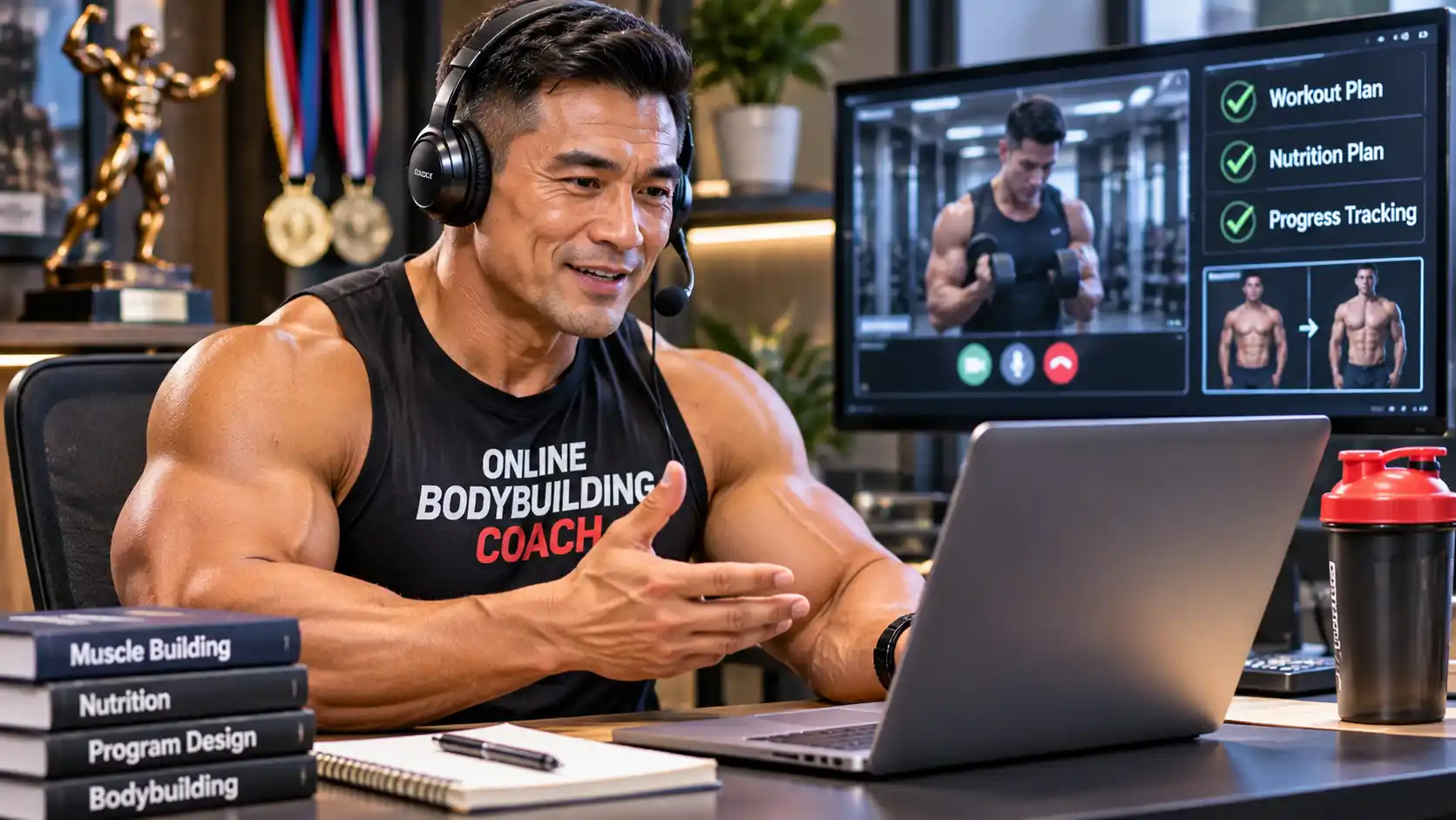
Online coaching allows trainers to work with clients without being physically present at every workout.
You can deliver customized training programs, monitor progress, review exercise videos, and adjust nutrition targets remotely.
Successful online coaches usually provide more than a generic workout spreadsheet. They offer regular feedback, accountability, and individualized programming.
Potential services include:
- Muscle-building workout plans
- Body recomposition coaching
- Strength progression tracking
- Exercise technique reviews
- Competition preparation support
Online coaching can scale beyond your immediate location, although client acquisition, retention, and service quality remain major challenges.
4. Fitness Content Creator or Influencer
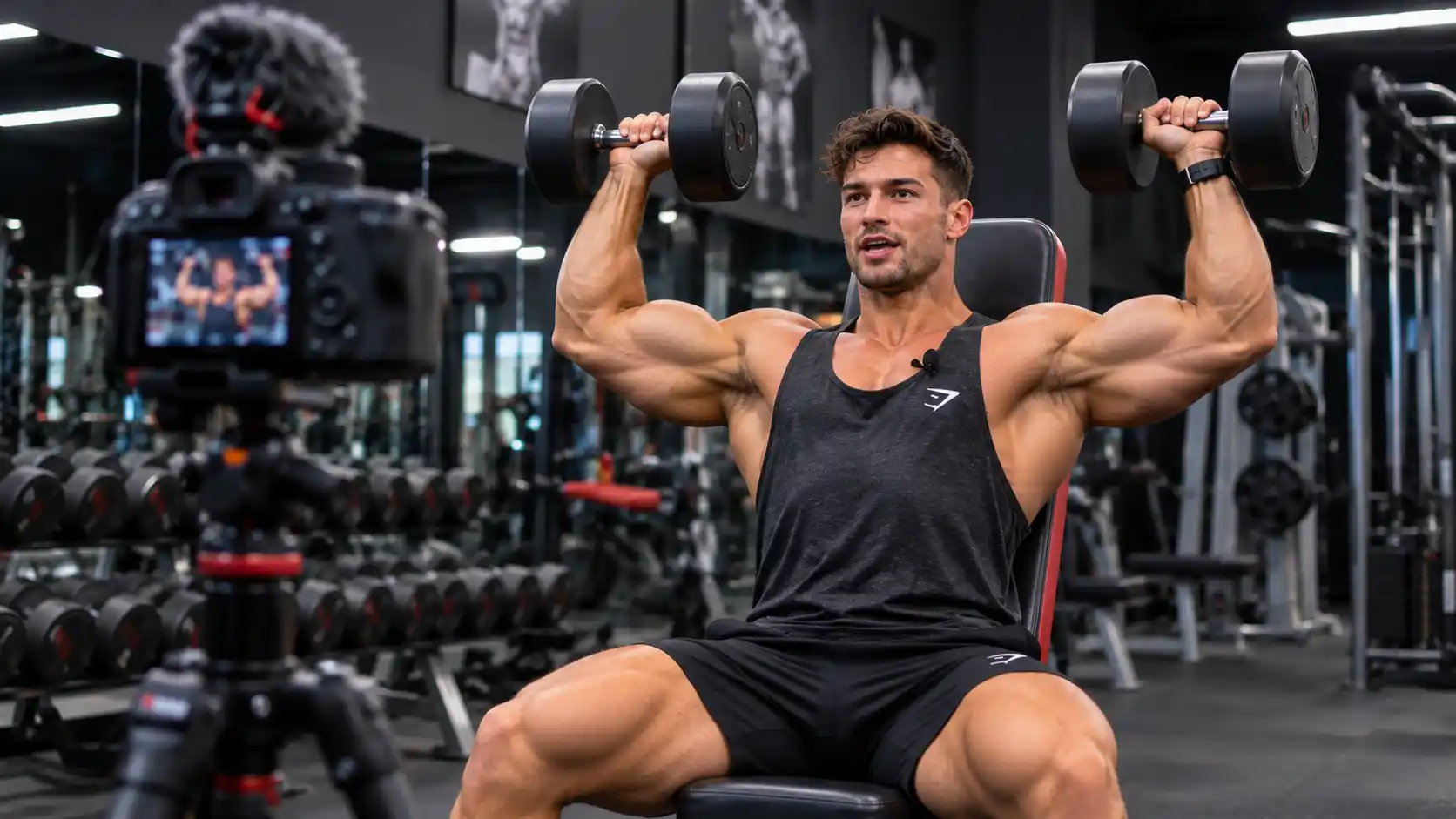
YouTube, Facebook, Instagram, TikTok, and fitness websites give bodybuilders opportunities to build an audience.
Content can include training tutorials, exercise demonstrations, competition coverage, nutrition guides, and realistic physique transformations.
You don’t need to be the biggest person in the gym. Clear explanations, useful information, and consistent publishing often matter more than appearance alone.
Ways to monetize fitness content:
- Advertising revenue
- Affiliate marketing
- Sponsored content
- Digital training guides
- Online coaching
- Paid communities
For Filipino creators, publishing in English, Filipino, or both can help reach different audiences.
However, audience growth and monetization are uncertain. Treat content creation as a business that requires time, testing, and consistency.
5. Gym Owner or Fitness Entrepreneur
Opening a gym is another possible bodybuilding career path.
Instead of relying on your own physique or competition results, you build a business that serves other fitness enthusiasts.
Possible concepts include bodybuilding gyms, strength-training facilities, personal training studios, and specialized coaching centers.
Running a gym involves much more than buying equipment. You must understand rent, staffing, maintenance, membership pricing, marketing, and cash flow.
Before investing, estimate your startup expenses, operating costs, member capacity, and break-even point.
Useful resource: IronPinoy offers bodybuilding and fitness information for people exploring the industry.
6. Bodybuilding Competition Organizer
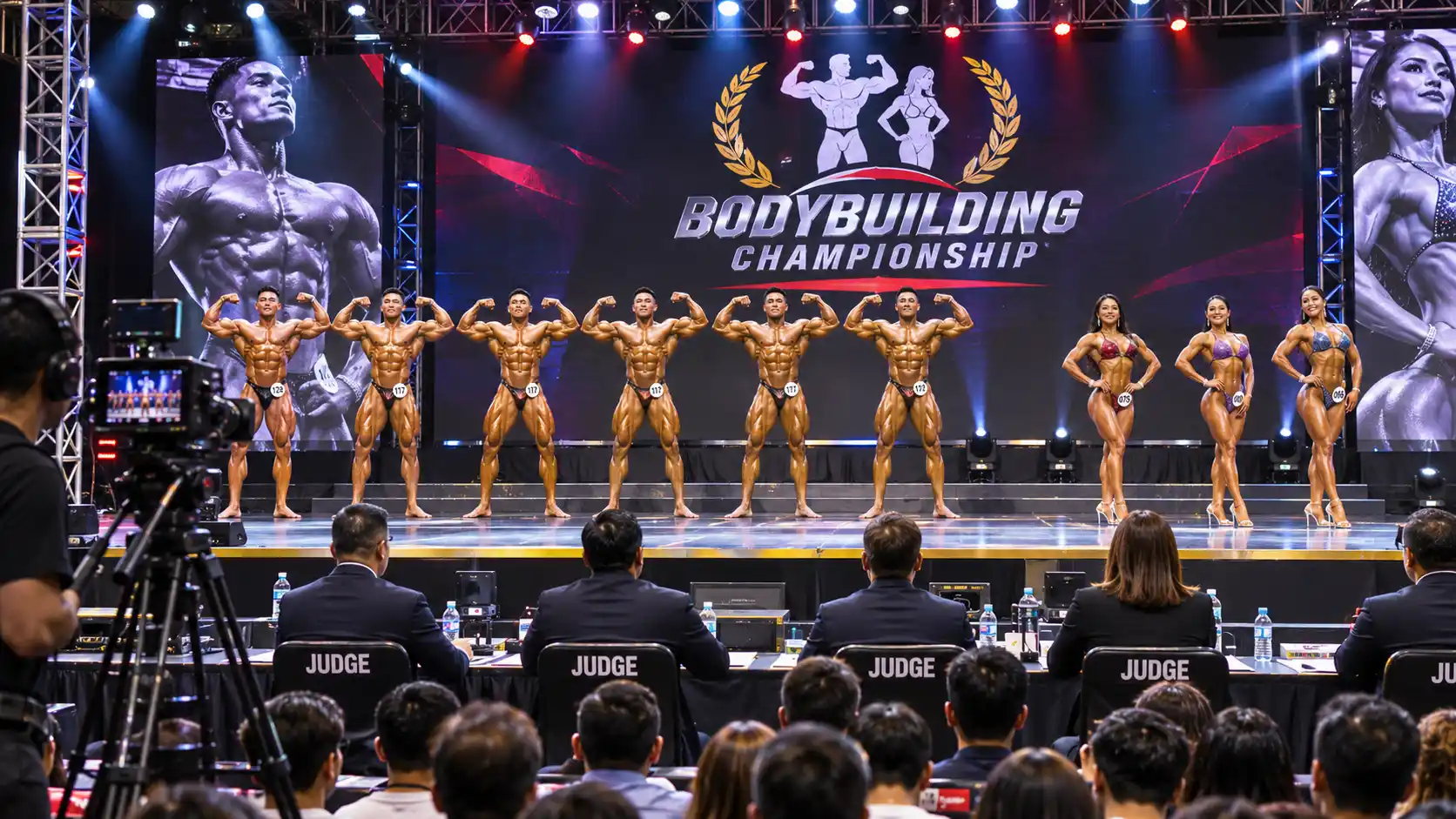
Bodybuilding events require organizers, sponsors, stage crews, photographers, judges, registration teams, and marketing professionals.
If you enjoy the competitive side of bodybuilding but don’t want to compete, event management could be a good fit.
Start by volunteering at local competitions, helping with athlete registration, or assisting established promoters.
Over time, you can develop experience in sponsorship sales, event logistics, ticketing, and competition production.
This career requires organizational and business skills rather than an elite physique.
7. Fitness Photographer or Videographer
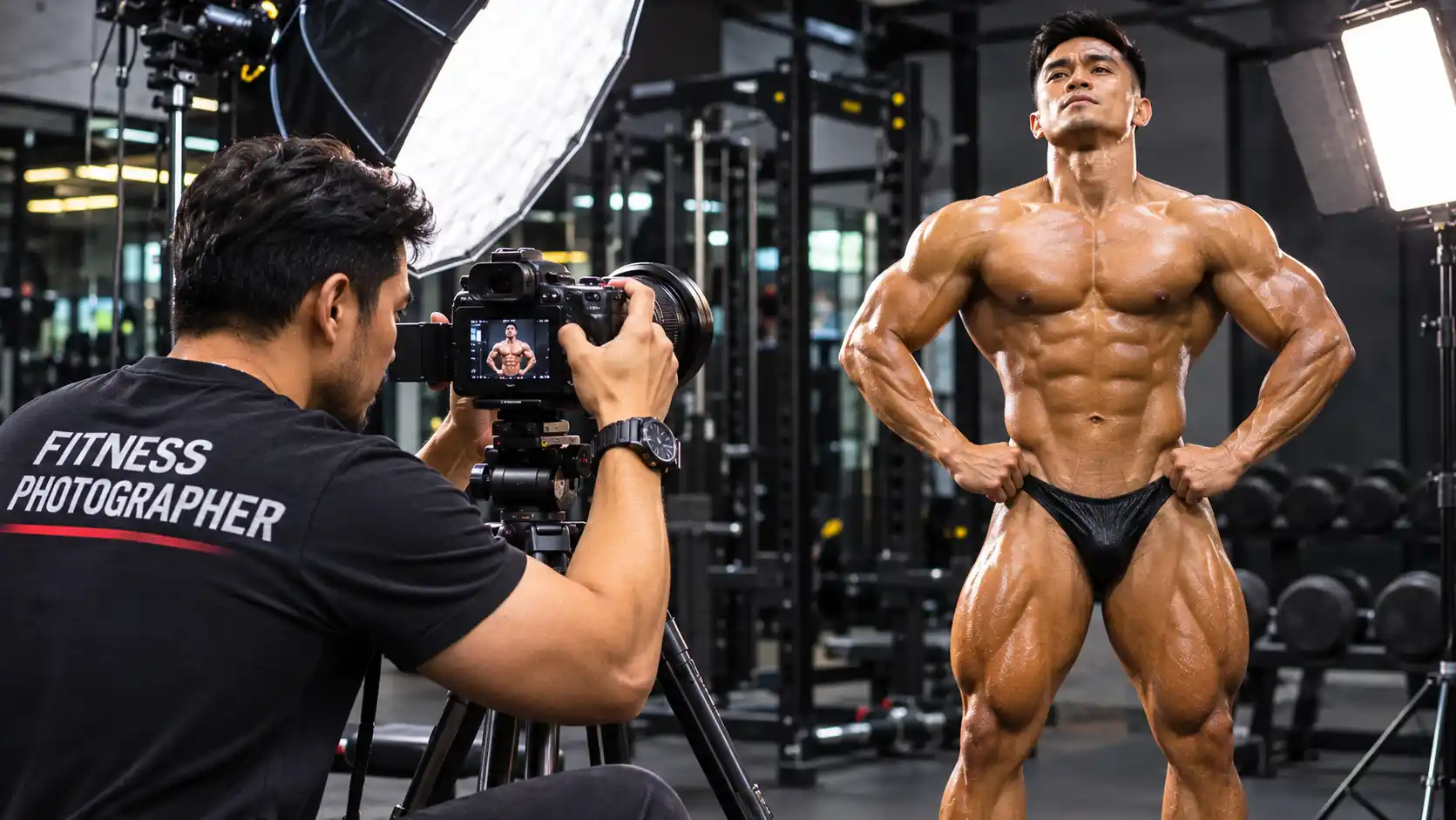
Bodybuilders need professional photos and videos for competition portfolios, social media, brand campaigns, and coaching businesses.
Fitness photography is a specialized field because lighting, posing, camera angles, and timing can dramatically affect how a physique appears.
You can provide gym photography, transformation shoots, event coverage, promotional videos, and social media production.
Building a portfolio with local athletes and gyms is a practical way to enter the market.
8. Sports Nutrition Professional
Nutrition is central to bodybuilding, creating opportunities for qualified professionals who understand performance nutrition.
Depending on your education, qualifications, and applicable regulations, you may work in nutrition education, meal planning, sports dietetics, or general fitness coaching.
However, there is an important distinction between providing general nutrition education and delivering individualized medical nutrition therapy.
In the Philippines, the practice of nutrition and dietetics is regulated. Anyone planning to provide professional dietetic services should understand the relevant licensing requirements.
Bodybuilding experience alone does not qualify someone to treat medical conditions or prescribe therapeutic diets.
9. Fitness Equipment or Supplement Business Owner
You can build a business around the products bodybuilders use.
Examples include gym accessories, lifting straps, training apparel, workout equipment, and legally marketed sports nutrition products.
Start by identifying a specific customer problem rather than stocking every possible product.
For example, a small business might focus on affordable lifting accessories for Filipino gym members.
Evaluate product quality, suppliers, customer service, margins, inventory costs, and applicable product regulations before launching.
10. Bodybuilding Writer, Educator, or Fitness Website Publisher
A bodybuilding career can also involve research, writing, education, and digital publishing.
Fitness websites need useful training guides, competition reports, exercise tutorials, athlete interviews, and nutrition explainers.
A publisher can monetize through advertising, affiliate partnerships, sponsorships, and digital products.
To succeed, focus on accurate information, firsthand experience, credible sources, and content that answers real questions.
This is particularly relevant for people who enjoy bodybuilding but have stronger skills in writing, marketing, technology, or education than competitive athletics.
How to Become a Professional Bodybuilder
If competing professionally is your main goal, the path requires more than lifting heavy weights.
Step 1: Build Your Foundation
Develop a structured training program around progressive overload, appropriate exercise volume, recovery, and consistent nutrition.
Track your strength, body weight, measurements, and physique changes.
Avoid rushing into extreme dieting or competition preparation before building sufficient muscle.
Step 2: Choose Your Bodybuilding Division
Common competitive divisions include Men’s Bodybuilding, Classic Physique, Men’s Physique, Women’s Bodybuilding, Women’s Physique, Figure, Bikini, and Wellness.
Each division has different judging standards and eligibility requirements.
Study the official rules of your chosen federation before planning your competitive journey.
Step 3: Enter Amateur Competitions
Amateur contests help you gain experience with posing, stage presentation, judging, and competition preparation.
You will also learn how your physique compares with other athletes in your division.
Your first competition should be treated as a learning opportunity rather than a guaranteed step toward a professional contract.
Step 4: Progress Through Qualifying Events
For the IFBB Professional League route, athletes must meet the current NPC or NPC Worldwide qualification requirements.
As of the 2026 NPC Worldwide rules, the Philippines is among the countries with a regional competition requirement for residents pursuing the relevant Pro Qualifier pathway.
Not every event awards professional status, and the number of available pro cards depends on the contest and division.
Check the official NPC Worldwide rules before registering.
Step 5: Earn and Maintain Professional Status
Qualifying for an IFBB Pro card is a major competitive milestone.
However, professional status does not guarantee sponsorship, a salary, or regular prize winnings.
Athletes must also follow the IFBB Professional League’s membership and eligibility requirements to participate in its professional contests.
How Much Money Can You Make From a Bodybuilding Career?
There is no fixed bodybuilding salary.
Earnings depend on whether you compete, coach, own a business, create content, or combine several activities.
| Career path | Main income source | Income predictability |
|---|---|---|
| Professional bodybuilder | Prizes and sponsorships | Low |
| Personal trainer | Client sessions and packages | Moderate with regular clients |
| Online coach | Recurring coaching fees | Variable |
| Fitness creator | Ads, affiliates, sponsorships | Highly variable |
| Gym owner | Memberships and services | Depends on profitability |
| Event organizer | Tickets and sponsorships | Project-based |
| Fitness photographer | Client bookings | Project-based |
| Nutrition professional | Consultations and employment | Depends on qualifications and clients |
| Equipment seller | Product sales | Depends on margins and demand |
| Fitness publisher | Ads, affiliates, digital products | Variable |
These are general business models, not guaranteed earnings.
Example: A Beginner Personal Trainer in the Philippines
Suppose a trainer charges ₱600 per session and delivers 40 paid sessions in a month.
Monthly gross revenue:
40 sessions × ₱600 = ₱24,000
If that trainer grows to 80 paid sessions:
80 × ₱600 = ₱48,000
These are illustrative calculations, not verified market averages or take-home salaries. Gym commissions, taxes, cancellations, transport, marketing, and other expenses reduce actual earnings.
The lesson is simple: building repeat business and managing costs matter as much as the price you charge.
How Much Does It Cost to Start a Bodybuilding Career?
The costs depend heavily on your chosen path.
A competitive athlete may need to budget for coaching, gym membership, food, travel, registration fees, posing instruction, and competition-related services.
An online coach might spend more on education, software, insurance, and marketing.
A gym owner needs substantially more capital for premises, equipment, staff, permits, and operating reserves.
Before spending money, separate essential investments from optional purchases.
A recognized qualification, appropriate safety training, and practical experience may provide more lasting value for an aspiring coach than expensive branding or equipment.
Bodybuilding Career Opportunities in the Philippines
The Philippines offers several possible starting points for people interested in bodybuilding-related work.
You can explore employment or freelance opportunities through commercial gyms, independent fitness studios, bodybuilding competitions, sports media, fitness retailers, and online coaching platforms.
For those interested in competing, research current Philippine bodybuilding events and the requirements of their respective organizers and federations.
For coaching careers, verify the qualifications employers accept. The Philippine Statistics Authority recognizes personal trainers and fitness instructors as occupations within its classification of fitness and recreation instructors.
The important point is to match your training, credentials, and experience to the actual job you want.
Can You Start a Bodybuilding Career After 30, 40, or 50?
Yes. A bodybuilding-related career does not have to begin in your twenties.
Older adults can compete in eligible masters divisions, become qualified coaches, create educational content, or operate fitness businesses.
In fact, experience working with older lifters may be useful for someone who wants to specialize in strength training for adults over 40 or 50.
However, age, health status, previous injuries, and recovery capacity should influence training decisions.
You do not need to train like a 25-year-old competitive bodybuilder to become a respected fitness professional.
Common Mistakes Aspiring Bodybuilders Make
Relying only on prize money. Most competitive athletes should not assume contest winnings will cover their expenses.
Ignoring education. Looking muscular does not automatically mean someone understands anatomy, coaching, nutrition, or injury prevention.
Spending too much too early. Expensive coaching, travel, and equipment can create financial pressure before a career produces income.
Using risky shortcuts. Anabolic steroids and other performance-enhancing drugs can carry significant health risks. They are not prerequisites for working in the fitness industry.
Failing to build a professional network. Relationships with gyms, athletes, clients, promoters, and other professionals can lead to opportunities.
Treating social media followers as guaranteed income. A large audience does not automatically create a profitable business.
A Practical 12-Month Bodybuilding Career Roadmap
| Timeline | Main objective | Suggested actions |
|---|---|---|
| Months 1–2 | Choose your direction | Compare competing, coaching, business, and content creation |
| Months 3–4 | Build skills | Study training science, qualifications, and industry requirements |
| Months 5–6 | Gain experience | Work with mentors, volunteer, or develop sample projects |
| Months 7–8 | Build your portfolio | Document legitimate results and develop your professional profile |
| Months 9–10 | Test your offer | Seek initial clients, projects, or relevant competition experience |
| Months 11–12 | Evaluate progress | Review income, expenses, results, and your next steps |
This is a planning framework, not a promise that you can become a professional competitor within one year.
Frequently Asked Questions About a Bodybuilding Career
Is bodybuilding a good career?
It can be, especially if you combine your interest in training with practical skills such as coaching, business management, content creation, or event production. Competitive bodybuilding alone offers less predictable income.
Can you make money from bodybuilding without competing?
Yes. Personal training, online coaching, gym ownership, fitness photography, content creation, and product sales are possible income sources.
Do professional bodybuilders receive a salary?
Not automatically. Professional status is not the same as salaried employment. Some athletes earn sponsorship income or prize money, but contracts and earnings vary.
How long does it take to become a professional bodybuilder?
There is no fixed timeline. Building a competitive physique may take many years, and earning professional status depends on performance and qualification rules. Many athletes never reach the professional level.
Do I need a degree to become a bodybuilder?
You generally do not need a university degree simply to train or compete in amateur bodybuilding. However, coaching, nutrition, healthcare, and other professional roles may require specific credentials or licenses.
Can I start bodybuilding at 40 or 50?
Yes. Many people begin resistance training later in life. Competition eligibility, appropriate programming, and medical considerations depend on individual circumstances.
Is a bodybuilding career possible in the Philippines?
Yes. Filipinos can pursue competitive bodybuilding and related careers in coaching, gym management, sports media, event organization, and fitness entrepreneurship. Research local opportunities and current qualification requirements before committing money.
Final Thoughts: Build a Career, Not Just a Physique
A successful bodybuilding career requires more than muscle size.
Training discipline can help you get started, but long-term opportunities come from developing useful skills, earning trust, managing money, and delivering value to others.
If you dream of becoming a professional bodybuilder, pursue that goal with a realistic understanding of the competition and financial demands.
If your main objective is to earn a living from fitness, consider coaching, content creation, entrepreneurship, or other roles that match your strengths.
The best bodybuilding career is one you can sustain financially, professionally, and physically.
For more training guides, bodybuilding information, and fitness resources, visit IronPinoy.com.