
Last Updated on November 17, 2026
How Long Does It Take to Build Muscle? You start lifting, eat a bit better, and expect the mirror to change fast. Then a few weeks pass and you wonder: am I actually building muscle, or just getting tired?
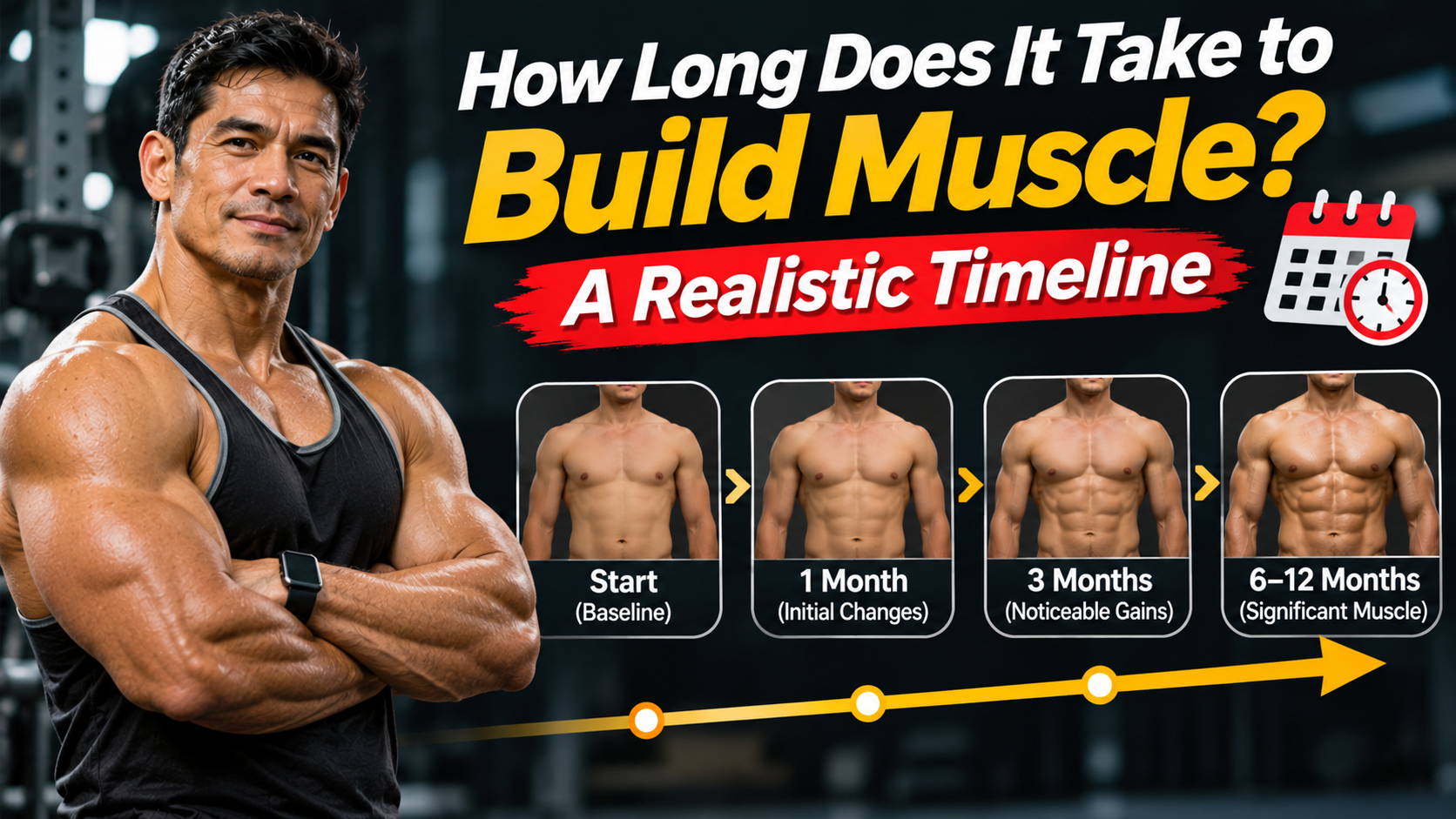
The evidence-based answer is more encouraging than most people think. For many beginners, strength improvements can show up within the first month, while measurable muscle growth may begin in roughly 3 to 4 weeks under research conditions. But visible physique changes usually take longer. In real life, many people need closer to 8 to 12 weeks or more before those changes look obvious enough to feel undeniable.
That does not mean nothing is happening early. It usually means progress starts under the surface before it becomes easy to see.
The short answer: muscle growth starts before it becomes obvious
A 2022 review on the time course of strength adaptation found that the first significant increase in strength appeared at an average of about 4.3 weeks across the included studies. In the same broad picture, measurable hypertrophy can also begin surprisingly early, although visible changes lag behind. You can see the strength review here: PubMed: time course of strength adaptation.
So if you are asking, “How long does it take to build muscle?” the practical answer is this:
- Strength often improves in about 3 to 5 weeks.
- Measurable muscle growth can begin in about 3 to 4 weeks.
- Visible muscular changes often take longer, commonly around 8 to 12 weeks or more.
That last point is a practical estimate, not a universal guarantee. Training age, body fat level, sleep, nutrition, genetics, and program quality all affect what you notice and when.
Why you may feel stronger before you look more muscular
This is one of the most normal parts of early training. In the first few weeks, your body often gets better at performing the lifts before your physique changes are obvious. Your technique improves, you become more coordinated, and you learn how to produce force more efficiently.
That is why many beginners can add reps or weight to the bar well before they look dramatically different. It is still real progress. In fact, it is often the first clear sign that your training is working.
If your squat, press, row, or pull-down numbers are steadily rising, do not dismiss that just because your arms do not look bigger after two weeks.
When does actual muscle growth begin?
Research suggests that hypertrophy can start earlier than the gym myths suggest. A study in previously sedentary men reported that significant skeletal muscle hypertrophy likely occurred around weeks 3 to 4 during an 8-week resistance training program, though the authors also noted that early changes may be partly influenced by swelling or edema. Here is the study: PubMed: time course of training-induced skeletal muscle hypertrophy.
Another study detected changes in muscle size after about 3 weeks of resistance training, and a separate short-term study reported small but detectable hypertrophy within seven training sessions in beginners under a design intended to reduce the confounding effect of muscle damage. These findings support the idea that muscle growth can begin early, even if it is too small to stand out in the mirror right away.
The key distinction is simple: lab-detectable hypertrophy is not the same as obvious visual transformation.
What makes muscle gain faster or slower?
Training status
Beginners often progress faster than experienced lifters. The jump from doing no resistance training to doing some is powerful. The 2026 ACSM Position Stand, which reviewed 137 systematic reviews covering more than 30,000 participants, concluded that resistance training improves muscle strength, size, power, endurance, balance, and physical function in healthy adults. It also reinforces a useful idea: consistency matters more than complexity for most people. See the overview here: ACSM Position Stand overview on PubMed.
Weekly volume
The same ACSM position stand found that hypertrophy was enhanced by higher weekly training volume, around 10 sets per muscle group per week or more. That does not mean everyone must start high, but it does give a practical target for people who want muscle growth rather than just a general health habit.
Training frequency
For health, the WHO physical activity guidelines recommend muscle-strengthening activities involving all major muscle groups on 2 or more days per week. For muscle gain, that minimum is a floor, not an optimized plan. In practice, training each major muscle at least twice per week is a solid starting point for many lifters.
Progressive overload
Beginners can grow from almost any sensible plan at first, but that does not last forever. A 2026 trial found that both progressive-overload and non-overload training increased muscle cross-sectional area over 12 weeks, but progressive overload produced greater growth later in the program, especially from sessions 18 to 24. In plain English: early training works, but continued challenge matters more as the weeks go on.
Individual variability
Not everyone grows at the same pace. Recent research also highlights considerable variation in hypertrophy response between individuals. So avoid fixed promises like “you will gain X kilograms of muscle per month.” Some people respond quickly. Others improve more gradually even with good habits.
A realistic muscle-building timeline
Weeks 1 to 4
Expect better workout performance first. You may feel more stable on basic lifts, get stronger, and notice a better pump. Some measurable hypertrophy may already be happening, but visible changes are usually subtle.
Weeks 5 to 8
This is often when beginners start noticing more convincing changes. You may see slightly fuller shoulders, arms, chest, back, or thighs. Clothes can start fitting differently. Your training log should show clear improvement if recovery is adequate.
Weeks 8 to 12 and beyond
For many lifters, this is when visual changes become easier to confirm. Progress photos, body measurements, and performance trends often tell the story more clearly than the mirror alone.
How to build muscle as fast as realistically possible
You do not need a complicated split or advanced techniques. Based on the evidence, a practical approach looks like this:
- Lift 2 to 4 days per week.
- Train each major muscle group at least twice per week.
- Accumulate roughly 10 weekly sets per muscle group as a useful starting target for hypertrophy.
- Use mostly basic exercises you can perform safely and repeat consistently.
- Progress by adding reps, load, or sets gradually over time.
- Stick with the plan for at least 8 to 12 weeks before deciding it “doesn’t work.”
The ACSM review also noted that training to failure, equipment type, and highly complex periodization did not consistently improve outcomes for the average healthy adult. That is good news if you are overwhelmed by internet advice. The basics still do most of the work.
Signs your program is working even if the mirror is slow
- You are lifting more weight with solid form.
- You are getting more reps with the same load.
- Your body measurements are slowly improving.
- Your progress photos look better over time.
- Your workouts feel more repeatable and less chaotic.
If those markers are moving in the right direction, stay patient. Muscle gain is often easier to interrupt than to accelerate.
Common mistakes that make muscle gain look slower than it is
- Changing programs every week.
- Doing too little weekly volume.
- Expecting visible changes before a full training block has passed.
- Confusing soreness with effectiveness.
- Comparing your first two months to someone else’s five years.
The bottom line: for most beginners and many returning lifters, strength gains usually show up first, measurable muscle growth can begin within a few weeks, and visible changes often require more patience. If you train consistently, use enough volume, and keep progressing, your body is probably adapting before the mirror fully catches up.
Sources
- Impact of Different Mechanical and Metabolic Stimuli on the Temporal Dynamics of Muscle Strength Adaptation
- American College of Sports Medicine Position Stand. Resistance Training Prescription for Muscle Function, Hypertrophy, and Physical Performance in Healthy Adults: An Overview of Reviews.
- An examination of the time course of training-induced skeletal muscle hypertrophy
- Early skeletal muscle hypertrophy and architectural changes in response to high-intensity resistance training
- The time course of short-term hypertrophy in the absence of eccentric muscle damage
- WHO guidelines on physical activity and sedentary behaviour
- Time course of muscle hypertrophy with and without progressive overload.
- Resistance training load does not determine resistance training-induced hypertrophy across upper and lower limbs in healthy young males
- WHO GUIDELINES ON