
Planning to start a gym business in the Philippines? Whether you’re considering a traditional neighborhood gym, a bodybuilding facility, or a modern fitness center, understanding the startup costs and potential profits is essential before investing your money.
Opening a gym can be a rewarding business for someone passionate about fitness. However, a gym with expensive equipment and an attractive interior won’t necessarily make money. Its success depends on membership growth, monthly operating expenses, location, equipment quality, and how efficiently the business is managed.
So, how much does it cost to open a gym in the Philippines in 2027?
A small neighborhood gym might require ₱500,000 to ₱1.2 million, while a mid-range commercial gym could require ₱1.5 million to ₱3.5 million or more. A premium fitness center can easily exceed ₱5 million.
In this guide, we’ll examine the costs of setting up a gym in Metro Manila, calculate how many members you’ll need to break even, estimate your return on investment (ROI), and explain how operating hours affect profitability.
We’ll also use a sample ₱3.45 million bodybuilding and strength gym to demonstrate how the business could perform over three years.
Important: The financial figures below are illustrative business-planning assumptions based on a proposed gym concept. They are not verified supplier quotations, actual operating results, or guaranteed investment returns.
How Much Capital Do You Need to Start a Gym in the Philippines?
The amount of money required depends on the gym’s size, target market, location, equipment, and facilities.
Here are estimated startup investment ranges:
| Type of Gym | Estimated Startup Capital |
|---|---|
| Small neighborhood gym | ₱500,000–₱1.2 million |
| Budget commercial gym | ₱1 million–₱2 million |
| Mid-range bodybuilding gym | ₱1.5 million–₱3.5 million |
| Boutique personal training studio | ₱800,000–₱2.5 million |
| Large premium gym | ₱5 million–₱15 million or more |
These amounts are preliminary planning ranges, not averages from a nationwide survey.
The difference between opening a basic neighborhood gym and a commercial fitness center can be substantial.
A smaller gym may operate with simple benches, free weights, squat racks, and locally fabricated machines. A modern commercial gym generally requires more sophisticated equipment, air conditioning, changing facilities, security, and a stronger interior design.
For this feasibility study, we’ll use a 180–200 square meter gym in Metro Manila, targeting regular gymgoers, bodybuilders, strength athletes, and fitness enthusiasts.
Sample Investment: Setting Up a Mid-Range Gym for ₱3.45 Million
Let’s assume we’re opening an independent gym in Mandaluyong, Pasig, or Quezon City.
The facility will feature:
- Commercial-grade strength training equipment
- Dumbbells, barbells, Olympic plates, and benches
- Squat racks, cable machines, and plate-loaded equipment
- Limited cardio equipment
- Air conditioning and proper ventilation
- Changing rooms, lockers, and a reception area
- CCTV, membership management, and access control
Estimated Gym Startup Expenses
| Startup Expense | Estimated Cost |
|---|---|
| Strength machines, free weights, and cardio | ₱1,150,000 |
| Renovation, rubber flooring, mirrors, and fit-out | ₱750,000 |
| Air conditioning and electrical works | ₱300,000 |
| Rental deposits and advance payments | ₱270,000 |
| CCTV, access control, and software | ₱80,000 |
| Business permits, registration, and professional fees | ₱70,000 |
| Pre-opening marketing | ₱80,000 |
| Construction and equipment contingency | ₱200,000 |
| Initial working capital | ₱550,000 |
| Total Estimated Capital | ₱3,450,000 |
The biggest investment is usually equipment and construction.
However, gym owners shouldn’t overlook working capital. Even if the gym opens successfully, membership revenue may take several months to cover monthly operating expenses.
The ₱550,000 working-capital allocation helps finance early operating losses and unexpected expenses.
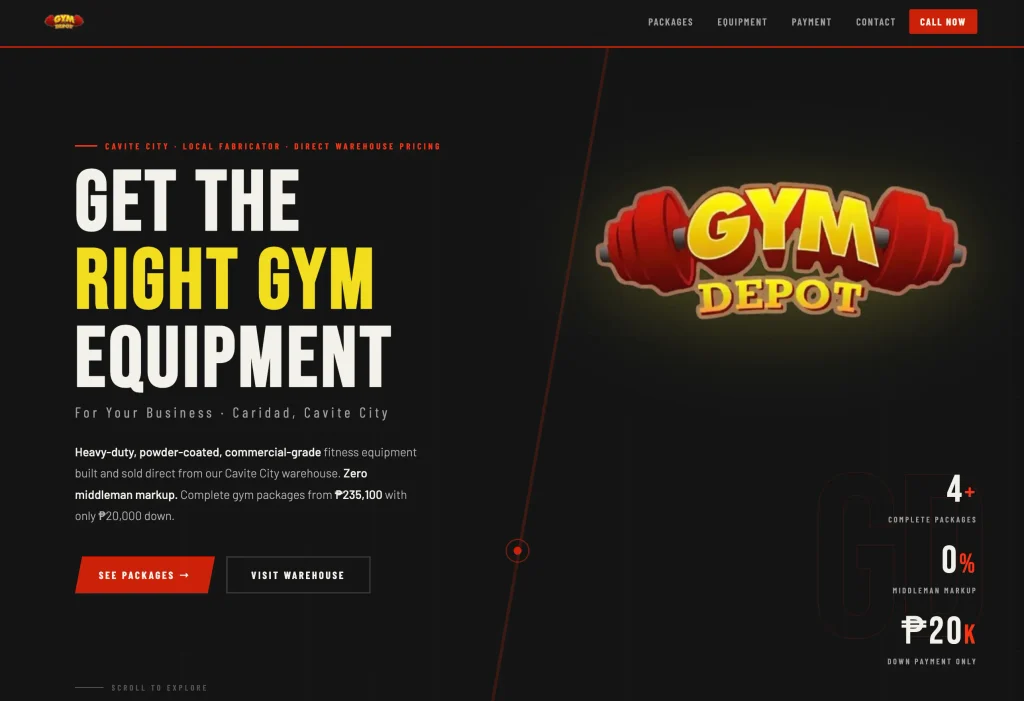
For equipment, locally manufactured commercial machines can potentially reduce initial investment. For example, Philippine equipment supplier Gym Depot advertises smaller gym packages starting at approximately ₱235,100. Those packages are designed for smaller facilities and should not be treated as the complete equipment budget for our 200-square-meter example.
What Equipment Does a Bodybuilding Gym Need?
A bodybuilding and strength-focused gym does not need dozens of treadmills or expensive luxury amenities to attract its target customers.
It needs equipment that members will actually use.
For a mid-range facility, the equipment priorities should include dumbbells, Olympic barbells and plates, adjustable benches, squat racks, Smith machines, cable stations, lat pulldown machines, rowing machines, leg presses, leg extension and curl machines, and selected chest and shoulder machines.
Good equipment spacing is equally important.
A gym may have 250 active paying members, but not all of them will train at the same time. Owners should design the facility around peak-hour traffic, particularly early mornings and evenings.
A crowded gym with long queues for basic equipment can quickly lose members.
Monthly Operating Expenses of a Gym in Metro Manila
Opening the gym is only the first part of the investment. The ongoing cost of operating it determines profitability.
A commercial gym must pay rent, employee salaries, electricity, water, equipment maintenance, insurance, and marketing expenses regardless of whether it has enough members.
For our sample gym, we’ll assume it operates from 6 AM to 10 PM, seven days a week.
Estimated Monthly Gym Operating Costs
| Monthly Expense | Estimated Cost |
|---|---|
| Rental and association dues | ₱80,000 |
| Employee salaries, benefits, and owner allowance | ₱80,000 |
| Electricity, water, and internet | ₱40,000 |
| Marketing and advertising | ₱15,000 |
| Cleaning supplies and consumables | ₱8,000 |
| Equipment maintenance reserve | ₱8,000 |
| Insurance, software, and administration | ₱9,000 |
| Total Monthly Expenses | ₱240,000 |
That means the business needs to generate enough monthly contribution to cover ₱240,000 before it produces an operating surplus.
Employee Salaries and Labor Costs
Staffing must account for reception, membership administration, cleaning, gym-floor supervision, and management.
As of November 2026, the National Capital Region’s current minimum daily wages under Wage Order NCR-28 range from ₱718 to ₱755, depending on the applicable establishment category.
Employers must also account for mandatory benefits, contributions, holidays, rest days, and appropriate overtime or night-shift pay.
Refer to the National Wages and Productivity Commission for the latest applicable wage requirements.
A gym operating 16 hours daily cannot rely on one employee working an entire day. Proper shift planning is essential.
How Much Should You Charge for Gym Membership?
Membership pricing directly affects how quickly the business can recover its startup investment.
Charge too little, and you’ll need hundreds of members to cover expenses. Charge too much, and customers may choose competing fitness centers.
The Philippine market already offers several pricing levels.
For example, published membership prices from GoGym, Smart Fit, and Fitness First illustrate how prices vary according to facilities, locations, and contract terms.
For a mid-range bodybuilding gym, we can consider the following pricing structure:
| Membership Package | Proposed Price |
|---|---|
| Day pass | ₱200 |
| Monthly unlimited | ₱1,800 |
| Three months | ₱5,100 |
| Six months | ₱9,600 |
| Annual membership | ₱18,000 |
| Student/off-peak membership | ₱1,400 per month |
| Personal training | ₱800–₱1,200 per session |
Longer packages encourage retention, although their discounts reduce average revenue per member.
Read our Philippines Gym Membership Price Guide 2027 for a broader comparison of gym membership costs.
How Many Gym Members Do You Need to Break Even?
This is one of the most important questions for any prospective gym owner.
The break-even point is when monthly income covers operating costs without generating an operating profit or loss.
For our example, assume:
- Monthly fixed operating costs: ₱240,000
- Net membership revenue per active member: ₱1,570
- Average ancillary contribution: ₱150 per member
- Payment and transaction costs: ₱30 per member
That produces a modeled monthly contribution of ₱1,690 per paying member.
To calculate break-even:
Break-even members = Monthly fixed costs ÷ Contribution per member
₱240,000 ÷ ₱1,690 = 142.01
Since a gym cannot have a fraction of a member, the business needs approximately 143 active paying members to break even.
This is an operating break-even estimate, not a full accounting break-even calculation that includes depreciation, borrowing costs, and taxes.
Profit Potential at Different Membership Levels
| Paying Members | Monthly Contribution | Operating Profit/Loss |
|---|---|---|
| 100 | ₱169,000 | −₱71,000 |
| 150 | ₱253,500 | ₱13,500 |
| 200 | ₱338,000 | ₱98,000 |
| 250 | ₱422,500 | ₱182,500 |
| 300 | ₱507,000 | ₱267,000 |
The difference between 150 and 250 members is significant.
At 150 members, the gym produces only a small operating surplus.
At 250 members, the same gym could generate approximately ₱182,500 monthly before income taxes, financing, depreciation, and additional capital spending.
This demonstrates why member retention is essential.
Do Gym Operating Hours Affect Profitability?
Absolutely.
Operating hours influence a gym’s staffing requirements, electricity consumption, maintenance, security, and potential membership demand.
A gym operating 24 hours daily has a different cost structure from one that opens for only 12 or 16 hours.
More operating hours do not automatically translate into more revenue.
Estimated Operating Cost by Gym Schedule
Using the original ₱240,000 monthly budget as a baseline:
| Operating Schedule | Hours Per Day | Estimated Monthly Costs | Break-Even Members |
|---|---|---|---|
| 6 AM–10 PM | 16 | ₱240,000 | 143 |
| 6 AM–12 midnight | 18 | ₱253,000 | 150 |
| 5 AM–12 midnight | 19 | ₱260,000 | 154 |
| 24 hours | 24 | ₱300,000 | 178 |
These are modeled cost sensitivities, not actual bills from operating gyms. The relationship is not perfectly linear because labor scheduling, air-conditioning requirements, and overnight security costs can change in steps.
Is a 24-Hour Gym More Profitable?
Not necessarily.
Consider a gym with 200 paying members contributing ₱338,000 monthly.
At 16 hours daily, operating profit is approximately ₱98,000.
If the gym operates 24 hours and costs increase to ₱300,000, operating profit falls to ₱38,000 unless the extended schedule attracts additional revenue.
The business would need approximately 36 additional paying members at the assumed contribution level to cover the extra ₱60,000 monthly expense.
For a new independent gym, starting with 6 AM–10 PM hours may be more practical than immediately operating around the clock.
Once membership grows, management can review actual check-in data to determine whether earlier opening, midnight closing, or 24-hour access makes financial sense.
Three-Year Gym Business Financial Projection
Let’s examine how our sample ₱3.45 million gym might perform over three years.
The projection assumes steady membership acquisition, reasonable retention, and gradual increases in operating expenses.
Membership Growth Assumptions
| Period | Average Active Members | Ending Members |
|---|---|---|
| Year 1 | 146 | 220 |
| Year 2 | 253 | 280 |
| Year 3 | 313 | 340 |
The gym opens with 65 paying members and gradually expands its customer base.
Marketing, referrals, personal training, good equipment maintenance, and an accessible location will all influence whether these targets can be achieved.
Projected Operating Cash Flow
| Financial Metric | Year 1 | Year 2 | Year 3 |
|---|---|---|---|
| Net operating contribution | ₱2.97M | ₱5.12M | ₱6.34M |
| Operating expenses | ₱2.88M | ₱3.06M | ₱3.24M |
| Annual operating surplus | ₱0.09M | ₱2.06M | ₱3.10M |
| Cumulative operating surplus | ₱0.09M | ₱2.15M | ₱5.24M |
The projection uses rounded annual figures and assumes a contribution of ₱1,690 per active member per month. Membership fees, discounts, ancillary services, and payment costs are incorporated into this contribution rather than added as separate revenue streams. Taxes on business profit, borrowing, depreciation, replacement capital expenditures, and distributions are excluded.
The first year is the most challenging.
Although the gym eventually reaches positive monthly operating cash flow, the early months generate losses while membership grows.
The business may not reach its first positive operating month until around Month 7.
This is precisely why a gym requires adequate working capital.
How Long Does It Take to Recover Your Gym Investment?
The time required to recover the initial investment depends on the gym’s monthly cash flow and enrollment growth.
In our base-case projection:
- Initial investment: ₱3,450,000
- Three-year cumulative operating surplus: approximately ₱5,240,000
- Operating cash generated beyond initial funding: approximately ₱1,790,000
- Three-year simple cash-on-investment return: approximately 52%
- Estimated simple operating cash payback: around 30 months
This looks promising, but it is important to understand what those figures mean.
The 52% projection is not a guaranteed after-tax ROI. It assumes the gym meets its growth targets and does not require substantial additional capital.
Actual returns could be lower because of taxes, equipment replacement, unexpected repairs, rent increases, loan interest, or slower membership growth.
What If the Gym Attracts Fewer Members?
A gym that attracts only 70% of its projected membership may produce a dramatically different result.
In a downside sensitivity test, cumulative operating cash generated over three years falls to approximately ₱920,000.
That would be insufficient to recover the ₱3.45 million initial investment.
The same scenario could require more working capital than originally allocated.
For this reason, prospective gym owners should prepare conservative, expected, and optimistic projections rather than relying on one forecast.
Can Personal Training Increase Gym Profit?
Yes. Personal training can create an additional source of income without requiring a much larger facility.
Suppose the gym sells 180 personal training sessions in a month at ₱800 per session.
That produces ₱144,000 in gross training revenue.
If trainers receive 60% and the gym receives 40%, the gym’s share would be ₱57,600 before other associated expenses.
Personal training also provides an opportunity to retain customers through structured exercise programs and progress monitoring.
However, avoid double-counting this revenue. If your financial forecast already includes average personal-training contributions per member, those amounts should not be added again.
Other potential revenue streams include day passes, small-group coaching, drinks, merchandise, and training-related products.
Choosing the Best Gym Location in Metro Manila
Location can make or break the business.
A gym in a busy commercial district may attract more customers, but expensive rent can absorb much of its profit.
A secondary commercial location near residential buildings, offices, and public transport may offer a better balance between operating costs and customer accessibility.
When evaluating a gym location, consider:
- Nearby residential and working populations
- Existing gyms and their membership fees
- Rental rates and lease conditions
- Accessibility and parking
- Electrical capacity and air-conditioning requirements
- Structural suitability for weights and exercise equipment
- Noise and vibration restrictions
- Local business permits and zoning requirements
For a bodybuilding-focused gym, structural capacity is particularly important.
Heavy dumbbells, barbells, power racks, and loaded machines create concentrated loads, and dropped weights generate impact and vibration.
A structural engineer should assess the premises before the lease is finalized.
What Permits Are Needed to Open a Gym?
Gym owners must comply with Philippine business registration, taxation, labor, and local government requirements.
Depending on the business structure and location, these can include DTI or SEC registration, BIR registration, barangay clearance, mayor’s or business permit, zoning and occupancy approvals, and fire safety documentation.
A gym should also consider liability insurance, equipment safety procedures, emergency response plans, and appropriate employment policies.
Tax treatment can materially affect the business model. Philippine VAT registration rules include a statutory threshold subject to adjustment, so owners should confirm the current rules with a qualified accountant instead of assuming that all membership collections are tax-free revenue.
How to Market a New Gym and Attract Members
Having quality equipment does not guarantee membership sales.
A new gym needs a marketing plan before opening.
Before Opening
Promote founding memberships, collect leads, create Google Business Profile and social media pages, and introduce the planned equipment and facilities.
A target of 50–75 paid founding memberships would help validate demand and generate early cash, although commitments should be supported by proper payment and refund terms.
During the First Six Months
Focus on local search visibility, customer referrals, introductory training, Google Maps reviews, and highly targeted social media advertising.
Gymgoers often choose a facility based on distance from home or work, equipment availability, cleanliness, and operating hours.
Long-Term Growth
As membership increases, encourage retention through community events, coaching, fitness challenges, and responsive customer service.
A gym with 250 members and 5% monthly churn loses approximately 13 members a month. Those cancellations must be replaced before the business can grow further.
Keeping existing customers satisfied can be as important as acquiring new ones.
Common Mistakes When Opening a Gym
Many gym businesses run into financial trouble because owners underestimate the costs involved.
Overspending on equipment, signing an expensive lease, setting membership fees too low, opening for unnecessarily long hours, and failing to reserve working capital can undermine an otherwise promising concept.
Another mistake is expanding too quickly.
A gym that is already struggling with monthly expenses should not automatically purchase additional machines or open another branch simply to attract attention.
Expansion should follow demonstrated customer demand and sustainable cash flow.
Try the IronPinoy Gym Business Feasibility Calculator

Open the IronPinoy Gym Business Feasibility Planner
Frequently Asked Questions
Is owning a gym profitable in the Philippines?
It can be, especially when a gym maintains enough paying members to cover its fixed operating expenses. However, profitability varies significantly with rental costs, pricing, retention, equipment investment, and staffing.
Can I open a gym with ₱500,000?
A small neighborhood gym may be possible with approximately ₱500,000 if the premises require little renovation and the business uses basic or secondhand equipment. This amount would usually be insufficient for the mid-range commercial gym described in this article.
How much does a small gym earn per month?
There is no reliable single figure for all Philippine gyms. For example, a gym generating ₱200,000 in monthly revenue but spending ₱180,000 would produce only ₱20,000 before other applicable costs and taxes. Revenue should not be confused with profit.
How many members does a gym need to become profitable?
In our sample model, approximately 143 paying members are needed to cover ₱240,000 in monthly fixed operating costs, assuming ₱1,690 in contribution per member.
A different gym could require significantly fewer or more members.
Is a 24-hour gym a good investment?
It depends on demand and operating expenses. A 24-hour gym may attract shift workers and customers who prefer overnight training, but it requires additional staffing, utilities, security, and operating controls. Extended hours should produce enough additional revenue to justify their cost.
How long does it take for a gym to recover its capital?
A successful gym might recover its original investment in three to five years, while some businesses may take longer or never recover their investment. Our illustrative base case reaches simple operating cash payback around Month 30, but that is an optimistic outcome dependent on sustained member growth.
Is a bodybuilding gym better than a general fitness gym?
A bodybuilding-focused gym may establish a strong customer community through specialized equipment and coaching. A general fitness gym may appeal to a wider market. Neither concept is automatically more profitable; the right choice depends on local demand and operating economics.
Final Thoughts: Is Opening a Gym Worth the Investment?
Opening a gym in the Philippines requires more than enthusiasm for bodybuilding or fitness.
It requires sufficient capital, a suitable location, a realistic membership strategy, and disciplined financial management.
A mid-range bodybuilding gym costing approximately ₱3.45 million could become profitable with a loyal membership base of 200–300 active customers. However, reaching that level requires consistent marketing, customer retention, and careful expense management.
Operating hours deserve particular attention. Staying open longer may improve convenience for members, but the additional staffing and utility costs must be justified by actual demand.
For first-time gym owners, beginning with a manageable facility and expanding when the business becomes financially stable may be a safer approach than investing heavily in a large commercial gym immediately.
Before signing a lease or purchasing equipment, calculate your break-even point, prepare a three-year cash-flow projection, and validate local membership demand.
A successful gym isn’t necessarily the one with the most expensive machines or the longest operating hours. It’s the one that consistently delivers value to members while maintaining a financially sustainable business.
References and Further Reading
- National Wages and Productivity Commission — NCR Wage Rates
- Gym Depot Philippines — Commercial Gym Equipment Packages
- GoGym Philippines — Membership Pricing
- Smart Fit Philippines — Membership Plans
- Fitness First Philippines — Membership Options
- Bureau of Internal Revenue — Revenue Regulations No. 3-2024
- IronPinoy — Philippines Gym Membership Price Guide 2027
Editorial note: Financial projections prepared as an illustrative independent gym feasibility model for IronPinoy. Market prices and applicable government requirements should be rechecked before making an investment decision.