

You do not need to train each muscle four times a week to grow. For hypertrophy, the big driver is usually your total weekly training volume, not frequency by itself. When weekly volume is matched, higher frequency has not shown a meaningful muscle-building advantage for most people in the research. That is why training a muscle around twice per week is a useful default for many lifters: it helps you spread out quality work without turning every session into a marathon.
A 2019 systematic review and meta-analysis found no significant hypertrophy benefit from higher training frequency when volume was equated. More recently, a 2026 ACSM guidance summary emphasized higher weekly volume for hypertrophy, using around 10 sets per muscle group as a practical benchmark for the average healthy adult.
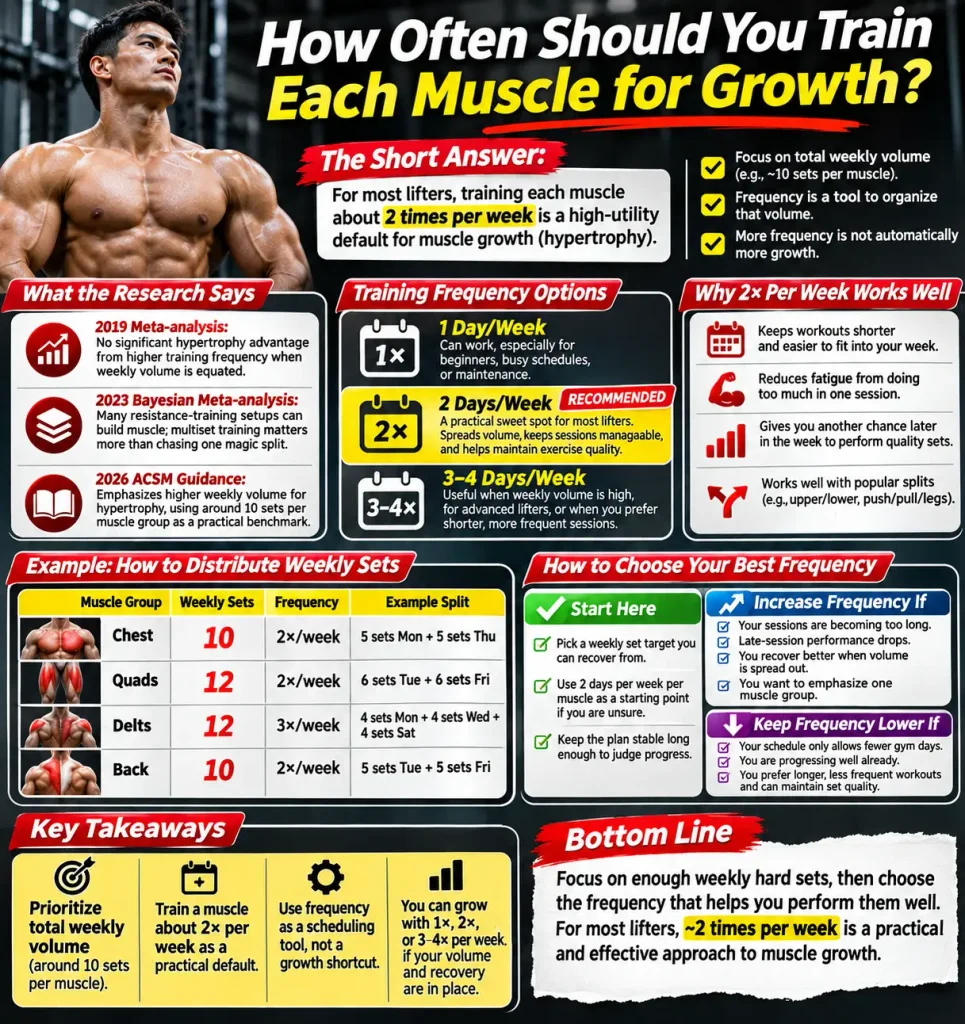
The short answer
If your goal is muscle growth, start by asking whether you are doing enough hard sets per muscle across the week and recovering well from them. Frequency matters mainly as a tool to organize that work.
For most people:
- 1 day per week per muscle can work.
- 2 days per week per muscle is a high-utility default.
- 3 to 4 days per week per muscle can make sense when weekly volume is high or when you want shorter sessions.
The key point is simple: more frequency is not automatically more growth.
What the research says about training frequency
The best-supported finding is that weekly volume carries more weight than frequency alone. In the 2019 meta-analysis on muscle training frequency, researchers concluded that when total weekly volume was held constant, training a muscle more often did not produce a meaningful hypertrophy advantage.
A 2023 Bayesian network meta-analysis reached a similar practical conclusion from a broader prescription angle: many resistance-training setups can build muscle, and multiset training matters more than chasing one magic split. The ACSM update also notes that equipment choice, training to failure, and complex periodization do not consistently change outcomes for the average healthy adult. That should reassure lifters who think they need a complicated plan before they can make progress.
There is still room for individual variation. A 2025 meta-regression reported that hypertrophy and strength tend to improve as weekly volume rises, but with diminishing returns. In that same analysis, frequency’s effect on hypertrophy was compatible with small or negligible effects in many cases.
Why 2 times per week works well for most lifters
Twice-weekly frequency is not a law. It is simply a practical sweet spot for many people.
If you aim for roughly 10 weekly sets for chest, doing all 10 sets on one day can work. But splitting them into 5 sets on Monday and 5 on Thursday often feels better and may help you maintain exercise quality across the week. That is a practical inference from the volume-first evidence, not proof that 2 times per week is mandatory.
Training a muscle twice weekly can help by:
- Keeping individual workouts shorter and easier to fit into a busy schedule
- Reducing the fatigue that can build up late in a long session
- Giving you another chance later in the week to perform quality sets
- Making it easier to use simple splits like upper/lower or push/pull/legs variations
If you are unsure where to start, 2 times per week is a reasonable default alongside an appropriate weekly set target. If you want a deeper look at volume, IronPinoy already has a guide on how many sets per muscle per week for hypertrophy.
When 1 day per week may be enough
Once-per-week training is often dismissed too quickly. Based on the volume-equated evidence, it can still build muscle, especially for beginners, people with limited schedules, or lifters in a maintenance phase.
The main tradeoff is practical, not magical: if your weekly target is high, fitting all of that work into one session can make performance drift downward by the end. If your chest day includes pressing, fly variations, warm-ups, and enough hard sets to challenge you, the session can become long and tiring.
Still, if training each muscle once a week is what you can follow consistently, that is far better than an “optimal” split you cannot sustain.
When 3 to 4 days per week makes sense
Higher frequency becomes more useful when you have more work to distribute. Advanced trainees often need higher weekly volume than beginners, and spreading that work over 3 or 4 exposures can make sessions more manageable.
This approach may be helpful if:
- You are specializing on a lagging muscle group
- Your current workouts are getting too long
- Your performance drops sharply in the second half of sessions
- You prefer shorter, more frequent gym visits
What higher frequency does not do is guarantee extra hypertrophy on its own. It is a scheduling tool for delivering weekly volume with better quality and recovery.
A simple way to distribute weekly sets
The table below is not a fixed prescription. It is a practical example based on the weekly-volume framing in the ACSM guidance.
| Muscle group | Weekly sets | Frequency | Example split |
|---|---|---|---|
| Chest | 10 | 2 days/week | 5 sets Monday + 5 sets Thursday |
| Quads | 12 | 2 days/week | 6 sets Tuesday + 6 sets Friday |
| Delts | 12 | 3 days/week | 4 sets Monday + 4 sets Wednesday + 4 sets Saturday |
| Back | 10 | 2 days/week | 5 sets Tuesday + 5 sets Friday |
If you need help choosing a broader structure, see IronPinoy’s guide to workout splits for muscle gain.
How to choose your best training frequency
A good rule is to choose the lowest frequency that lets you complete quality weekly volume consistently.
Start here
- Pick a weekly set target you can recover from.
- Use 2 days per week per muscle as a starting point if you are unsure.
- Keep the plan stable long enough to judge progress.
Increase frequency if
- Your sessions are becoming too long
- Late-session performance drops noticeably
- You recover better when volume is spread out
- You want to emphasize one muscle group without crushing one workout
Keep frequency lower if
- Your schedule only allows fewer gym days
- You are progressing well already
- You prefer longer, less frequent workouts and can maintain set quality
Bottom line
If you are stuck wondering whether once, twice, or four times per week is best, the evidence points to a calmer answer: focus on enough weekly hard sets, then choose the frequency that helps you perform them well. For most lifters, training each muscle about 2 times per week is a practical default, not because it is magically superior, but because it makes good training easier to execute.
If your weekly volume is appropriate and your recovery is in place, you can grow with several different frequencies. The best split is usually the one that lets you train hard, recover, and repeat it next week.
Sources
- How many times per week should a muscle be trained to maximize muscle hypertrophy? A systematic review and meta-analysis of studies examining the effects of resistance training frequency – PubMed
- Resistance training prescription for muscle strength and hypertrophy in healthy adults: a systematic review and Bayesian network meta-analysis – PubMed
- ACSM Publishes Updated Resistance Training Guidelines
- The Resistance Training Dose Response: Meta-Regressions Exploring the Effects of Weekly Volume and Frequency on Muscle Hypertrophy and Strength Gains.
- American College of Sports Medicine Position Stand. Resistance Training Prescription for Muscle Function, Hypertrophy, and Physical Performance in Healthy Adults: An Overview of Reviews.