
Last Updated on November 16, 2026
If you are trying to lose body fat without watching your hard-earned muscle disappear, protein matters more than usual. The practical short answer is this: many lifters cutting do well with about 1.6 to 2.2 grams of protein per kilogram of body weight per day. If you are already fairly lean, training hard, or using a more aggressive calorie deficit, going closer to the high end may make more sense.
That is higher than the minimum intake for general health, but cutting is different. When calories drop, the body has less energy available, and the risk of losing lean mass goes up. According to the 2026 International Society of Sports Nutrition position stand, resistance training and adequate protein intake are key tools for limiting lean-mass loss during a sustained calorie deficit.


The best protein target for most people while cutting
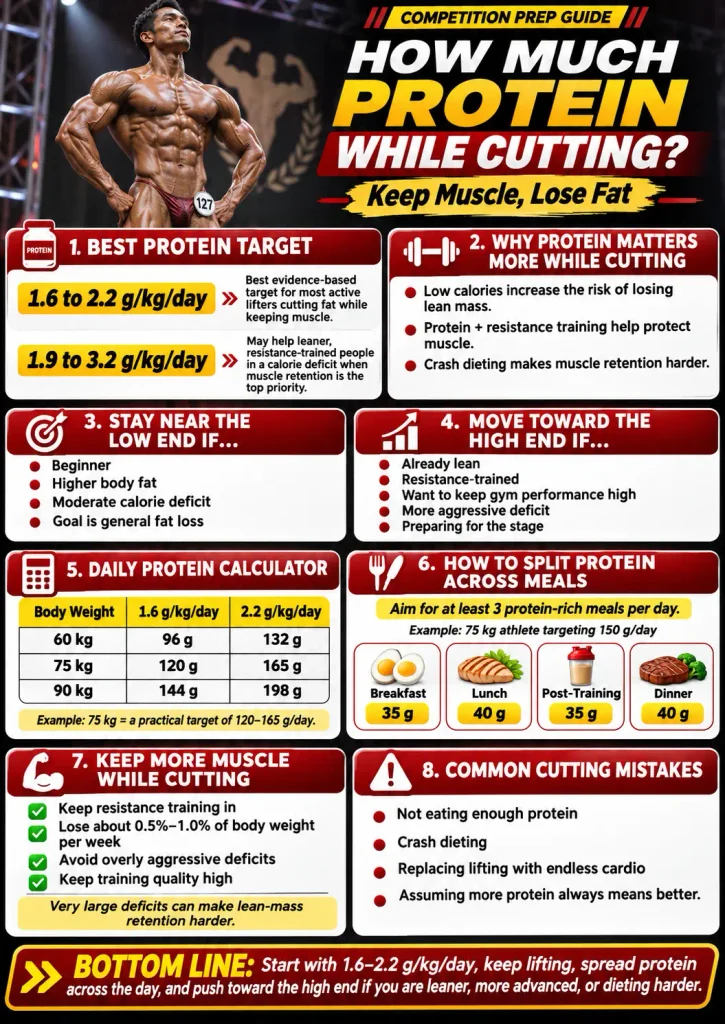
For most active gym-goers, a useful evidence-based target is 1.6 to 2.2 g/kg/day.
That range covers many people who lift weights and want to lose fat while keeping as much muscle as possible. The same ISSN position stand also notes that leaner, resistance-trained people in a hypocaloric phase may benefit from roughly 1.9 to 3.2 g/kg/day when retaining lean mass is the top priority.
That does not mean everyone needs extreme bodybuilding-style protein intakes. It means protein needs can rise when you combine three things: lower body fat, harder training, and a calorie deficit.
Why protein matters more when calories are low
A cut is not just “fat loss mode.” It is also a situation where muscle retention becomes harder. A 2022 meta-analysis found that energy deficiency reduces lean-mass gains from resistance training compared with training outside an energy deficit, even though strength gains may remain more similar. The same paper suggested that deficits above about 500 kcal per day make lean-mass retention or gain harder.
Exercise helps, too. In a 2026 systematic review and meta-analysis in overweight and obese adults, calorie restriction plus exercise preserved more fat-free mass than dieting alone. On average, exercise prevented a substantial portion of fat-free-mass loss, and the point estimates suggested strength training was especially useful.
So if your goal is to look leaner without ending up smaller, the foundation is simple:
Keep lifting weights
Eat enough protein
Avoid turning your cut into a crash diet
Who should stay near the low end or high end?
Stay closer to 1.6 g/kg/day if:
You are a beginner
You have plenty of body fat to lose
Your calorie deficit is moderate
Your main goal is general fat loss with basic muscle retention
Move closer to 2.2 g/kg/day, or sometimes above, if:
You are already relatively lean
You are resistance-trained
You want to keep gym performance as high as possible
Your deficit is more aggressive
You are preparing for a physique-focused goal
Older research often cited in sports nutrition estimated that lean, resistance-trained athletes dieting down may need around 2.3 to 3.1 g/kg of fat-free mass per day, not body weight. That distinction matters because this higher-end estimate applies most directly to leaner, harder-training populations, not everyone trying to lose a few kilos. You can see that context in this systematic review by Helms and colleagues.
How to calculate your daily protein intake
Use your body weight in kilograms and multiply by your target.
| Body weight | 1.6 g/kg/day | 2.2 g/kg/day |
|---|---|---|
| 60 kg (132 lb) | 96 g | 132 g |
| 75 kg (165 lb) | 120 g | 165 g |
| 90 kg (198 lb) | 144 g | 198 g |
Example: if you weigh 75 kg and want a practical cutting target, aiming for roughly 120 to 165 g of protein per day is a reasonable starting range. If you are leaner and dieting hard, you would usually push toward the upper end rather than the lower end.
How to split protein across meals
Total daily intake matters more than chasing perfect timing. Still, the ISSN position stand says that physically active people may benefit from spreading protein across at least three protein-rich meals or eating occasions per day during sustained dieting.
In practice, that usually means 3 to 5 meals with meaningful protein in each one. For the same 75 kg person targeting 150 g per day, that could look like:
Breakfast: 35 g
Lunch: 40 g
Post-training meal: 35 g
Dinner: 40 g
If you want help thinking about protein distribution, this recent IronPinoy guide on how much protein per meal for muscle growth is a useful companion read.
What else helps you keep muscle while cutting
1. Keep resistance training in
Do not make the mistake of replacing lifting with endless cardio. The evidence supports exercise, especially strength training, as a major protector of fat-free mass during calorie restriction.
2. Use a moderate rate of loss
The 2026 ISSN position stand supports roughly 0.5% to 1.0% of body weight per week as a useful target in athletic populations. That is not a rigid rule, but it is a good reality check. Fast weight loss is more likely to come with a bigger performance and muscle-retention tradeoff.
3. Avoid overly aggressive deficits
If keeping muscle is a priority, a huge calorie deficit is usually a bad bargain. Based on the 2022 meta-analysis, going much beyond roughly 500 kcal per day may make lean-mass retention harder.
4. Keep your training quality up
You do not need perfect workouts during a cut, but you do need productive ones. If your diet is so aggressive that your loads, energy, and recovery collapse, muscle retention becomes harder no matter how high your protein intake is.
Common mistakes when cutting
Eating “clean” but not enough protein. A healthy-looking diet can still fall short on protein.
Crash dieting. Bigger deficits are not automatically better if muscle retention matters.
Dropping heavy lifting. Cardio can help with energy expenditure, but it should not replace resistance training.
Assuming more protein always means better results. Higher protein helps within a sensible range, but it does not guarantee muscle retention.
The bottom line
If you are cutting and want to keep muscle, start with 1.6 to 2.2 g/kg/day of protein and keep lifting. Move toward the higher end if you are leaner, more advanced, or dieting harder. Spread that protein across at least three meals, keep your calorie deficit reasonable, and judge your plan by more than just scale weight.
Protein is not magic, but during a cut it is one of the most useful nutritional levers you can control.
Sources
- International Society of Sports Nutrition position stand: diets for body weight reduction
- Effects of Calorie Restriction With and Without Strength, Endurance or Mixed Training on Fat-Free and Skeletal Muscle Mass in Overweight or Obese Individuals-A Systematic Review With Pairwise Meta-Analysis and Network Meta-Analysis of Randomized Controlled Studies – PubMed
- Energy deficiency impairs resistance training gains in lean mass but not strength: A meta-analysis and meta-regression – PubMed
- A systematic review of dietary protein during caloric restriction in resistance trained lean athletes: a case for higher intakes
- Higher compared with lower dietary protein during an energy deficit combined with intense exercise promotes greater lean mass gain and fat mass loss: a randomized trial
- International Society of Sports Nutrition position stand: diets for body weight reduction
- International Society of Sports Nutrition position stand: diets for body weight reduction