Last Updated on November 17, 2026
Want to build muscle, get stronger, or lose body fat but don’t know how to organize your workouts? The IronPinoy Free Gym Workout Planner helps you turn your fitness goals into a structured training program without spending hours researching exercises or building complicated spreadsheets.
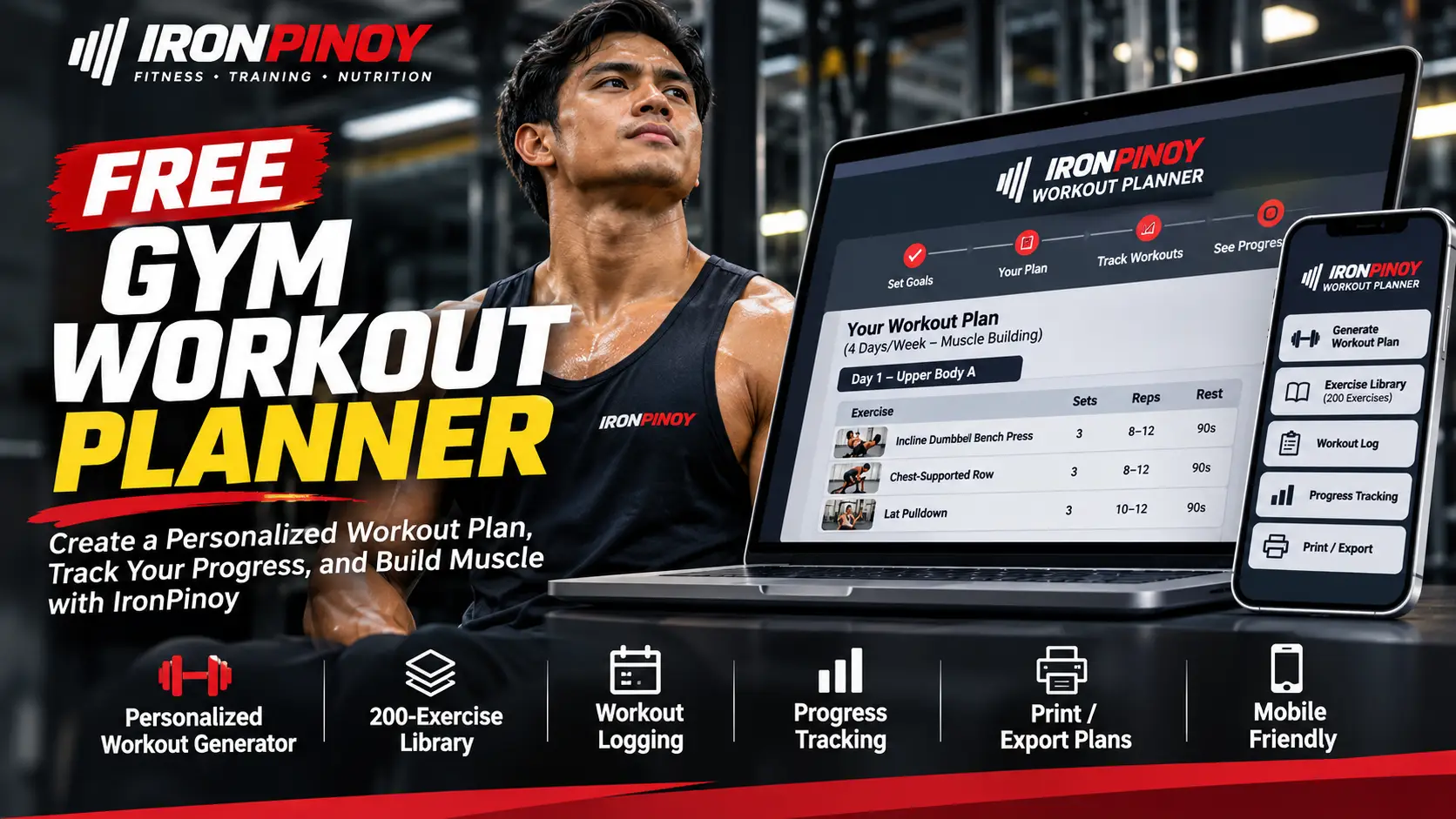
Designed for Filipino fitness enthusiasts, beginners, intermediate lifters, and experienced bodybuilders, the IronPinoy Gym Workout Planner is a free online workout planning and tracking tool with a library of 200 exercises.
Whether you’re starting your first gym membership, returning to weight training, or looking for a better way to monitor progressive overload, the planner helps you organize your workouts and track your performance.
You can generate a training schedule, explore exercises, record weights and repetitions, review progress, and print or export your program directly from your browser.
What Is the IronPinoy Free Gym Workout Planner?
The IronPinoy Gym Workout Planner is a web-based fitness tool developed for IronPinoy.com. It combines a workout plan generator, exercise library, and gym workout tracker in one interface.
Instead of relying on a generic workout chart or trying to remember which exercises you performed last week, you can build a program based on your training preferences and maintain a record of your workouts.
The planner lets you choose:
- Training goal: Muscle building, strength development, fat loss, or general fitness.
- Experience level: Beginner, intermediate, or advanced.
- Workout frequency: Two to six training days per week.
- Session duration: Select how much time you have for each workout.
- Available equipment: Choose equipment settings that match your training environment.
- Muscle emphasis: Prioritize specific muscle groups or build a balanced routine.
The generator uses these settings to create a structured training program using exercises from the IronPinoy library.
It is designed to help you make better training decisions, but it does not replace personalized guidance from a qualified trainer or healthcare professional.
Why Use a Gym Workout Planner?
Walking into a gym without a program can make it difficult to train consistently.
You might repeat your favorite chest exercises, neglect your legs, change your routine too often, or forget how much weight you lifted during your previous session.
A structured workout plan solves several common problems.
1. You Know What to Train Every Day
A workout planner creates a clear schedule so you know which muscle groups and exercises to prioritize.
For example, instead of randomly training chest and biceps whenever you visit the gym, you might follow a four-day upper/lower program that distributes training across the week.
2. You Can Track Progressive Overload
Progressive overload means gradually increasing the demands of training as your strength and ability improve.
This might involve lifting slightly heavier weights, completing more repetitions with the same weight, or improving movement quality.
Keeping workout records helps you identify when an increase is appropriate.
3. You Can Manage Training Volume
Training volume matters for muscle growth, but more isn’t always better.
The American College of Sports Medicine’s 2026 position stand found that greater weekly training volume can support hypertrophy, with approximately 10 or more sets per muscle group per week often providing a useful reference point.
However, the appropriate amount of training depends on your experience, recovery, goals, and individual response.
4. You Can Build a More Balanced Program
A good routine trains major movement patterns and muscle groups rather than focusing exclusively on the muscles you enjoy exercising.
This includes the chest, back, shoulders, arms, quadriceps, hamstrings, glutes, calves, and core.
5. You Have a Record of Your Progress
Recording your workouts gives you a clearer picture of improvement over weeks and months.
Instead of guessing whether you’re getting stronger, you can compare your previous training sessions.
IronPinoy Workout Planner Features
Personalized Workout Plan Generator
The workout generator is the main feature of the IronPinoy planner.
It creates a training schedule using your fitness goal, experience level, weekly availability, equipment, and muscle-group preferences.
For example, an intermediate lifter wanting muscle growth with four available training days could use an upper/lower split.
Someone with fewer available days could choose a shorter full-body training schedule.
The purpose is to make workout planning more practical, especially for people juggling work, family responsibilities, and gym sessions.
Exercise Library With 200 Exercises
IronPinoy Gym Workout Planner v1.1 includes a WordPress-managed library of 200 exercises.
The library covers:
| Muscle Group | Number of Exercises |
|---|---|
| Chest | 30 |
| Back | 32 |
| Shoulders | 30 |
| Arms | 32 |
| Legs and glutes | 54 |
| Core and abdominals | 22 |
| Total | 200 |
The database includes exercise information such as muscle groups, equipment, difficulty, instructions, and available exercise alternatives.
Examples include dumbbell bench presses, cable rows, lat pulldowns, shoulder raises, leg presses, curls, triceps extensions, and core exercises.
Exercises are searchable and filterable, making it easier to explore movements that match your needs.
Note: Detailed anatomical muscle diagrams and exercise demonstration image galleries are planned enhancements, rather than completed features in v1.1.
Gym Workout Logging
One of the most useful features of the planner is its workout log.
You can record training information such as:
- Exercise performed
- Weight lifted
- Sets completed
- Repetitions achieved
- Rate of perceived exertion (RPE)
- Workout date
Consider someone performing a dumbbell bench press.
During the first week, they might complete three sets of eight repetitions using 20 kg dumbbells.
After several sessions, they may perform three sets of twelve repetitions with the same weight.
That improvement provides a useful reason to consider increasing the load, assuming technique remains good.
Progress Tracking and Workout Statistics
IronPinoy includes a progress dashboard for reviewing training history and workout statistics.
You can use it to see how your recorded performance changes over time and identify exercises where your progress has slowed.
Tracking training volume can also be useful, although volume alone does not measure muscle growth or guarantee results.
Use your training records alongside other indicators, including strength, recovery, body measurements, and changes in performance.
Printable Workout Plans and Data Export
Some gym-goers prefer printed workout sheets, while others maintain training records digitally.
The planner supports printing workouts and exporting training information, including CSV workout data and JSON backup files.
These features are useful when you want to keep an independent copy of your training records.
Browser-Based Workout Storage
The current version saves workout data locally in the user’s browser.
This means visitors can use the planner without creating a WordPress account.
However, browser storage has an important limitation: workout history is not automatically synchronized between devices.
Clearing website data, changing browsers, or using a different phone may make previously saved records unavailable. Exporting your data regularly is recommended.
How to Use the IronPinoy Gym Workout Planner
Getting started is straightforward.
Step 1: Choose Your Fitness Goal
Start by selecting what you want to achieve.
If your goal is larger muscles, choose muscle building or hypertrophy.
If your priority is improving how much weight you can lift, select strength.
You can also choose fat loss or general fitness depending on your current priorities.
Step 2: Select Your Experience Level
Choose beginner if you’re new to structured resistance training.
Intermediate is more appropriate if you’ve been training consistently and understand basic lifting techniques.
Advanced is intended for experienced lifters who can manage higher training demands.
Your experience level should reflect your actual ability and consistency, not simply how many years ago you first joined a gym.
Step 3: Choose Your Training Days
Select between two and six workout days per week.
A schedule should fit your lifestyle and recovery capacity.
You don’t need to train six days every week to build muscle.
In fact, a well-designed three- or four-day plan can be an excellent option for many recreational lifters.
Step 4: Choose Your Equipment and Training Preferences
Select the equipment available to you and any muscle groups you want to emphasize.
For example, you may prefer dumbbells and machines over barbells, or you may want a balanced routine that gives every major muscle group adequate attention.
Step 5: Generate Your Workout Program
Once you’ve selected your settings, generate your workout.
Review the exercises, sets, repetitions, and training schedule.
Make sure the program matches your capabilities, available equipment, and recovery needs.
Step 6: Record Every Workout
After each working set or training session, record your weight and repetitions.
You don’t need complicated calculations to benefit from workout tracking.
The most important habit is keeping accurate, consistent records.
Step 7: Review and Adjust Your Progress
Review your training history regularly.
If an exercise becomes easier, you may be ready to perform more repetitions or increase the weight.
If progress stalls and fatigue is accumulating, consider whether your training volume, sleep, nutrition, or recovery needs adjustment.
Sample Four-Day Muscle-Building Workout Plan
Here is an example of a balanced upper/lower program for an intermediate gym-goer.
This is an illustrative program. Your generated workout may differ depending on your settings.
Day 1 — Upper Body A
| Exercise | Sets | Reps |
|---|---|---|
| Incline Dumbbell Bench Press | 3 | 8–12 |
| Chest-Supported Row | 3 | 8–12 |
| Machine Chest Press | 2 | 10–12 |
| Lat Pulldown | 3 | 10–12 |
| Dumbbell Lateral Raise | 3 | 12–15 |
| Cable Triceps Pushdown | 2 | 10–15 |
| Cable Biceps Curl | 2 | 10–15 |
Day 2 — Lower Body A
| Exercise | Sets | Reps |
|---|---|---|
| Leg Press | 3 | 8–12 |
| Seated Leg Curl | 3 | 10–12 |
| Split Squat | 2 | 10 each leg |
| Leg Extension | 3 | 12–15 |
| Standing Calf Raise | 3 | 12–15 |
| Dead Bug | 2 | 10 each side |
Day 3 — Rest or Active Recovery
Use this day for easy walking, mobility exercises, or rest.
Day 4 — Upper Body B
| Exercise | Sets | Reps |
|---|---|---|
| Seated Cable Row | 3 | 8–12 |
| Machine Chest Press | 3 | 8–12 |
| Neutral-Grip Lat Pulldown | 3 | 10–12 |
| Reverse Pec Deck | 3 | 12–15 |
| Cable Lateral Raise | 2 | 12–15 |
| Preacher Curl | 3 | 10–12 |
| Rope Triceps Extension | 2 | 10–15 |
Day 5 — Lower Body B
| Exercise | Sets | Reps |
|---|---|---|
| Hip Thrust | 3 | 8–12 |
| Lying Leg Curl | 3 | 10–12 |
| Leg Press | 3 | 10–15 |
| Hip Abduction Machine | 2 | 12–15 |
| Seated Calf Raise | 3 | 12–20 |
| Pallof Press | 2 | 10–12 each side |
The remaining two days can be used for rest or light activity.
Start with manageable loads and leave approximately two or three repetitions in reserve on most working sets. Adjust the program to your recovery capacity.
How Many Days a Week Should You Work Out?
The best workout frequency depends on how much training you need and can consistently recover from.
| Gym Days Per Week | Practical Approach |
|---|---|
| 2 days | Full-body training |
| 3 days | Full-body or rotating split |
| 4 days | Upper/lower split |
| 5 days | Bodybuilding or hybrid split |
| 6 days | Higher-frequency split with careful recovery planning |
The World Health Organization recommends muscle-strengthening activities involving the major muscle groups on at least two days per week for adults.
For hypertrophy, total weekly training volume, training effort, and consistency can matter more than simply adding gym days.
A 2026 evidence review by the American College of Sports Medicine also found that increasing training frequency alone does not consistently produce greater hypertrophy when weekly training volume is matched.
In practical terms, four productive training days may be better than six poorly managed sessions.
How to Build Muscle With Progressive Overload
Progressive overload is one of the central principles of resistance training.
A simple method is called double progression.
Suppose your target for the dumbbell bench press is three sets of 8–12 repetitions.
During your first workout, you complete:
- Set 1: 20 kg × 10 reps
- Set 2: 20 kg × 9 reps
- Set 3: 20 kg × 8 reps
Over the following sessions, work toward completing three sets of twelve repetitions with good technique.
Once you achieve the upper end of your target range, you can consider increasing the weight by a small amount and starting near the lower end again.
Not every session needs to produce a personal record.
Improved control, better technique, consistent range of motion, and more stable performance are also signs of productive training.
How Much Training Volume Do You Need for Muscle Growth?
Training volume is commonly expressed as the number of challenging working sets performed for a muscle group each week.
For example, three chest exercises performed for three sets each would provide nine direct chest sets.
A practical starting range for many lifters is approximately 8–12 challenging sets per major muscle group per week, with the amount adjusted for training experience and recovery.
Some lifters benefit from higher volumes, but there is no universal optimal number.
The ACSM’s 2026 position stand supports higher weekly volumes for hypertrophy while also finding diminishing returns as more sets are added.
Rather than automatically performing twenty sets for every muscle group, start with a manageable amount and increase only when your results and recovery justify it.
Workout Planning for Beginners
If you’re new to weight training, don’t assume that a complicated bodybuilding split is necessary.
A beginner program should emphasize learning movement technique, developing consistency, and gradually increasing training demands.
A simple full-body workout could include a leg press, chest press, rowing movement, pulldown, shoulder exercise, and core movement.
Two or three weekly sessions can provide a useful starting point.
Avoid copying the training volume of professional bodybuilders before you’ve developed sufficient technique and recovery capacity.
Workout Planning for Adults Over 40 and 50
Resistance training remains useful as people grow older.
Building and maintaining muscle supports physical function, strength, and the ability to perform everyday activities.
Older adults can use the IronPinoy planner to create a manageable training schedule, but exercise selection and loading should reflect joint comfort, health conditions, and recovery needs.
Practical considerations include choosing stable equipment when appropriate, allowing sufficient rest between sessions, using controlled technique, and progressing gradually.
People returning from injury or managing medical conditions should consult their healthcare professional before starting a demanding program.
The goal is sustainable improvement, not proving how much weight you can lift in a single workout.
Can You Use the Planner for Fat Loss?
Yes. The IronPinoy planner includes fat loss among its training goals.
Resistance training can help maintain muscle during weight loss, especially when combined with appropriate nutrition and sufficient protein intake.
However, resistance training alone does not guarantee body fat loss.
Fat loss primarily requires an appropriate energy deficit over time, supported by consistent eating habits, physical activity, and recovery.
If your goal is to lose fat without sacrificing muscle, use the planner to maintain a structured resistance training program while monitoring your nutrition and progress.
Free Workout Planner vs. Traditional Workout Spreadsheet
Both methods can work, but a dedicated workout planner may be more convenient.
| Feature | IronPinoy Workout Planner | Basic Spreadsheet |
|---|---|---|
| Generate workout programs | Built in | Usually manual |
| Exercise database | 200 exercises | User-created |
| Workout logging | Built in | Manual setup |
| Progress tracking | Built in | Requires formulas/charts |
| Print workout plan | Available | Available |
| CSV export | Available | Available |
| Browser-based access | Yes | Depends on platform |
| Account required | No | Depends on platform |
Spreadsheets remain an excellent choice for people who want complete control over their training records.
The advantage of a dedicated planner is that its exercise selection, program generation, and workout logging are already organized into one interface.
Is the IronPinoy Workout Planner Free?
The IronPinoy Gym Workout Planner is intended as a free fitness resource for visitors to IronPinoy.com.
You can generate workout plans and use its tracking tools without creating a user account.
The current version stores training records locally in the browser rather than uploading your personal workout history to a WordPress account.
For safekeeping, export your records periodically.
Frequently Asked Questions
What is the best free gym workout planner in the Philippines?
The best workout planner is one that fits your goals, available equipment, training schedule, and preferred way of tracking progress.
IronPinoy offers a free browser-based workout planner with personalized program generation, 200 exercises, workout logging, and progress tracking for Filipino fitness enthusiasts.
Can beginners use the IronPinoy Workout Planner?
Yes. Beginners can select their training experience, available equipment, and preferred workout frequency to generate a suitable starting program.
Learning proper exercise technique and using manageable weights remain essential.
Can I create a bodybuilding workout plan?
Yes. Select muscle building as your training goal and choose the number of training days that fits your schedule.
The planner can generate structured resistance training programs using its exercise database.
Does the workout planner support progressive overload?
Yes. You can record weights and repetitions and review previous sessions to inform gradual increases in training load.
You still need to decide when an increase is appropriate based on technique, effort, and recovery.
How many exercises are in the IronPinoy Workout Planner?
Version 1.1 includes 200 exercises covering chest, back, shoulders, arms, legs, glutes, and core muscles.
Can I use the planner on my phone?
Yes. The planner is designed with a responsive interface for mobile phones, tablets, and desktop browsers.
Do I need to download an app?
No. The IronPinoy Workout Planner runs through a web browser. You don’t need to install a separate Android or iPhone application.
Will my workouts be saved?
Workout records are saved in your browser’s local storage.
They are not automatically synchronized between your phone, computer, or other devices. Export your data if you want to preserve or transfer your records.
Can I print my workout program?
Yes. The planner supports printing workout plans and exporting training data for your records.
Is the planner suitable for women?
Yes. The planner is intended for adults regardless of gender. The training principles of progressive overload, exercise selection, and recovery apply broadly, while individual programs should reflect personal goals and capabilities.
Can a workout planner guarantee muscle growth?
No. Muscle growth depends on multiple factors, including training consistency, sufficient effort, nutrition, recovery, and individual response.
A workout planner helps organize and monitor training, but it cannot guarantee a specific physical result.
Start Building Your Workout Plan With IronPinoy
You don’t need an overly complicated program to make progress in the gym.
What you need is a structured routine you can follow, a practical way to monitor your performance, and the willingness to train consistently.
The IronPinoy Gym Workout Planner brings these tools together.
With 200 exercises, customizable workout schedules, progress tracking, and printable training plans, you can organize your workouts whether you’re a beginner or an experienced bodybuilder.
Create your personalized workout plan, track every session, and start building a more consistent training routine with IronPinoy.
Try the Free IronPinoy Gym Workout Planner today.
References and Further Reading
- American College of Sports Medicine (2026). Resistance Training Prescription for Muscle Function, Hypertrophy, and Physical Performance in Healthy Adults: An Overview of Reviews. https://pmc.ncbi.nlm.nih.gov/articles/PMC12965823/
- World Health Organization. Physical Activity Recommendations. https://www.who.int/initiatives/behealthy/physical-activity
- IronPinoy. Anabolic Workout. https://ironpinoy.com/anabolic-workout/
Disclaimer: This article is for general fitness education. It does not provide individualized medical advice or injury rehabilitation instructions. Consult a qualified professional when appropriate.