
Last Updated on November 16, 2026
You can have a normal body weight and still carry excess belly fat that increases your risk of heart disease and type 2 diabetes. That’s why understanding your waist-to-hip ratio and body fat distribution can tell you something important that your bathroom scale cannot.
Have you noticed how some people have relatively slim arms and legs but carry most of their fat around their stomach? Others store more fat around their hips, thighs, and buttocks.
These differences are known as body fat distribution, and they matter for more than appearance.
Where your body stores fat can influence your metabolic health, cardiovascular risk, and response to weight loss.
The good news? Although genetics and hormones influence your natural fat distribution, regular exercise, strength training, and better nutrition can help reduce harmful abdominal fat.
What Is the Waist-to-Hip Ratio?
The waist-to-hip ratio (WHR) is a simple measurement that compares the circumference of your waist with that of your hips.
It helps estimate how much fat you carry around your abdomen relative to your lower body.
Unlike body mass index (BMI), which compares your weight with your height, WHR provides information about where your body carries fat.
This distinction is especially important for people who lift weights.
A muscular person may have a relatively high BMI because muscle contributes to body weight. However, BMI alone cannot distinguish muscle from fat or identify abdominal fat accumulation.
Current NICE guidelines on obesity and central adiposity recommend using waist-related measurements alongside BMI when assessing health risks.
Why Body Fat Distribution Matters
Not all body fat behaves the same way.
Two people with similar weights and body fat percentages may have different health risks depending on where that fat is stored.
Fat accumulated deep inside the abdomen, known as visceral fat, is particularly important because it surrounds internal organs and is associated with metabolic problems.
Higher abdominal fat levels are linked to:
- Type 2 diabetes
- High blood pressure
- Cardiovascular disease
- Insulin resistance
- Unhealthy cholesterol and triglyceride levels
- Metabolic dysfunction-associated steatotic liver disease (MASLD)
This doesn’t mean everyone with a larger waist will develop these conditions. It means abdominal fat is one factor worth monitoring alongside blood pressure, blood sugar, cholesterol, family history, and lifestyle.
How to Calculate Your Waist-to-Hip Ratio
You don’t need expensive equipment or a body composition scanner.
All you need is a flexible measuring tape.
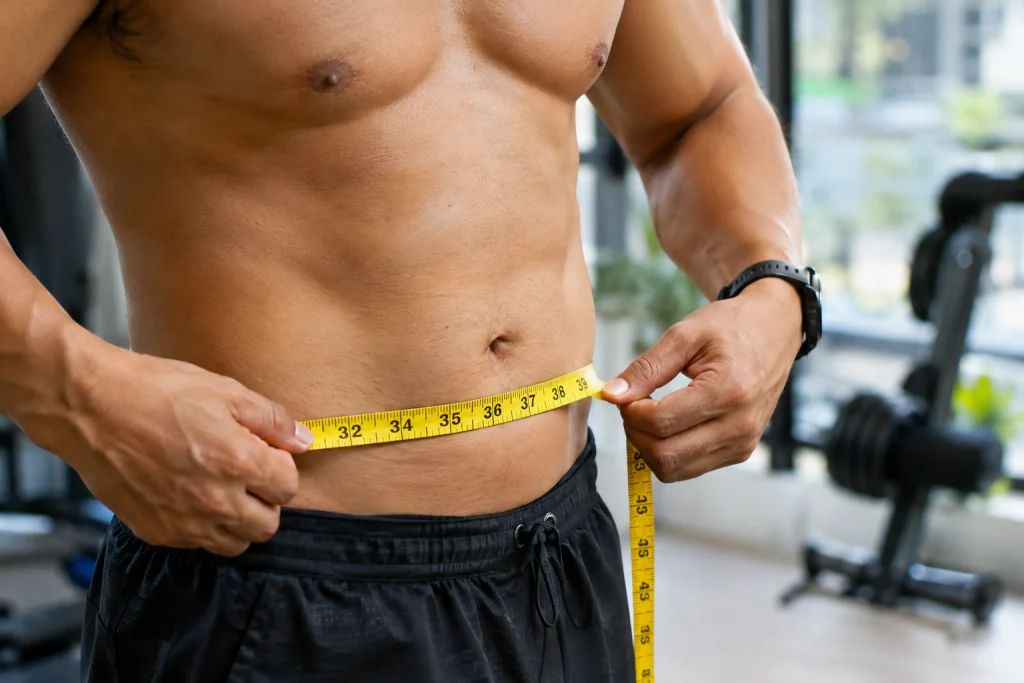
Step 1: Measure Your Waist
Stand upright and relax your abdomen.
Wrap the measuring tape around your waist, midway between your lowest rib and the top of your hip bone.
Measure after breathing out normally.
Avoid pulling the tape too tightly or sucking in your stomach.
Step 2: Measure Your Hips
Wrap the tape around the widest part of your buttocks.
Keep the tape level and parallel to the floor.
Step 3: Calculate Your Ratio
Divide your waist circumference by your hip circumference.
Waist-to-Hip Ratio = Waist Circumference ÷ Hip Circumference
For example:
- Waist: 90 cm
- Hips: 100 cm
- WHR: 90 ÷ 100 = 0.90
You can use either centimeters or inches, provided both measurements use the same unit.
For consistent results, measure at the same anatomical locations every time.
Waist-to-Hip Ratio Chart for Men and Women
Commonly used World Health Organization abdominal-obesity thresholds are:
| Sex | WHR threshold associated with abdominal obesity |
|---|---|
| Men | 0.90 or higher |
| Women | 0.85 or higher |
These are screening thresholds, not precise boundaries separating healthy and unhealthy individuals.
Risk generally increases as abdominal fat accumulation increases. A result below the threshold does not guarantee good metabolic health, and a result above it does not automatically mean you have a disease.
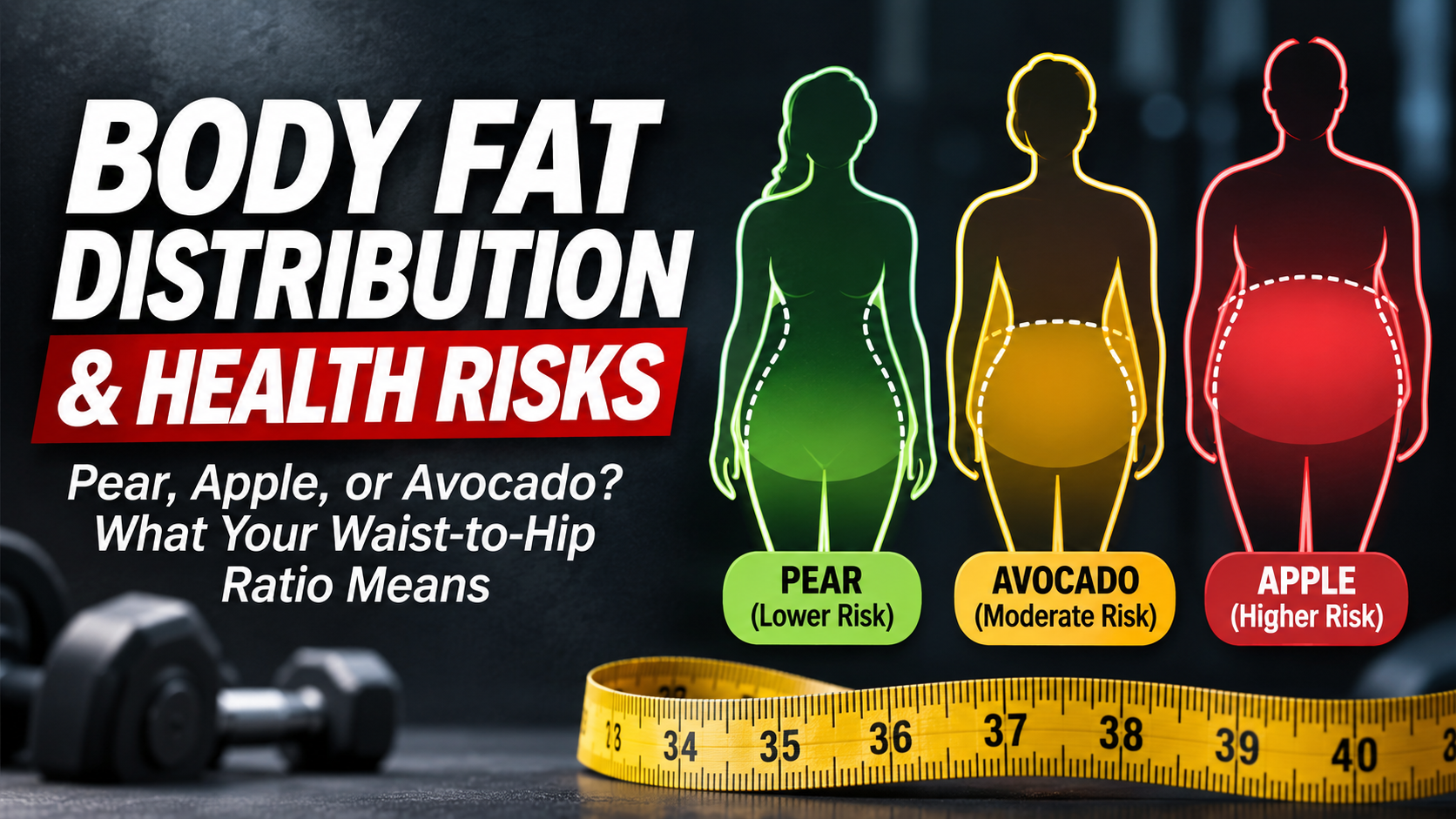
The original apple, pear, and avocado body-shape classifications are useful for explaining fat distribution, but they are not standardized medical risk categories.
Important: WHR should be interpreted together with waist circumference, BMI, health history, and other clinical measurements.
Body Fat Distribution Calculator
Calculate your waist-to-hip and waist-to-height ratios to better understand your abdominal fat distribution.
Please enter valid positive measurements in all fields.
Understanding Your Results
Reference Guidelines
| Measurement | Screening Reference |
|---|---|
| WHR - Men | 0.90 or higher |
| WHR - Women | 0.85 or higher |
| WHtR - Healthy central adiposity | 0.40 to 0.49 |
| WHtR - Increased central adiposity | 0.50 to 0.59 |
| WHtR - High central adiposity | 0.60 or higher |
Disclaimer: These measurements are screening tools, not medical diagnoses. Waist-to-height categories are primarily intended for adults with BMI below 35. Consult a qualified healthcare professional for individual health assessment.
Understanding the Three Common Body Fat Distribution Patterns
1. Pear-Shaped Body: More Fat Around the Hips and Thighs
People with a pear-shaped body tend to store a greater proportion of their fat around the:
- Hips
- Buttocks
- Thighs
- Lower body
This pattern is often described as gynoid fat distribution.
Research suggests that subcutaneous fat stored around the hips and thighs may be associated with a more favorable metabolic profile than excess abdominal visceral fat.
One possible explanation is that lower-body fat tissue can store circulating fatty acids without exposing internal organs to the same metabolic effects associated with visceral fat accumulation.
However, being pear-shaped doesn’t automatically protect someone from cardiovascular disease.
Overall body fat, fitness, diet, genetics, and other health markers still matter.
2. Apple-Shaped Body: More Fat Around the Abdomen
An apple-shaped body describes someone who carries a larger proportion of fat around the waist and upper torso.
This is sometimes called android fat distribution.
People with this pattern may have more abdominal subcutaneous fat, visceral fat, or both.
Visceral fat is metabolically active and is associated with inflammation, insulin resistance, and unfavorable changes in blood lipids.
This helps explain why people with significant abdominal fat can have elevated cardiometabolic risk even when their BMI is not particularly high.
The important measurement isn’t simply how large your stomach looks. It’s how much abdominal fat you carry and how that relates to your overall health.
3. Avocado-Shaped Body: Fat Distributed Between the Upper and Lower Body
The term avocado-shaped is sometimes used to describe people whose fat distribution falls between the typical apple and pear patterns.
They may carry noticeable fat around the waist while also storing fat around the hips and thighs.
Unlike WHR, however, the avocado classification has no widely accepted medical definition or validated risk threshold.
It is better to assess actual waist measurements than assume an intermediate body shape means intermediate health risk.
Visceral Fat vs. Subcutaneous Fat: What’s the Difference?
Understanding these two types of fat is more useful than focusing only on body shape.
Subcutaneous Fat
Subcutaneous fat sits directly beneath the skin.
You can often pinch it around your stomach, thighs, arms, or hips.
It serves several functions, including energy storage, insulation, and cushioning.
Although excessive subcutaneous fat can contribute to overall obesity, its health effects depend partly on where it is stored.
Visceral Fat
Visceral fat is stored deeper inside the abdominal cavity, surrounding organs such as the liver and intestines.
Excess visceral fat is strongly associated with metabolic and cardiovascular risk.
Unlike subcutaneous fat, visceral fat cannot be measured accurately by pinching your stomach.
CT and MRI scans can quantify it, but these tests are generally unnecessary for routine fitness monitoring.
Waist circumference and waist-to-height ratio are more practical screening tools.
Waist-to-Hip Ratio vs. Waist-to-Height Ratio: Which Is Better?
While WHR remains useful, modern clinical guidance also emphasizes the waist-to-height ratio (WHtR).
This measurement compares your waist circumference with your height.
The formula is:
Waist-to-Height Ratio = Waist Circumference ÷ Height
For example, if you’re 170 cm tall with a waist measuring 85 cm:
85 ÷ 170 = 0.50
The 2025 NICE obesity guidance provides the following adult classifications:
| Waist-to-height ratio | Central adiposity classification |
|---|---|
| 0.40–0.49 | Healthy central adiposity |
| 0.50–0.59 | Increased central adiposity |
| 0.60 or higher | High central adiposity |
These categories are recommended for adults with BMI below 35, including adults with high muscle mass.
A simple public-health message is to aim for a waist circumference less than half your height.
For someone who is 170 cm tall, that means a waist below approximately 85 cm.
This is a screening guideline rather than an individual medical diagnosis.
Why This Matters for Filipino Adults
Asian populations can experience increased cardiometabolic risk at lower BMI levels than some other populations.
For many Asian adults, a BMI of 23 or higher already warrants greater attention to metabolic risk.
That makes waist measurements especially valuable for Filipinos who appear relatively lean but carry excess abdominal fat.
If you train regularly, track your waist alongside body weight, strength, and other health indicators rather than relying on BMI alone.
Can You Change Where Your Body Stores Fat?
Your genes, age, hormones, and biological sex influence fat distribution.
However, the idea that your body shape can never change is incorrect.
While you cannot choose precisely where your body loses fat, changes in overall fat mass and muscle development can change your body proportions.
For example:
- Losing abdominal fat may reduce your waist circumference.
- Building glute and leg muscles can change lower-body proportions.
- Strengthening your shoulders and back can improve your upper-body shape.
- Age-related hormonal changes can affect where fat accumulates.
The goal should be improving body composition and metabolic health rather than trying to force your body into a particular shape category.
Can You Target Belly Fat With Specific Exercises?
One of the most persistent fitness myths is that training a particular muscle automatically burns the fat covering it.
Doing hundreds of crunches will strengthen your abdominal muscles, but it won’t selectively remove fat from your stomach.
Likewise, squats and lunges build lower-body strength without guaranteeing that fat will disappear specifically from your thighs.
This is why spot reduction is not a reliable fat-loss strategy.
Your body determines where stored fat is mobilized based on several biological factors.
For most people, reducing abdominal fat requires a combination of appropriate calorie intake, physical activity, and consistent training.
How to Reduce Belly Fat and Improve Body Composition
1. Combine Cardio With Strength Training
Aerobic exercise and resistance training offer complementary benefits.
Cardio activities such as brisk walking, cycling, swimming, and jogging increase energy expenditure and improve cardiovascular fitness.
Resistance training helps build or preserve muscle, improves strength, and supports long-term body composition.
A systematic review and network meta-analysis of 84 randomized controlled trials found that several exercise approaches, including aerobic training, resistance training, and combined training, can improve body composition and reduce abdominal fat measures.
For most adults, a practical starting point is:
- At least 150 minutes of moderate-intensity aerobic activity per week
- Strength training at least twice weekly
- Regular walking and movement throughout the day
You can increase training volume gradually based on your fitness level, recovery, and health status.
2. Maintain a Sustainable Calorie Deficit
Fat loss generally requires consuming fewer calories than your body uses over time.
However, aggressive dieting can make it harder to preserve muscle mass, particularly for older adults and people who lift weights.
A moderate calorie deficit is often easier to sustain.
Focus on:
- Adequate protein
- Vegetables and fruits
- Fiber-rich carbohydrates
- Healthy dietary fats
- Appropriate portion sizes
- Consistent eating habits
You don’t need to eliminate rice or carbohydrates to lose belly fat.
Total calorie intake, diet quality, and consistency matter more than avoiding one particular food.
3. Eat Enough Protein to Preserve Muscle
Protein is especially important when losing weight because calorie restriction can lead to losses of both fat and lean tissue.
For many healthy adults who resistance-train, approximately 1.4–2.0 grams of protein per kilogram of body weight daily is a reasonable starting range, with individual needs varying.
Higher intakes may be appropriate for some lean, highly trained individuals during calorie restriction.
For example, a healthy 75 kg lifter might aim for approximately 105–150 grams of protein daily.
People with kidney disease or other conditions requiring dietary restrictions should seek individualized advice.
4. Prioritize Sleep and Recovery
Poor sleep can interfere with appetite regulation, training recovery, and weight-management efforts.
Most adults should aim for approximately 7–9 hours of sleep per night.
Consistent sleep habits, stress management, and recovery days support a sustainable training routine.
5. Track Your Waist, Not Just Your Weight
Your weight may remain stable even as your body composition improves.
For example, someone beginning resistance training may gain some muscle while losing body fat.
That is why it’s useful to monitor:
- Waist circumference
- Body weight trends
- Strength and workout performance
- Progress photos taken under consistent conditions
- Blood pressure and relevant blood tests
Measuring your waist every two to four weeks is generally sufficient for tracking longer-term changes.
Avoid overinterpreting small day-to-day changes caused by meals, hydration, or bloating.
Why Strength Training Is Especially Important After 40 and 50
As we age, maintaining muscle becomes increasingly important.
Age-related muscle loss can reduce strength, mobility, and functional independence.
At the same time, fat distribution may shift toward the abdominal region, particularly with hormonal changes and reduced physical activity.
This makes resistance training valuable for both men and women.
A properly designed strength program can:
- Preserve or increase muscle mass
- Improve functional strength
- Support bone health
- Improve insulin sensitivity
- Help maintain physical independence
- Support healthier body composition during weight loss
Women should not avoid lifting weights because they fear becoming excessively muscular.
Building substantial muscle requires progressive training, adequate nutrition, and time. Resistance training does not automatically create a bulky appearance.
For adults over 50, training should be adapted to current strength, joint health, recovery, and medical needs.
The objective is to build and maintain useful muscle while managing body fat and supporting long-term health.
Frequently Asked Questions
What Is a Healthy Waist-to-Hip Ratio?
Common abdominal-obesity screening thresholds are 0.90 or higher for men and 0.85 or higher for women. Risk exists along a continuum, so these values should not be treated as absolute definitions of health.
Is Waist-to-Hip Ratio Better Than BMI?
WHR provides information about fat distribution that BMI cannot. However, neither measurement is perfect. Using waist-related measurements alongside BMI and other health indicators gives a more complete picture.
Can You Have a Normal BMI but Too Much Belly Fat?
Yes. Some people have a normal BMI but carry excess abdominal fat, which may increase metabolic risk. This is one reason waist measurements are useful.
Does Strength Training Burn Visceral Fat?
Resistance training can help reduce abdominal fat and improve metabolic health, particularly when combined with aerobic exercise and appropriate nutrition. Results vary depending on the individual and training program.
How Often Should You Measure Your Waist?
Every two to four weeks is a practical interval for most people tracking fitness progress. Use the same measurement technique each time.
Can Your Waist-to-Hip Ratio Improve Without Major Weight Loss?
Yes. Changes in waist circumference, hip circumference, and muscle development can affect WHR even when body weight changes only slightly.
Final Thoughts: Focus on Health, Not Just Body Shape
Your waist-to-hip ratio is a useful tool for understanding body fat distribution, but it isn’t a complete assessment of your health.
The old apple, pear, and avocado comparisons can help explain where fat tends to accumulate, but modern fitness and health advice should focus more on measurable risk factors.
Excess abdominal fat deserves attention because of its association with diabetes, cardiovascular disease, and metabolic problems.
Fortunately, you don’t need extreme diets or endless abdominal exercises to make progress.
A consistent combination of strength training, aerobic exercise, adequate protein, balanced nutrition, and proper recovery can improve your body composition and long-term health.
For Filipino fitness enthusiasts, particularly those entering their 40s, 50s, and beyond, tracking waist circumference alongside strength and other health markers is a practical way to measure progress.
The goal isn’t simply to weigh less. It’s to maintain muscle, reduce excess fat, and stay strong and healthy as you age.
References and Further Reading
- NICE — Overweight and Obesity Management: Identifying and Assessing Central Adiposity
- NICE — Recording BMI and Waist-to-Height Ratio in Adults (2025)
- Chen et al. — Effects of Various Exercise Types on Visceral Adipose Tissue: Systematic Review and Network Meta-Analysis
- Effect of Aerobic Exercise on Waist Circumference: Systematic Review and Meta-Analysis
- NHS England — Adult Overweight and Obesity: Waist Measurements
Medical disclaimer: This article is intended for educational purposes and does not replace professional medical advice. Waist-related measurements are screening tools, not diagnostic tests.