
Last Updated on November 15, 2026
If you can only lift two days per week, you do not need to give up on building muscle or getting stronger. For a beginner, a well-structured 2-day full-body workout can absolutely work.
The key is simple: train the major muscle groups in both sessions, do enough hard work to improve, and progress gradually over time. That approach lines up with the U.S. Physical Activity Guidelines for Americans, which recommend muscle-strengthening activity for all major muscle groups on 2 or more days per week. Those same guidelines also note that 1 set of 8–12 reps can be effective, while 2–3 sets may be more effective for strength development.
That is good news if your schedule is busy. You do not need a 5-day bodybuilding split to make beginner progress.
Why a 2-day full-body workout makes sense
A full-body setup is efficient because each session can cover the basic movement patterns: squat, hinge, push, pull, and trunk work. That helps you train the whole body without needing many gym visits.
Recent high-level evidence also supports the bigger idea that consistency matters more than chasing a perfect split. A 2026 ACSM position stand reported that resistance training improves strength, muscle size, power, balance, gait speed and physical function versus doing no exercise, and its practical guidance emphasizes training all major muscle groups at least twice weekly and getting from no training to some training first. The same review also notes that strength tends to benefit from at least 2 sessions per week, 2–3 sets, heavier loads, and full range of motion, while hypertrophy tends to benefit from higher weekly volume over time. You can read the overview on PubMed.
There is also useful nuance on training frequency. A systematic review and meta-analysis found that frequency by itself does not significantly or meaningfully affect hypertrophy when total training volume is equated. In plain English: two well-planned sessions can work if they include enough quality work. See the review on PubMed.
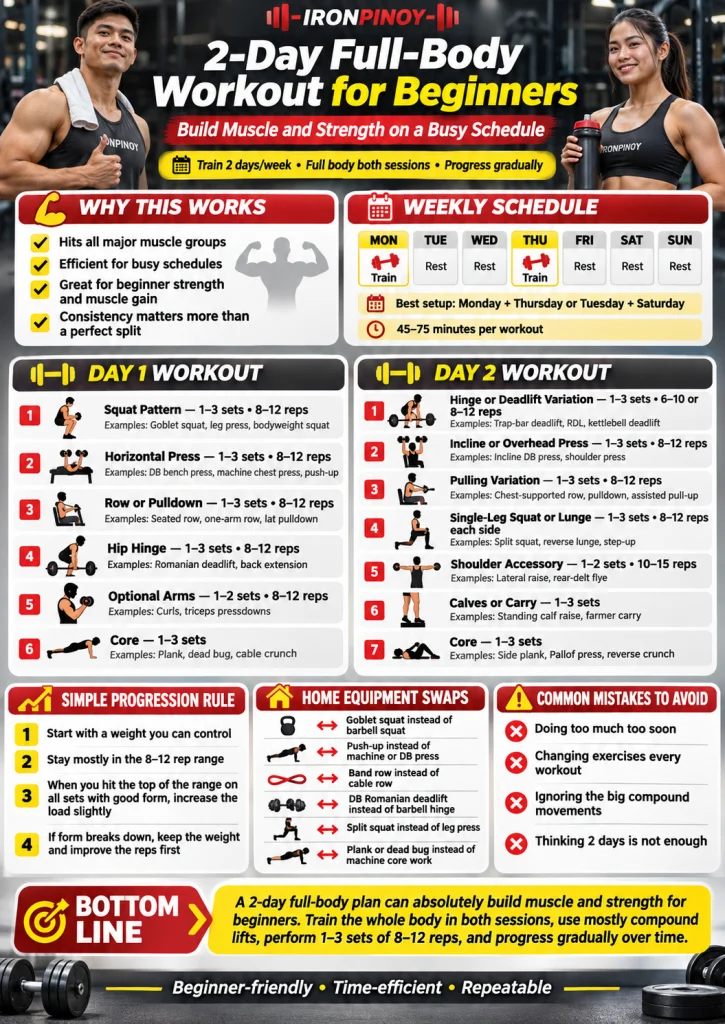
The beginner-friendly 2-day full-body template
This is not the only effective plan, but it is a practical one. Start with 1–3 sets per exercise and mostly 8–12 reps. Rest long enough to keep your form solid and your reps productive.
Day 1
1. Squat pattern
Examples: goblet squat, leg press, bodyweight squat
Sets: 1–3
Reps: 8–12
2. Horizontal press
Examples: dumbbell bench press, machine chest press, push-up
Sets: 1–3
Reps: 8–12
3. Row or pulldown
Examples: seated cable row, one-arm dumbbell row, lat pulldown
Sets: 1–3
Reps: 8–12
4. Hip hinge
Examples: Romanian deadlift, machine back extension, hip hinge with dumbbells
Sets: 1–3
Reps: 8–12
5. Optional arm work
Examples: curls, triceps pressdowns
Sets: 1–2
Reps: 8–12
6. Core
Examples: plank, dead bug, cable crunch
Sets: 1–3
Day 2
1. Hip hinge or deadlift variation
Examples: trap-bar deadlift, Romanian deadlift, kettlebell deadlift
Sets: 1–3
Reps: 6–10 or 8–12 depending on the exercise
2. Incline or overhead press
Examples: incline dumbbell press, machine shoulder press, standing dumbbell press
Sets: 1–3
Reps: 8–12
3. Pulling variation
Examples: chest-supported row, pulldown, assisted pull-up
Sets: 1–3
Reps: 8–12
4. Single-leg squat or lunge pattern
Examples: split squat, reverse lunge, step-up
Sets: 1–3
Reps: 8–12 each side
5. Shoulder accessory
Examples: lateral raise, rear-delt flye
Sets: 1–2
Reps: 10–15
6. Calves or carry
Examples: standing calf raise, farmer carry
Sets: 1–3
7. Core
Examples: side plank, Pallof press, reverse crunch
Sets: 1–3
How long should each workout take?
For most beginners, this can fit into about 45–75 minutes depending on how many sets you do and how much time you spend resting. If that still feels long, cut back to one or two sets on most exercises and focus on the first four movements in each session.
The 2023 American Heart Association scientific statement supports this practical approach. It notes that you do not need to perform every possible exercise in each session, that compound lifts can train more than one major muscle group, and that machines, free weights, elastic bands and body weight can all be used. You can find that summary on PubMed.
How to progress without overcomplicating it
Beginners do best when the plan is simple enough to repeat.
Use this progression rule:
- Start with a weight you can control with solid form.
- Stay mostly in the 8–12 rep range.
- When you can hit the top of the range on all your working sets with good technique, increase the load slightly next time.
- If your form breaks down, keep the same weight and try to perform the reps better.
- As you gain experience, you can gradually add sets if muscle gain becomes your main goal.
This fits the guideline-level advice to progress gradually rather than trying to max out too early. If you are completely new to lifting, getting consistent with two sessions per week is the main win.
What if you only have dumbbells or home equipment?
That is fine. Based on the AHA statement, you are not limited to barbells or commercial gym machines. You can build a useful beginner plan with dumbbells, resistance bands or body weight.
Here are easy swaps:
- Goblet squat instead of barbell squat
- Push-up instead of machine or dumbbell press
- Band row instead of cable row
- Dumbbell Romanian deadlift instead of barbell hinge work
- Split squat instead of leg press
- Plank or dead bug instead of machine core work
Common mistakes to avoid
Doing too much too soon. Two hard, repeatable workouts beat one week of motivation followed by three weeks of soreness and missed sessions.
Changing exercises every workout. Keep the main lifts stable long enough to practice technique and measure progress.
Ignoring the big movements. Isolation work is fine, but your plan should revolve around the basic compound patterns.
Assuming two days is “not enough.” For a beginner, two well-organized sessions can go a long way.
When should you train?
Try two non-consecutive days such as Monday and Thursday or Tuesday and Saturday. The official guidance confirms at least two strength-training days per week; spacing them apart is a practical recovery strategy, especially for beginners.
If you want help making those sessions feel better, IronPinoy already has a practical guide on how to warm up before lifting.
Who should be more cautious?
Healthy adults who increase activity gradually often can start a basic program without needing to overthink it. But if you have a chronic condition, major health concerns, or concerns about vigorous exercise, it is sensible to speak with a clinician or qualified exercise professional first. The CDC also advises older adults to start slowly and scale activity to their abilities and conditions. See the CDC guidance here.
The bottom line
If you only have two days a week, a 2-day full-body workout is a realistic way to build muscle and strength. Cover the major muscle groups, use mostly compound exercises, start with 1–3 sets of 8–12 reps, and add weight or reps gradually as your technique improves.
You do not need a complicated split. You need a plan you can actually do next week, and the week after that.
Sources
- Physical Activity Guidelines for Americans, 2nd edition
- American College of Sports Medicine Position Stand. Resistance Training Prescription for Muscle Function, Hypertrophy, and Physical Performance in Healthy Adults: An Overview of Reviews.
- Resistance Exercise Training in Individuals With and Without Cardiovascular Disease: 2023 Update: A Scientific Statement From the American Heart Association – PubMed
- How many times per week should a muscle be trained to maximize muscle hypertrophy? A systematic review and meta-analysis of studies examining the effects of resistance training frequency
- Older Adults: Adding Activity Recommendations | Physical Activity Basics | CDC
- 5 Things to Know About Creating an Effective Resistance Training Plan
- Resistance training prescription for muscle strength and hypertrophy in healthy adults: a systematic review and Bayesian network meta-analysis