
Last Updated on November 18, 2026
Shoulder mobility plays an important role in everyday movement, from reaching overhead and lifting groceries to performing exercises such as bench presses, shoulder presses, and pull-ups. However, poor posture, muscle tightness, injuries, and prolonged inactivity can limit how freely your shoulders move.
If you experience stiffness when raising your arms or difficulty performing upper-body exercises, incorporating shoulder mobility exercises into your routine may help improve flexibility, movement control, and range of motion.
The good news is that many shoulder mobility exercises require little or no equipment. Whether you’re a beginner, an experienced bodybuilder, or an older adult looking to maintain joint function, these movements can help support healthier shoulder movement.
In this guide, we’ll cover the benefits of shoulder mobility training, common causes of shoulder stiffness, 10 exercises you can try, and a simple 10-minute shoulder mobility routine.
What Is Shoulder Mobility?
Shoulder mobility refers to your ability to move your shoulder joints through their available range of motion with appropriate control.
The shoulder is one of the most mobile joint systems in the human body. Its movement involves several structures, including:
- Glenohumeral joint: The ball-and-socket joint connecting the upper arm to the shoulder blade.
- Scapula (shoulder blade): Helps position and stabilize the shoulder during arm movements.
- Rotator cuff muscles: Four muscles that help stabilize and control the shoulder joint.
- Thoracic spine: The upper and middle back, which contributes to comfortable overhead movement.
Healthy shoulder movement depends on these structures working together.
Shoulder Mobility vs. Shoulder Flexibility
Although often used interchangeably, mobility and flexibility are different.
Shoulder flexibility refers to the ability of muscles and other soft tissues to lengthen and allow movement.
Shoulder mobility refers to the available movement of the joint, including your ability to actively control that movement.
For example, being able to stretch your arms overhead does not necessarily mean you have enough shoulder control to perform an overhead press safely.
A well-rounded training program should develop both flexibility and active mobility.
Why Is Shoulder Mobility Important?
Improving shoulder mobility can benefit people of different ages and fitness levels.
1. Supports Better Exercise Technique
Exercises such as overhead presses, pull-ups, and certain squat variations require adequate shoulder movement.
Limited mobility may cause you to compensate by excessively arching your lower back, shrugging your shoulders, or changing your arm position.
Improving mobility can help you perform these exercises with better control.
2. Helps Maintain Everyday Function
Reaching shelves, putting on clothes, washing your hair, and carrying objects all involve shoulder movement.
Maintaining shoulder mobility becomes particularly important as we age because joint stiffness and reduced activity can make these tasks more difficult.
3. Supports Shoulder Muscle Coordination
Shoulder mobility exercises encourage coordinated movement between the shoulder blade, upper arm, and surrounding muscles.
When combined with appropriate strength training, mobility work can support better movement mechanics.
4. May Reduce Certain Types of Stiffness
Gentle movement and stretching may help relieve stiffness associated with inactivity or muscular tightness.
However, shoulder mobility exercises are not a guaranteed treatment for shoulder pain, and persistent pain may require medical evaluation.
5. Prepares the Shoulders for Strength Training
Dynamic shoulder mobility exercises can be included in your warm-up before upper-body workouts.
They help you gradually explore comfortable movement ranges before lifting heavier weights.
Common Causes of Limited Shoulder Mobility
Shoulder stiffness can develop for several reasons.
Poor Posture and Prolonged Sitting
Spending long hours working at a computer may contribute to muscle tightness and reduced movement variety.
Rounded shoulders and limited upper-back movement can also affect how comfortably you raise your arms.
Muscle Tightness and Imbalances
Tight chest muscles, latissimus dorsi muscles, and other surrounding tissues may restrict certain shoulder movements.
Weakness or poor coordination of the muscles controlling the shoulder blade can also affect movement.
Rotator Cuff Problems
Rotator cuff tendinopathy or tears can cause pain, weakness, and difficulty moving the shoulder.
These conditions may require targeted rehabilitation rather than general stretching.
Frozen Shoulder
Frozen shoulder, medically known as adhesive capsulitis, causes progressive stiffness and restricted shoulder movement.
It often requires a carefully managed rehabilitation program.
Arthritis and Age-Related Changes
Arthritis and other age-related changes can affect shoulder comfort and range of motion.
Previous Injuries or Surgery
Shoulder dislocations, fractures, tendon injuries, and surgery can limit movement during recovery.
Important: If your shoulder stiffness follows an injury, surgery, or is accompanied by significant pain or weakness, consult a qualified healthcare professional before beginning mobility exercises.
10 Best Shoulder Mobility Exercises
The following exercises target different aspects of shoulder movement, including flexion, extension, rotation, and shoulder blade control.
Perform them slowly and stay within a comfortable range of motion. Do not force your shoulder into painful positions.
1. Arm Circles
Best for: General shoulder warm-ups and active mobility.
Arm circles are a simple dynamic exercise that moves the shoulders through gradually increasing ranges.
How to perform:
- Stand upright with your feet shoulder-width apart.
- Extend your arms to the sides.
- Begin making small, controlled circles.
- Gradually increase the size of the circles as comfortable.
- Reverse direction and repeat.
Recommended repetitions: 10–15 circles in each direction.
Training tip: Avoid swinging your arms aggressively. Keep the movement smooth and controlled.
2. Shoulder Rolls
Best for: Gentle shoulder blade movement and reducing feelings of upper-body stiffness.
Shoulder rolls involve controlled elevation, retraction, depression, and forward movement of the shoulders.
How to perform:
- Stand or sit with your spine in a comfortable upright position.
- Relax your arms at your sides.
- Slowly lift your shoulders toward your ears.
- Roll them backward and downward.
- Repeat in the opposite direction.
Recommended repetitions: 10 rolls forward and 10 backward.
Training tip: Focus on smooth movement rather than exaggerated circles.
3. Wall Angels
Best for: Shoulder elevation, shoulder blade coordination, and upper-back mobility.
Wall angels are particularly useful for practicing controlled overhead movement.
How to perform:
- Stand with your back near a wall.
- Position your feet slightly away from the wall.
- Raise your arms into a goalpost position, with elbows bent.
- Slowly slide your arms upward as far as comfortable.
- Return to the starting position.
Recommended repetitions: 8–12 repetitions.
Training tip: Do not force your wrists or elbows against the wall. Avoid excessive lower-back arching.
4. Doorway Chest Stretch
Best for: Stretching the chest and front of the shoulders.
Tight chest muscles can contribute to restricted shoulder movement.
How to perform:
- Stand in an open doorway.
- Place your forearms against the doorframe, with your elbows at a comfortable height.
- Step one foot forward.
- Gently move your chest forward until you feel a stretch.
- Hold the position before returning.
Recommended duration: 20–30 seconds, repeated twice.
Training tip: Avoid overstretching, particularly if you experience pain at the front of the shoulder.
5. Shoulder Extension Stretch
Best for: Improving comfort when reaching your arms behind your body.
Shoulder extension is involved in movements such as reaching backward and certain pulling exercises.
How to perform:
- Stand upright.
- Bring your hands behind your back.
- Gently move your arms backward while keeping your chest lifted.
- Stop when you feel a comfortable stretch.
- Return slowly.
Recommended duration: 15–20 seconds, repeated twice.
Training tip: Keep your shoulders relaxed and avoid forcing your arms upward.
6. Cross-Body Shoulder Stretch
Best for: Stretching the back of the shoulder.
This exercise can help improve comfort during movements that bring the arm across the body.
How to perform:
- Stand or sit upright.
- Bring one arm across your chest.
- Use your opposite hand to support the upper arm.
- Gently draw the arm closer without forcing it.
- Hold and switch sides.
Recommended duration: 20–30 seconds per side.
Training tip: Avoid pressing directly on the elbow or forcing the shoulder into pain.
7. Thread the Needle
Best for: Thoracic rotation and shoulder movement.
Thread the needle combines upper-back rotation with gentle shoulder movement.
How to perform:
- Start on your hands and knees.
- Lift one hand from the floor.
- Reach that arm underneath your opposite arm.
- Rotate your upper body gently while allowing the shoulder to move.
- Return to the starting position and repeat.
Recommended repetitions: 8–10 per side.
Training tip: Move through your upper back rather than twisting aggressively through your lower back.
8. Wall Slides
Best for: Shoulder flexion and shoulder blade coordination.
Wall slides can help you practice raising your arms overhead with control.
How to perform:
- Face a wall and place your forearms or hands against it.
- Keep your shoulders relaxed.
- Slowly slide your arms upward.
- Stop before discomfort or excessive lower-back arching.
- Return to the starting position.
Recommended repetitions: 10–12 repetitions.
Training tip: Use a pain-free range rather than trying to reach the highest possible position.
9. Shoulder External Rotation With a Resistance Band
Best for: Strengthening the external rotators and improving shoulder control.
Unlike passive stretching, this exercise develops strength in muscles involved in shoulder stability.
How to perform:
- Attach a light resistance band to a stable anchor.
- Stand sideways to the anchor.
- Hold the band with the hand farthest from the anchor.
- Keep your elbow close to your side and bent approximately 90 degrees.
- Slowly rotate your forearm outward.
- Return under control.
Recommended repetitions: 10–15 per side, for 1–2 sets.
Training tip: Use light resistance and avoid rotating your torso to move the band.
10. Shoulder Flexion With a Stick
Best for: Gentle assisted overhead range of motion.
A lightweight stick or broom handle can help guide controlled shoulder movement.
How to perform:
- Lie on your back or stand comfortably.
- Hold a lightweight stick with both hands.
- Slowly raise your arms overhead.
- Use your less affected arm to assist gently if necessary.
- Stop at a comfortable range and return.
Recommended repetitions: 8–12 repetitions.
Training tip: Do not force the movement, especially if you have a recent shoulder injury or significant pain.
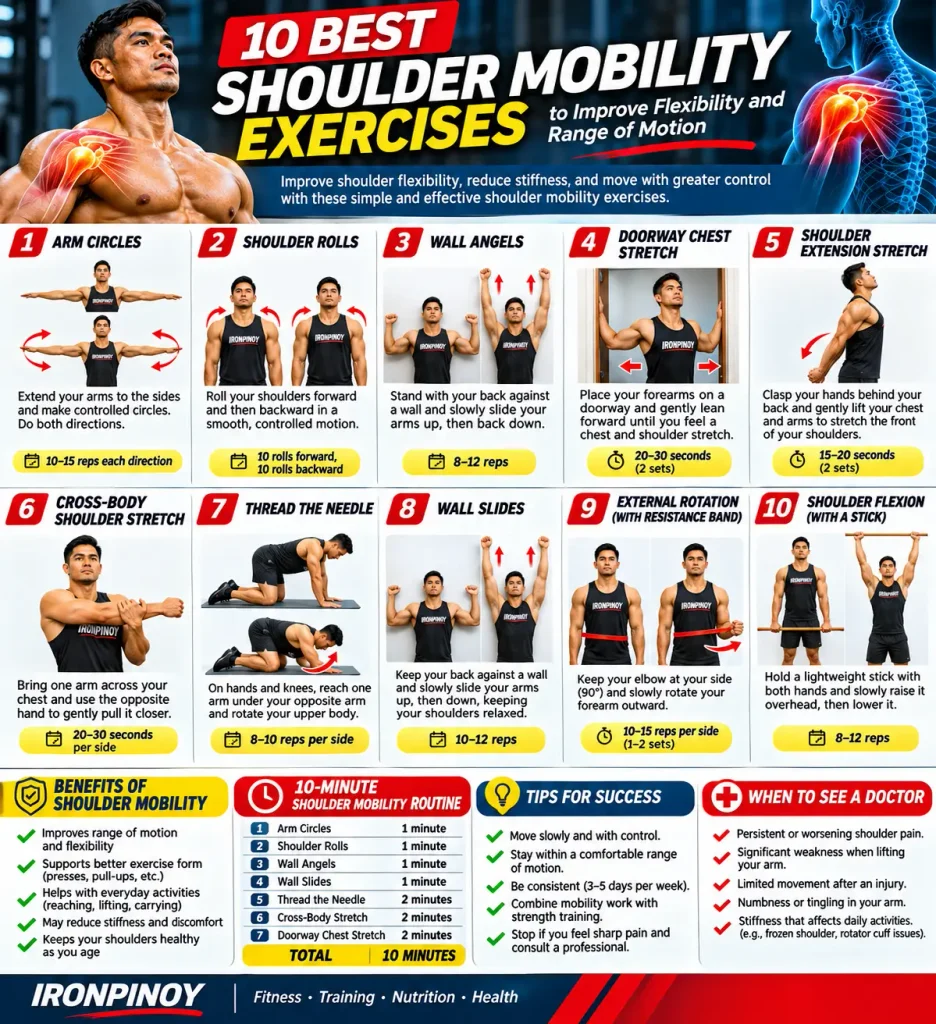
10-Minute Shoulder Mobility Routine
You don’t need a long workout to begin improving shoulder movement.
The following routine can be used as a general mobility session or a light warm-up, provided the exercises are comfortable and appropriate for your shoulders.
| Exercise | Duration |
|---|---|
| Arm Circles | 1 minute |
| Shoulder Rolls | 1 minute |
| Wall Angels | 1 minute |
| Wall Slides | 1 minute |
| Thread the Needle | 2 minutes |
| Cross-Body Shoulder Stretch | 2 minutes |
| Doorway Chest Stretch | 2 minutes |
| Total | 10 minutes |
Move slowly and take brief breaks when necessary. If a particular exercise causes pain, skip it rather than pushing through.
For a pre-workout warm-up, prioritize dynamic movements. Longer static stretches can be performed separately or after training.
Shoulder Mobility Exercises for Bodybuilders and Weightlifters
For bodybuilders and strength-training enthusiasts, shoulder mobility is especially relevant to exercises that involve pressing, pulling, and overhead movement.
Before Chest Workouts
Use gentle arm circles, wall slides, and light pressing warm-up sets to prepare for movements such as the dumbbell incline bench press.
Before Shoulder Workouts
Focus on controlled shoulder elevation, shoulder blade movement, and light rotator cuff activation.
Do not force overhead pressing if your shoulder range of motion is limited or painful.
Before Back Workouts
Gentle shoulder flexion, upper-back rotation, and shoulder blade control exercises may help prepare you for pulling movements.
For example, controlled mobility work can complement your seated cable row training.
During Recovery Days
A short mobility routine may help you maintain comfortable movement without the fatigue of a full resistance-training session.
However, mobility training should not replace appropriate strengthening or rehabilitation when these are needed.
Shoulder Mobility Exercises for Adults Over 40 and 50
Maintaining shoulder mobility becomes increasingly important as we grow older.
Age-related changes, reduced physical activity, arthritis, and previous injuries can make shoulder movements less comfortable.
For adults over 40 or 50, the priority should be controlled movement, appropriate strengthening, and consistency rather than forcing extreme flexibility.
Consider these practical guidelines:
- Begin with gentle movements such as shoulder rolls and small arm circles.
- Use a wall or stick for support when appropriate.
- Start with a smaller range of motion and gradually increase it.
- Combine mobility exercises with resistance training suited to your ability.
- Allow adequate recovery between demanding upper-body workouts.
If you have diagnosed arthritis, a rotator cuff tear, frozen shoulder, or another shoulder condition, ask your healthcare professional which movements are appropriate.
How Often Should You Do Shoulder Mobility Exercises?
The ideal frequency depends on your goals, current range of motion, training schedule, and medical history.
For generally healthy adults, a short mobility routine several days per week is a reasonable starting point.
Gentle, comfortable movements may also be performed daily.
If your goal is to improve flexibility, regular stretching combined with active movement and strength training may be more useful than occasional long stretching sessions.
Progress gradually rather than trying to achieve a dramatic increase in range of motion in one session.
Common Shoulder Mobility Mistakes to Avoid
Even simple exercises can become uncomfortable when performed incorrectly.
Forcing painful movements: A mild stretching sensation may be normal, but sharp pain, catching, or increasing discomfort is a reason to stop.
Moving too quickly: Fast movements can make it harder to control your shoulder position.
Ignoring shoulder blade movement: Shoulder mobility depends partly on coordinated movement of the scapula and upper arm.
Overarching the lower back: Excessive spinal extension can make an overhead movement appear easier without improving actual shoulder motion.
Stretching without strengthening: Mobility and strength work together. Developing control within your available range is important.
Continuing despite worsening symptoms: Persistent pain, weakness, or loss of movement deserves professional assessment.
When Should You See a Doctor or Physical Therapist?
Not every stiff shoulder can be improved through stretching alone.
Seek professional assessment if you experience:
- Persistent or worsening shoulder pain.
- Significant weakness when lifting your arm.
- Difficulty moving your shoulder after an injury.
- Numbness or tingling extending into your arm.
- Increasing stiffness that affects everyday activities.
- Night pain that repeatedly disrupts sleep.
Seek urgent medical attention for severe pain after trauma, obvious deformity, sudden major weakness, or shoulder pain accompanied by chest pain or shortness of breath.
A physical therapist can assess whether your movement restriction is related to muscle tightness, joint stiffness, weakness, injury, or another condition.
Frequently Asked Questions About Shoulder Mobility
What is the best exercise for shoulder mobility?
There is no single best exercise for everyone. Wall slides, arm circles, wall angels, and controlled shoulder rotations are useful options, depending on which movements are limited and whether you have pain.
Can I improve shoulder mobility in 10 minutes a day?
A 10-minute routine can be a practical starting point. Improvements depend on consistency, the cause of your restrictions, and whether your program includes appropriate strengthening.
How long does it take to improve shoulder mobility?
Some people notice reduced stiffness after a session, while measurable and lasting improvements may take several weeks or longer. Medical conditions such as frozen shoulder may require months of rehabilitation.
Should I stretch my shoulders every day?
Gentle stretching can be performed daily if it does not aggravate symptoms. More demanding mobility or strengthening exercises may require recovery time.
Can shoulder mobility exercises help with shoulder pain?
They may help some people, especially when stiffness or reduced activity contributes to discomfort. However, shoulder pain can have many causes, and mobility exercises are not a substitute for diagnosis or treatment.
Are shoulder mobility exercises safe for rotator cuff injuries?
Some gentle exercises may be appropriate during rehabilitation, but the correct movements depend on the type and severity of injury. Follow guidance from your doctor or physical therapist.
Do shoulder mobility exercises improve bench press performance?
Adequate shoulder movement and control can support comfortable pressing technique. However, mobility exercises alone do not guarantee a stronger bench press. Strength, technique, and progressive training remain important.
Final Thoughts: Build Stronger, More Mobile Shoulders
Shoulder mobility is an important part of maintaining upper-body function, whether you’re lifting weights, working at a desk, or simply trying to move more comfortably throughout the day.
By combining shoulder mobility exercises, gentle stretching, and appropriate strength training, you can work toward better range of motion and improved movement control.
Start with a few simple exercises, stay within a comfortable range, and gradually progress as your movement improves.
For more strength-training guidance, exercise tutorials, and practical workout advice, explore the resources at IronPinoy.com.
Ready to put your training into action? Use the IronPinoy Workout Planner to organize your exercises, track your training sessions, and build a more consistent workout routine.