
Last Updated on November 18, 2026
Walk into almost any gym and take a close look at the members working out. Come back a year later, and you may notice that many are still lifting the same weights they used during your first visit.
Why?
Many bodybuilders spend years following the same training routines without making meaningful progress. If building muscle were simply a matter of spending more time in the gym, there would be far more massive bodybuilders.
Unfortunately, conventional bodybuilding programs often fail to produce consistent results because they lack proper intensity, progression, or recovery.
Many athletes also create unnecessary obstacles that make their goals of building strength and muscle harder to achieve.
Some consider themselves hardcore bodybuilders. However, being hardcore does not mean training six times a week for three hours or copying Lee Haney’s competition training program.
Instead, it means something entirely different.
A true hardcore bodybuilder creates a sensible training plan and follows it consistently over a prolonged period. Success requires willpower, discipline, ambition, and perseverance.
Forget endless training routines, Mr. Olympia superstar programs, and unrealistic advertisements promising 30 pounds of muscle in four weeks.
Instead, concentrate on the fundamental principles that support the development of a strong, muscular physique.
The Role of Anabolic Steroids in Bodybuilding
Before discussing the training principles, we must acknowledge the role of anabolic-androgenic steroids in bodybuilding.
Athletes who use anabolic steroids can experience significantly greater increases in muscle mass and strength than natural athletes. Furthermore, these substances can help users reach levels of muscularity beyond their natural genetic potential.
However, anabolic steroids also carry significant health risks. These include cardiovascular complications, unfavorable cholesterol changes, high blood pressure, hormonal suppression, and fertility problems.
Therefore, athletes should not confuse steroid-assisted muscle development with the body’s normal response to resistance training.
Although natural and steroid-assisted bodybuilders may have different recovery capacities and muscle-building potential, both groups still benefit from proper training, nutrition, and recovery.
With these differences in mind, the following five principles form the foundation of traditional high-intensity bodybuilding.
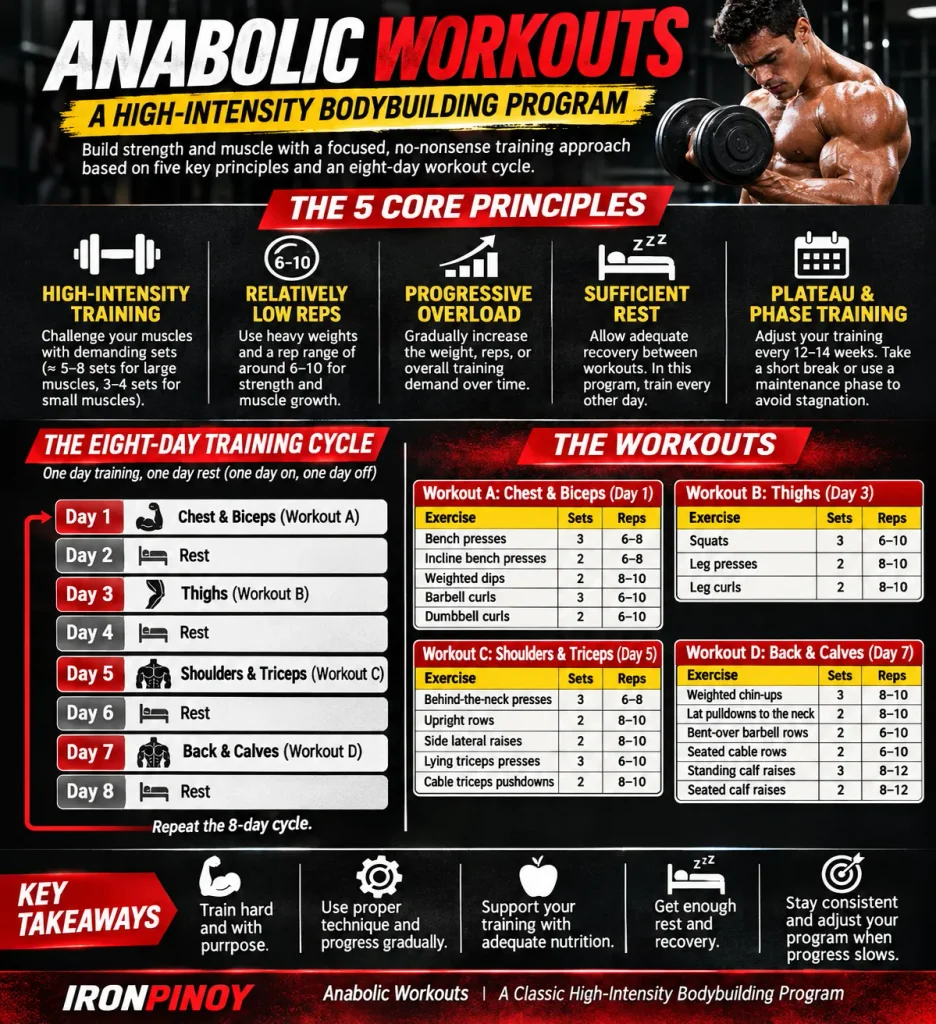
1. High-Intensity Training
The human body naturally attempts to maintain a stable internal environment, a condition known as homeostasis.
Consequently, muscles need a sufficient training stimulus to develop additional strength and size.
Challenging resistance training provides this stimulus, particularly when athletes combine proper technique with progressive overload.
Traditional high-intensity bodybuilding emphasizes relatively few sets performed with maximum effort.
A typical approach includes:
- Large muscle groups: 5–8 challenging working sets per session.
- Small muscle groups: 3–4 challenging working sets per session.
These figures reflect the original low-volume training philosophy rather than universal requirements.
However, modern research indicates that muscle growth depends on total training volume, exercise intensity, frequency, and recovery.
Furthermore, athletes do not need to reach absolute muscular failure during every set.
For most exercises, stopping approximately 1–3 repetitions short of failure provides a strong training stimulus while helping manage fatigue.
Above all, every working set should serve a clear purpose and provide enough resistance to challenge the muscles.
2. Training With Relatively Low Repetitions
Muscles contain different fiber types, commonly classified as Type I and Type II.
Type I fibers generally resist fatigue more effectively, whereas Type II fibers produce greater force and power.
Traditionally, bodybuilding programs emphasize heavy weights and relatively low repetitions to recruit and develop fast-twitch muscle fibers.
A repetition range of 6–10 reps remains an effective choice for building strength and muscle.
However, muscle hypertrophy is not limited to this range or exclusively to Type II fibers.
Modern exercise science shows that both fiber types can grow. Moreover, muscle hypertrophy can occur across a wide range of repetitions when athletes perform sufficiently challenging sets.
For practical bodybuilding training:
- 4–6 repetitions can emphasize heavier strength-oriented training.
- 6–10 repetitions work well for many compound bodybuilding exercises.
- 10–15 repetitions are useful for both compound and isolation exercises.
- 15–20 or more repetitions can also stimulate hypertrophy, particularly with lighter loads performed close to failure.
Therefore, heavy training remains valuable, but athletes should not focus exclusively on lifting the greatest possible weight.
Instead, the objective is to challenge the target muscles effectively while maintaining proper technique.
3. Training With Progressively Heavier Weights
Muscles must face gradually increasing demands to develop greater size and strength.
This principle is called progressive overload.
One of the simplest ways to apply it is to increase the weight used during an exercise.
For example, a bodybuilder who performs eight controlled bench press repetitions with 80 kg may eventually progress to ten repetitions before increasing the weight.
Nevertheless, adding more weight is not the only way to make progress.
Athletes can also increase repetitions, improve exercise technique, use a greater range of motion, or add productive training volume.
The original bodybuilding philosophy emphasizes the relationship between strength and muscular size.
Although strength and muscle mass are closely related, they are not identical. Improvements in lifting performance can also result from better technique and nervous-system adaptations.
Even so, becoming stronger over time remains a useful indicator of progress.
Basic exercises are especially valuable, including:
- Squats
- Bench presses
- Overhead presses
- Barbell and dumbbell rows
- Barbell curls
- Pull-ups
- Dips
These movements allow athletes to handle substantial resistance while developing multiple muscle groups.
Ultimately, the key is to use progressively challenging weights without sacrificing proper exercise technique.
4. Sufficient Rest Periods
Training stimulates muscle growth, but much of the adaptation process occurs during recovery.
Heavy resistance training creates fatigue and places mechanical stress on muscle tissue. In response, the body increases muscle protein synthesis and activates other processes that support repair and adaptation.
For this reason, traditional high-intensity bodybuilding emphasizes long recovery periods between demanding workouts.
Under this approach, athletes take a complete rest day after every training day. Additionally, they directly train each muscle group only once every seven to eight days.
This schedule provides considerable recovery time between sessions.
However, modern evidence suggests that muscles do not necessarily require an entire week of rest after every productive workout.
Many bodybuilders successfully train each major muscle group approximately twice per week.
Therefore, athletes should determine training frequency according to total training volume, intensity, experience, and individual recovery capacity.
For those following this traditional high-intensity routine, the longer recovery periods remain part of the program’s structure rather than a universal requirement for muscle growth.
Regardless of the training split, adequate sleep, nutrition, and recovery remain essential.
5. Plateau and Phase Training
The body can tolerate demanding training only when it has enough time and resources to recover.
When fatigue accumulates faster than recovery occurs, performance may decline. As a result, progress can temporarily stop.
This explains why traditional bodybuilding programs periodically adjust training intensity and volume.
The original approach recommends changing the training program after approximately 12–14 weeks.
Following a demanding training phase, an athlete may take several days of reduced activity or temporarily follow a maintenance program.
Traditional bodybuilders sometimes describe this approach as plateau training.
Similarly, modern training programs use a concept called periodization. This involves adjusting training volume, intensity, and recovery over time to support continued progress.
However, athletes do not need to change their programs automatically every 12–14 weeks.
If a routine continues to produce results and recovery remains adequate, there may be no reason to replace it.
Instead, monitor workout performance, recognize signs of excessive fatigue, and adjust training demands when necessary.
The Anabolic Workout Training Program
The following training program combines high-intensity training, relatively low repetitions, progressive overload, and extended recovery.
It follows the original eight-day cycle, with one training day followed by one rest day.
When combined with adequate nutrition and recovery, this routine offers a structured approach to developing strength and muscle mass.
Because each muscle group receives direct training only once every eight days, the program represents a traditional low-frequency bodybuilding approach.
Natural bodybuilders can follow this type of routine. However, some may achieve better results by distributing their weekly training volume across more frequent sessions.
Therefore, consider this program one possible bodybuilding approach rather than the only effective method.
Eight-Day Training Cycle: One Day Training, One Day Rest
One day on, one day off.
Day 1: Chest and Biceps
| Exercise | Sets | Repetitions |
|---|---|---|
| Bench presses | 3 | 6–8 |
| Incline bench presses | 2 | 6–8 |
| Weighted dips | 2 | 8–10 |
| Barbell curls | 3 | 6–10 |
| Dumbbell curls | 2 | 6–10 |
Day 2: Complete Rest
Day 3: Thighs
| Exercise | Sets | Repetitions |
|---|---|---|
| Squats | 3 | 6–10 |
| Leg presses | 2 | 8–10 |
| Leg curls | 2 | 8–10 |
Day 4: Complete Rest
Day 5: Shoulders and Triceps
| Exercise | Sets | Repetitions |
|---|---|---|
| Behind-the-neck presses | 3 | 6–8 |
| Upright rows | 2 | 8–10 |
| Side lateral raises | 2 | 8–10 |
| Lying triceps presses | 3 | 6–10 |
| Cable triceps pushdowns | 2 | 8–10 |
Day 6: Complete Rest
Exercise note: The original program includes behind-the-neck presses and upright rows. However, lifters who experience shoulder discomfort may prefer standard overhead presses or other shoulder-friendly alternatives.
Day 7: Back and Calves
| Exercise | Sets | Repetitions |
|---|---|---|
| Weighted chin-ups | 3 | 8–10 |
| Lat pulldowns to the neck | 2 | 8–10 |
| Bent-over barbell rows | 2 | 6–10 |
| Seated cable rows | 2 | 6–10 |
| Standing calf raises | 3 | 8–12 |
| Seated calf raises | 2 | 8–12 |
Day 8: Complete Rest
Exercise note: Front lat pulldowns provide a practical alternative to behind-the-neck pulldowns, particularly for lifters with limited shoulder mobility.
Important Training Notes
Athletes train on Days 1, 3, 5, and 7. Meanwhile, Days 2, 4, 6, and 8 serve as complete rest days.
Rest intervals between demanding working sets should generally last approximately 3–4 minutes, particularly during heavy compound exercises.
However, smaller isolation exercises may require shorter rest periods.
The original program emphasizes free-weight movements rather than machines. Although free weights remain valuable, modern resistance-training machines can also stimulate muscle hypertrophy effectively.
Each muscle group receives direct training only once during the eight-day cycle.
Training to Muscular Failure
The original program instructs athletes to perform every working set until muscular failure. At this point, the lifter cannot complete another full repetition independently.
Although this approach creates a demanding training stimulus, it can also generate considerable fatigue.
Current evidence suggests that training close to failure generally provides sufficient stimulation for muscle hypertrophy.
Therefore, athletes can reserve absolute failure for selected sets, particularly during certain isolation exercises, rather than using it throughout every workout.
The Role of Anabolic Steroids
The traditional explanation for this routine emphasizes the anti-catabolic effects of anabolic-androgenic steroids. It also suggests that extremely demanding training can take advantage of those effects.
However, deliberately maximizing muscle damage does not guarantee better muscle growth.
While anabolic steroids can increase muscle mass and influence recovery, athletes still need appropriate resistance training, nutrition, and rest to support adaptation.
Example: Heavy Bench Press Training
The original workout uses a descending-weight approach.
After completing several warm-up sets, the athlete begins with the heaviest working weight. Subsequently, each working set uses slightly less resistance.
Bodybuilders commonly call this method reverse pyramid training.
For example, consider an experienced athlete who can complete six bench press repetitions with 300 pounds.
Warm-Up and Working Sets
| Set | Repetitions | Weight |
|---|---|---|
| 1st warm-up set | 10 reps | 140 lb |
| 2nd warm-up set | 2 reps | 200 lb |
| 3rd warm-up set | 2 reps | 240 lb |
| 1st working set | 6 reps | 300 lb |
| 2nd working set | 7 reps | 280 lb |
| 3rd working set | 7 reps | 260 lb |
The first warm-up set prepares the muscles and joints for heavier resistance.
Next, the second and third warm-up sets introduce progressively heavier loads while limiting unnecessary fatigue.
Consequently, the athlete becomes familiar with the working weight before performing the most demanding set.
During subsequent chest exercises, fewer warm-up sets may be necessary because the muscles are already prepared.
Nevertheless, additional exercise-specific warm-ups can help when changing movement patterns or increasing resistance substantially.
Increasing Repetitions and Training Weights
During each workout, aim to improve your performance compared with previous sessions.
For example, you might perform an additional repetition with the same weight. Alternatively, you could increase the resistance after consistently reaching your target repetition range.
Suppose you complete six repetitions with 300 pounds during one session. Your next goal could be seven controlled repetitions with the same weight.
Once you consistently achieve the upper end of your repetition target, consider increasing the load.
However, progress does not need to occur during every workout. Sleep, nutrition, fatigue, and other factors can temporarily affect performance.
Ultimately, consistent improvements over weeks and months matter more than setting a personal record during every session.
The traditional bodybuilding saying remains:
HEAVY WEIGHTS BUILD BIG MUSCLES.
More accurately, progressively challenging resistance training, combined with proper nutrition and recovery, provides the foundation for long-term muscle development.
Originally published September 19, 2001. Updated to clarify current resistance-training recommendations while preserving the original anabolic workout program.
Original article reposted with permission from AnabolicReview.com.