Last Updated on August 27, 2024
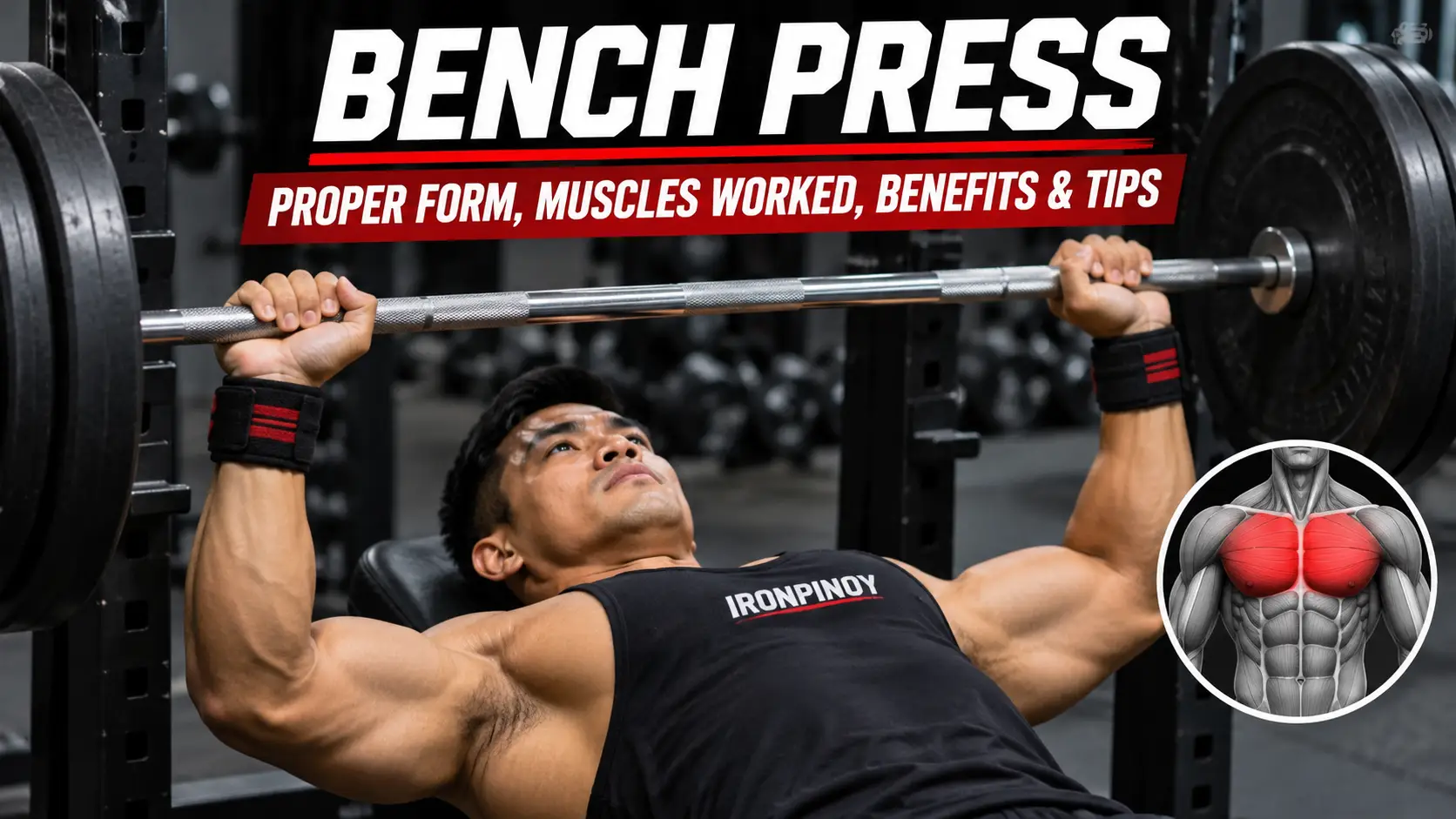
The bench press is one of the most effective compound exercises for building upper-body strength and developing bigger, stronger chest muscles. Whether you’re a beginner learning how to lift weights or an experienced bodybuilder working toward a heavier bench press, mastering proper technique can make a significant difference in your results.
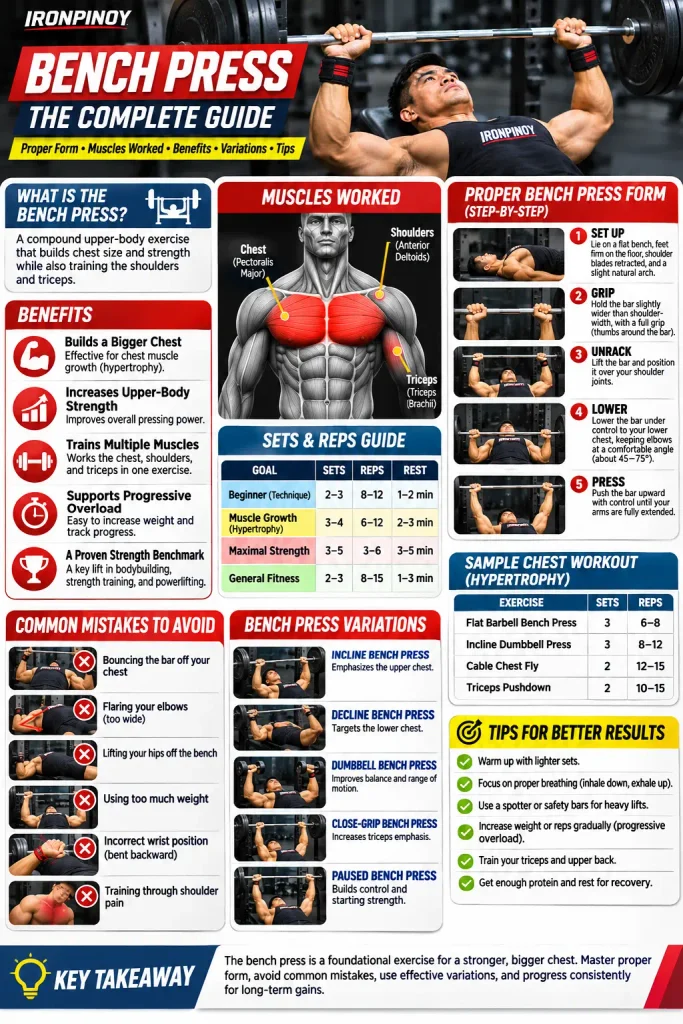
The barbell bench press primarily trains the pectoralis major (chest), anterior deltoids (front shoulders), and triceps. It also requires stability from the upper back, core, and lower body.
However, lifting heavier weights isn’t the only factor that matters. Your grip width, elbow position, range of motion, training volume, and recovery all influence how effectively you develop strength and muscle.
In this guide, you’ll learn how to perform the bench press correctly, which muscles it works, common mistakes to avoid, the best variations for chest development, and how to include it in your workout routine.
What Is the Bench Press?
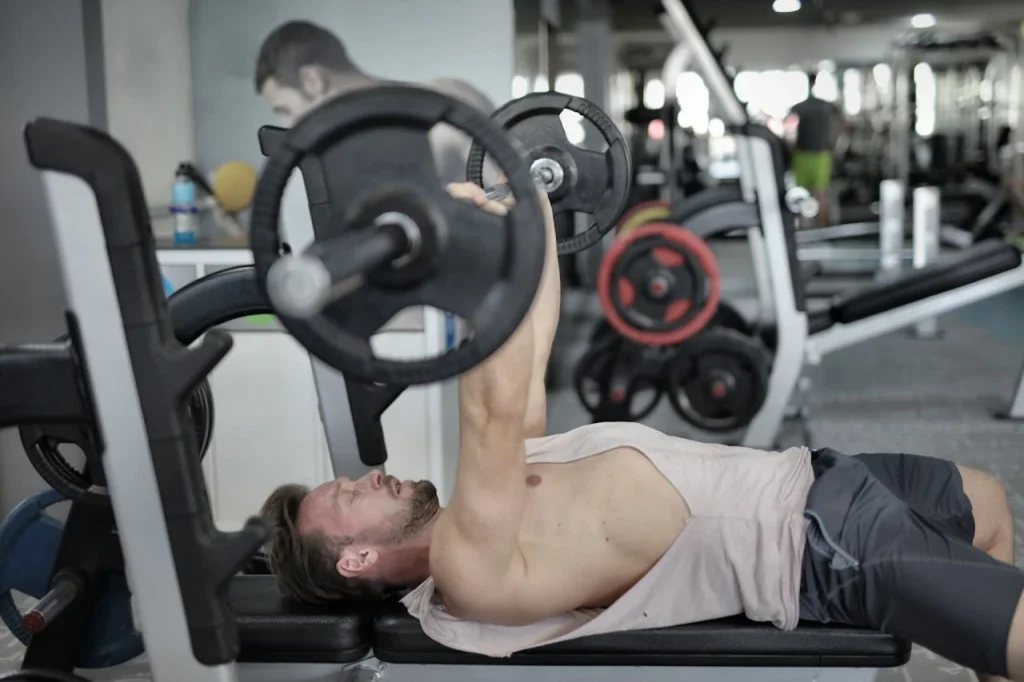
The bench press is a compound resistance-training exercise performed by lying on a weight bench and pressing a barbell or dumbbells away from the chest.
It is widely used in bodybuilding, powerlifting, athletic conditioning, and general strength training.
Unlike isolation exercises that primarily focus on one muscle group, the bench press trains several upper-body muscles simultaneously.
The traditional flat barbell bench press is particularly effective for developing horizontal pressing strength and overall chest muscle mass.
Bench Press Muscles Worked
| Muscle Group | Role During the Bench Press |
|---|---|
| Pectoralis major | Primary muscle responsible for moving the upper arms across the body during pressing |
| Anterior deltoids | Assist with shoulder flexion and horizontal pressing |
| Triceps brachii | Extend the elbows during the upward press |
| Serratus anterior | Contributes to shoulder-blade function and stability |
| Upper-back muscles | Help stabilize the shoulders and upper body |
| Core and legs | Support body positioning, stability, and force production |
The chest, shoulders, and triceps perform most of the pressing work.
The upper back, abdominal muscles, and legs provide a stable foundation that helps transfer force efficiently.
For additional chest training, see our push-up exercise guide.
Benefits of the Bench Press
1. Builds Bigger Chest Muscles
The bench press provides mechanical tension to the pectoral muscles, making it an effective exercise for muscle hypertrophy.
When combined with sufficient training volume, progressive overload, proper nutrition, and recovery, it can contribute significantly to chest development.
Both moderate and heavier training loads can stimulate muscle growth when sets are performed with sufficient effort.
2. Improves Upper-Body Strength
The bench press strengthens the muscles responsible for pushing movements.
Increasing your bench press strength can improve performance in exercises such as push-ups, dumbbell presses, and other horizontal pressing movements.
3. Develops Triceps and Shoulder Strength
Although primarily considered a chest exercise, the bench press also places substantial demands on the triceps and front deltoids.
This makes it an efficient exercise for developing multiple upper-body muscles in one movement.
4. Supports Progressive Overload
The barbell bench press allows relatively small increases in resistance.
Adding weight gradually, performing additional repetitions, or improving movement control can help you progress over time.
5. Provides a Measurable Strength Benchmark
The bench press is one of the three competition lifts in powerlifting, alongside the squat and deadlift.
It is also commonly used to assess upper-body strength development.
However, your bench press numbers should be evaluated relative to your training experience, technique, body size, and individual goals.
How to Bench Press Properly: Step-by-Step Guide
Learning the correct bench press technique helps improve lifting efficiency and manage unnecessary stress on the shoulders and other joints.
Step 1: Set Up Your Position
Lie on a flat bench with your eyes approximately underneath the barbell.
Position your feet firmly on the floor and establish a stable base.
Keep your head, upper back, and glutes in contact with the bench.
Pull your shoulder blades gently together and downward to create a stable upper-back position.
A comfortable, controlled arch in your lower back is normal. You do not need to force your entire spine flat against the bench.
Key tip: Your body should feel stable before you unrack the barbell.
Step 2: Choose the Correct Grip Width
Grasp the barbell with a full grip, wrapping your thumbs around the bar.
For many lifters, a grip slightly wider than shoulder width is a reasonable starting point.
When the bar reaches your chest, your forearms should be approximately vertical when viewed from the front.
Avoid using an excessively wide grip if it causes shoulder discomfort.
Grip width can be adjusted according to your arm length, shoulder mobility, and training goals.
Step 3: Unrack the Barbell
Straighten your arms to lift the barbell out of the rack.
Move the bar horizontally until it is positioned over your shoulder joints.
Keep your shoulder blades stable and avoid losing your upper-back position during the unrack.
If the weight is heavy, ask a spotter to assist with the lift-off.
Step 4: Lower the Bar Under Control
Bend your elbows and lower the barbell toward your lower chest or sternum area.
Keep your wrists relatively straight and positioned over your forearms.
Your elbows should generally remain somewhat tucked rather than flared directly outward.
A moderate elbow angle, often around 45–75 degrees relative to your torso, works for many lifters, although the ideal position varies.
Lower the bar through a comfortable range of motion without bouncing it off your chest.
Step 5: Press the Bar Upward
Push through your feet to maintain whole-body tension.
Press the bar upward and slightly backward toward your shoulders.
Extend your elbows smoothly until your arms are straight, without aggressively snapping the joints.
Keep your glutes on the bench and maintain control throughout the movement.
Step 6: Complete the Repetition
At the top of the movement, stabilize the bar before beginning the next repetition.
Repeat for your planned number of repetitions.
When finished, guide the barbell securely into the rack hooks before releasing your grip.
Important: Use a competent spotter or properly positioned safety bars when lifting challenging weights.
Bench Press Demonstration Video
Watch the bench press exercise demonstration. Video by Tima Miroshnichenko via Pexels.
How Many Sets and Reps Should You Do?
Your ideal bench press sets and repetitions depend on whether your goal is muscle growth, maximal strength, or general fitness.
| Training Goal | Sets | Repetitions | Rest Between Sets |
|---|---|---|---|
| Beginner technique | 2–3 | 8–12 | 1–2 minutes |
| Muscle hypertrophy | 3–4 | 6–12 | 2–3 minutes |
| Maximal strength | 3–5 | 3–6 | 3–5 minutes |
| General fitness | 2–3 | 8–15 | 1–3 minutes |
These are practical starting ranges, not strict rules.
Muscle growth can occur across a wider range of repetitions, provided the resistance and effort are sufficient.
For hypertrophy, finishing most working sets with approximately 1–3 repetitions in reserve (RIR) is a useful approach.
This means stopping when you estimate you could perform only one to three additional repetitions with good technique.
Beginners should prioritize movement quality rather than training to failure.
How Often Should You Bench Press?
Most lifters can benefit from training their chest approximately twice per week, depending on total training volume and recovery.
For example:
- Monday: Flat barbell bench press, 3 sets of 6–8 repetitions.
- Thursday: Incline dumbbell press, 3 sets of 8–12 repetitions.
This distributes chest training across the week while allowing recovery between sessions.
Training frequency alone does not guarantee better muscle growth. Total weekly training volume, exercise effort, and recovery are also important.
If you’re a beginner, one or two weekly bench press sessions may be sufficient to build a foundation.
Common Bench Press Mistakes to Avoid
Even experienced lifters can develop habits that reduce pressing efficiency or place unnecessary stress on their joints.
1. Bouncing the Bar Off Your Chest
Using your chest to rebound the bar reduces control and can increase the risk of injury.
Solution: Lower the bar smoothly, touch the chest lightly when appropriate, and press without bouncing.
2. Flaring Your Elbows Excessively
Positioning your upper arms directly out to the sides may be uncomfortable for some shoulders.
Solution: Use a moderate elbow angle and choose a grip width that allows comfortable movement.
3. Lifting Your Hips Off the Bench
Raising your glutes during the press changes your body position and may reduce stability.
Solution: Maintain contact between your glutes and the bench while using controlled leg drive.
4. Using Too Much Weight
Attempting weights beyond your current ability often results in shortened range of motion, unstable positioning, or poor bar control.
Solution: Select a load you can control throughout the prescribed repetitions.
5. Neglecting Your Upper Back
An unstable upper back can make it harder to maintain consistent pressing mechanics.
Solution: Set your shoulder blades before unracking and include rowing and other upper-back exercises in your training.
6. Incorrect Wrist Position
Allowing your wrists to bend excessively backward may create unnecessary discomfort.
Solution: Position the bar securely in your palm and keep your wrists stacked over your forearms.
7. Training Through Shoulder Pain
Pain during pressing may indicate that your technique, loading, range of motion, or exercise selection needs adjustment.
Solution: Stop painful repetitions and reassess the movement. Persistent or recurring shoulder pain should be evaluated by a qualified healthcare professional.
Best Bench Press Variations for Chest Growth
Different bench press variations can help target specific muscle regions, accommodate equipment availability, and provide variety.
1. Flat Barbell Bench Press
The traditional flat bench press is an excellent exercise for developing overall chest size and pressing strength.
Best for: General chest development and progressive strength training.
2. Incline Bench Press
The incline bench press uses an elevated bench, commonly around 15–30 degrees, to emphasize the clavicular or upper portion of the pectoralis major.
A steeper incline generally increases front-deltoid involvement.
Best for: Upper chest development.
3. Decline Bench Press
The decline bench press positions your torso at a downward angle.
It changes the pressing angle and may emphasize the lower or sternocostal region of the chest.
Best for: Adding variety to chest training when the position feels comfortable.
4. Dumbbell Bench Press
Dumbbells allow each arm to move independently and can provide a comfortable range of motion for some lifters.
They also require additional stabilization.
Best for: Chest hypertrophy, unilateral control, and training variety.
5. Close-Grip Bench Press
The close-grip bench press uses a narrower hand position than the traditional bench press.
This variation increases the emphasis on elbow extension and can be useful for triceps development.
Best for: Triceps strength and improving pressing lockout.
6. Paused Bench Press
The paused bench press involves briefly holding the bar motionless on the chest before pressing upward.
It reduces the contribution of momentum and develops strength from the bottom position.
Best for: Powerlifting technique, control, and starting strength.
Barbell vs. Dumbbell Bench Press: Which Is Better?
Both exercises can build chest muscle and upper-body strength.
| Feature | Barbell Bench Press | Dumbbell Bench Press |
|---|---|---|
| Heavy loading | Usually easier | More limited by setup and stabilization |
| Independent arm movement | No | Yes |
| Range of motion | Bar contacts the torso | May allow a greater range |
| Stability demands | Lower | Higher |
| Progressive loading | Small plate increments | Depends on available dumbbell sizes |
| Muscle growth | Effective | Effective |
For maximum barbell pressing strength, the barbell bench press should be a priority.
For general chest hypertrophy, both are useful. Neither is universally superior for muscle growth.
Including both variations can help provide different training stimuli and improve overall chest development.
How to Increase Your Bench Press Strength
Improving your bench press requires consistent practice, appropriate loading, and sufficient recovery.
Apply Progressive Overload
Gradually increase your training demands as you become stronger.
For example, if you currently bench press 50 kg for three sets of eight repetitions, work toward performing three sets of ten with good form.
Once you reach the upper end of your target repetition range, consider increasing the weight by 2–2.5 kg if your equipment allows it.
Train Your Triceps
Strong triceps contribute to elbow extension, particularly during the later stages of the press.
Useful accessory exercises include:
- Close-grip bench press
- Cable triceps pushdowns
- Overhead triceps extensions
Strengthen Your Upper Back
Upper-back strength helps support stable bench press positioning.
Include exercises such as barbell rows, chest-supported rows, and seated cable rows.
Improve Your Technique
Practice a consistent setup, grip width, bar path, and controlled lowering phase.
Small improvements in technique can help you lift more efficiently without immediately increasing muscle mass.
Prioritize Recovery
Allow adequate recovery between demanding chest workouts.
Consume sufficient calories and protein to support your goals, and aim for consistent sleep.
For muscle-building adults, approximately 1.4–2.0 grams of protein per kilogram of body weight per day is a useful general target, although individual requirements vary.
Sample Bench Press Workout for Chest Hypertrophy
This workout combines heavy compound pressing with accessory exercises for chest development.
| Exercise | Sets | Reps |
|---|---|---|
| Flat Barbell Bench Press | 3 | 6–8 |
| Incline Dumbbell Bench Press | 3 | 8–12 |
| Cable Chest Fly | 2 | 12–15 |
| Triceps Pushdown | 2 | 10–15 |
Rest approximately 2–3 minutes between demanding compound sets and 1–2 minutes between lighter accessory sets.
Beginners may start with fewer sets.
More experienced lifters can adjust total weekly training volume according to their progress and recovery.
This workout can be performed once or twice weekly, but total volume should be adjusted if you train your chest on additional days.
Bench Press Tips for Lifters Over 40 and 50
The bench press remains a valuable strength-training exercise as you get older.
Resistance training helps maintain muscle mass, strength, and physical function during aging.
However, older lifters may benefit from paying closer attention to joint comfort, recovery, and appropriate training progression.
Consider these recommendations:
- Warm up thoroughly. Perform light pressing and gradually heavier warm-up sets before your working weight.
- Avoid unnecessary maximal attempts. You can build muscle effectively without regularly testing your one-repetition maximum.
- Use comfortable pressing variations. Dumbbells or machines may be useful alternatives if the barbell causes discomfort.
- Manage training volume. Increase weekly sets gradually rather than adding too much work at once.
- Prioritize shoulder health. Include pulling exercises, maintain comfortable shoulder mobility, and avoid pressing through pain.
- Allow sufficient recovery. Adjust training frequency and intensity according to your recovery rather than following a fixed schedule regardless of fatigue.
If you have a history of shoulder injuries, rotator cuff problems, or persistent joint pain, seek individualized guidance before performing heavy bench presses.
Bench Press Safety: When Should You Use a Spotter?
A spotter is especially important when performing heavy bench presses or sets close to muscular failure.
Unlike some exercises, the barbell bench press can leave you trapped beneath the weight if you cannot complete a repetition.
When training alone, use a power rack with correctly positioned safety bars or another suitable safety system.
Avoid relying on the ability to roll a loaded barbell off your body.
If suitable safety equipment is unavailable, consider using dumbbells or a chest press machine instead.
Frequently Asked Questions About the Bench Press
Is the bench press good for building a bigger chest?
Yes. The bench press is an effective compound exercise for developing chest muscle mass. For balanced chest development, combine it with other pressing angles and, when appropriate, chest isolation exercises.
How much should a beginner bench press?
There is no universal starting weight. Beginners should use a load they can control for approximately 8–12 repetitions while maintaining proper technique. An empty standard Olympic barbell weighs 20 kg, which may already be too heavy for some beginners.
Should the bar touch your chest?
In a traditional full-range barbell bench press, the bar typically makes light contact with the chest. However, individual anatomy, mobility, injury history, and training goals may require adjustments. Never force a painful range of motion.
Is bench pressing twice a week enough?
Yes. Two weekly chest-training sessions can provide an effective stimulus for strength and muscle growth when total training volume and recovery are appropriate.
Which is better for chest growth: flat or incline bench press?
Both are effective. The flat bench press provides broad chest stimulation, while a moderate incline can increase emphasis on the upper chest. Combining them is a practical approach for balanced development.
Can I bench press every day?
Daily bench pressing is generally unnecessary for most recreational lifters. High-frequency training can be structured successfully, but it requires careful management of volume, intensity, and recovery.
Why do my shoulders hurt when bench pressing?
Shoulder discomfort can have several causes, including unsuitable grip width, excessive loading, limited movement tolerance, or an underlying injury. Stop if the movement causes pain and seek professional assessment if symptoms persist.
Does the bench press work the entire chest?
The bench press activates the pectoralis major, including its major regions. However, changing the pressing angle can alter the relative emphasis on different portions of the muscle.
Final Thoughts: Master the Bench Press for Better Results
The bench press deserves its place as one of the most popular upper-body exercises in bodybuilding and strength training.
It develops chest strength, trains the shoulders and triceps, and provides a practical way to measure progress over time.
But building a stronger bench press isn’t simply about lifting the heaviest weight possible.
Consistent technique, progressive overload, sufficient training volume, and proper recovery are the foundations of long-term progress.
Start with a manageable weight, master your setup and bar path, and increase your training demands gradually.
Whether your goal is a bigger chest, improved pressing strength, or better overall fitness, the bench press can be a valuable part of your training program.
References and Further Reading
- American College of Sports Medicine. Progression Models in Resistance Training for Healthy Adults. Medicine & Science in Sports & Exercise, 2009. PubMed
- Schoenfeld BJ, Ogborn D, Krieger JW. Dose-response relationship between weekly resistance training volume and increases in muscle mass. Journal of Sports Sciences, 2017. PubMed
- Morton RW et al. A systematic review, meta-analysis and meta-regression of the effect of protein supplementation on resistance training-induced gains in muscle mass and strength. British Journal of Sports Medicine, 2018. PubMed
- Lauver JD et al. Influence of bench angle on upper extremity muscular activation during bench press exercise. European Journal of Sport Science, 2016. PubMed