

Last Updated on November 20, 2026
The rope triceps pushdown is one of the most popular cable exercises for building stronger, bigger triceps. It uses a cable machine and rope attachment to train the muscles at the back of your upper arms through controlled elbow extension.
Whether you’re a beginner learning proper technique or an experienced bodybuilder looking to improve arm development, the cable rope triceps pushdown is a useful addition to your workout.
But getting the best results isn’t just about pushing heavy weights. Your elbow position, range of motion, resistance, and control all matter.
In this guide, you’ll learn how to perform rope triceps pushdowns correctly, which muscles they target, the best sets and reps for muscle growth, common mistakes, and variations worth adding to your routine.
What Is a Rope Triceps Pushdown?
A rope triceps pushdown, also called a triceps rope pushdown or cable rope pushdown, is a resistance-training exercise performed using a high cable pulley and rope attachment.
The movement primarily involves extending your elbows against resistance, allowing you to train your triceps without requiring heavy compound lifts.
Unlike a straight-bar attachment, the rope lets your hands move independently. You can keep a neutral grip and gently separate the rope ends near the bottom of the movement.
This makes it a practical exercise for building triceps strength, adding training volume, and finishing an upper-body workout.
Rope Triceps Pushdown: Exercise Overview
| Exercise detail | Description |
|---|---|
| Primary muscle | Triceps brachii |
| Secondary muscles | Forearms and core for stabilization |
| Equipment | Cable machine and rope attachment |
| Exercise type | Single-joint isolation |
| Difficulty | Beginner to advanced |
| Primary movement | Elbow extension |
| Recommended sets | 2–4 |
| Recommended reps | 8–15 for general muscle-building workouts |
| Rest between sets | 60–120 seconds |
| Best workout placement | After compound pressing exercises or during an arm workout |
Muscles Worked During Rope Triceps Pushdowns
The rope triceps pushdown primarily works the triceps brachii, which consists of three heads.
1. Lateral Head
The lateral head sits along the outer portion of the upper arm and contributes to the visible horseshoe shape of well-developed triceps.
It is active during elbow extension, including rope pushdowns.
2. Long Head
The long head runs along the back of your upper arm and crosses both the shoulder and elbow joints.
It contributes to elbow extension and is also influenced by shoulder position.
Although rope pushdowns train the long head, exercises performed with the arms overhead may provide an additional muscle-growth stimulus because they train this head at a longer muscle length.
3. Medial Head
The medial head lies deeper beneath the other triceps heads and contributes to elbow extension throughout the movement.
It helps generate and control force during the pushdown.
Do Rope Pushdowns Work All Three Triceps Heads?
Yes. Rope pushdowns recruit all three heads of the triceps.
However, no single attachment completely isolates one head from the others. Grip and arm position may affect comfort and muscle emphasis, but all three heads contribute to extending the elbow.
For more complete triceps development, combine pushdowns with an overhead triceps extension and a pressing movement when appropriate.
How to Do Rope Triceps Pushdowns Correctly
Proper technique helps you direct more of the effort toward your triceps instead of relying on body momentum.
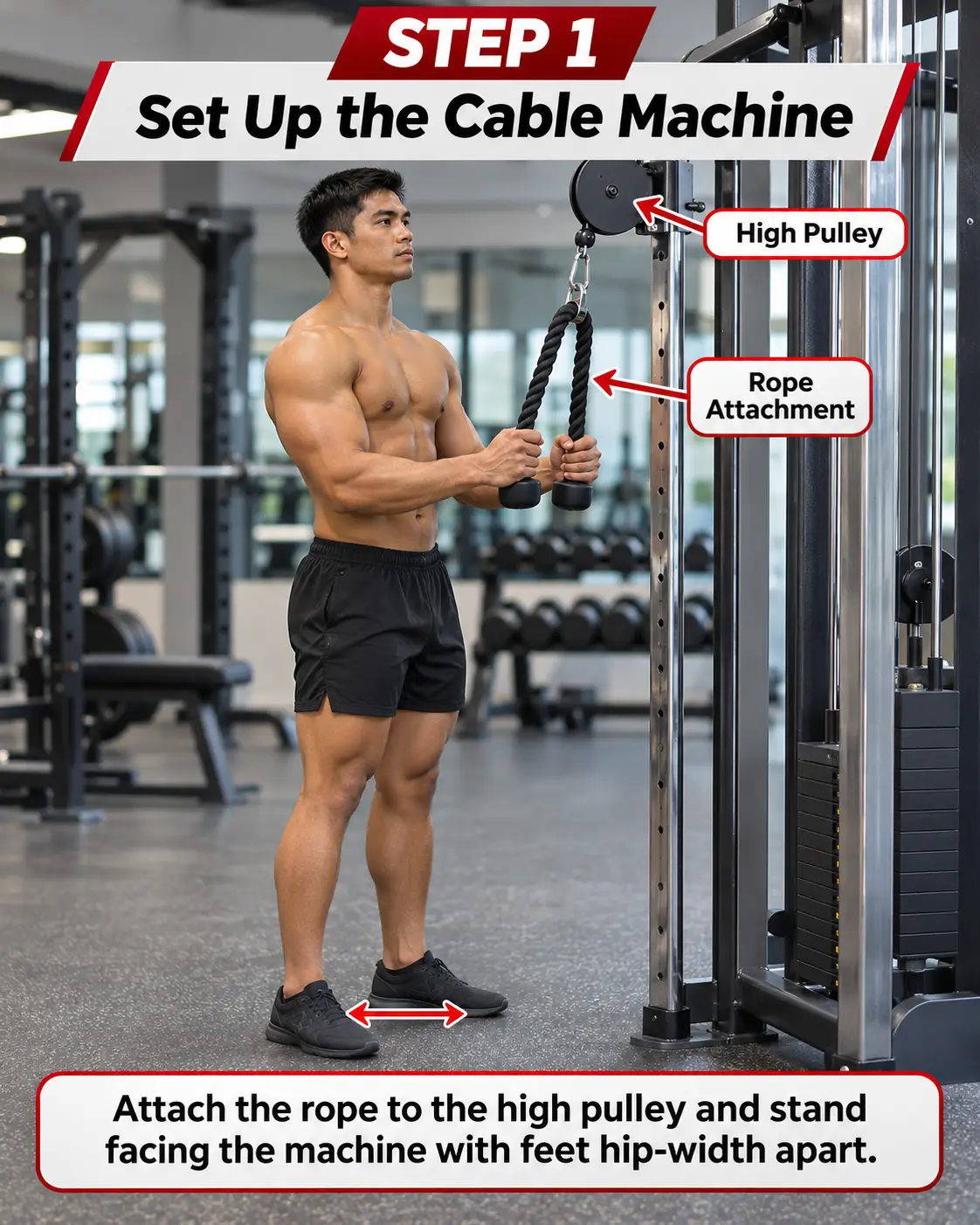
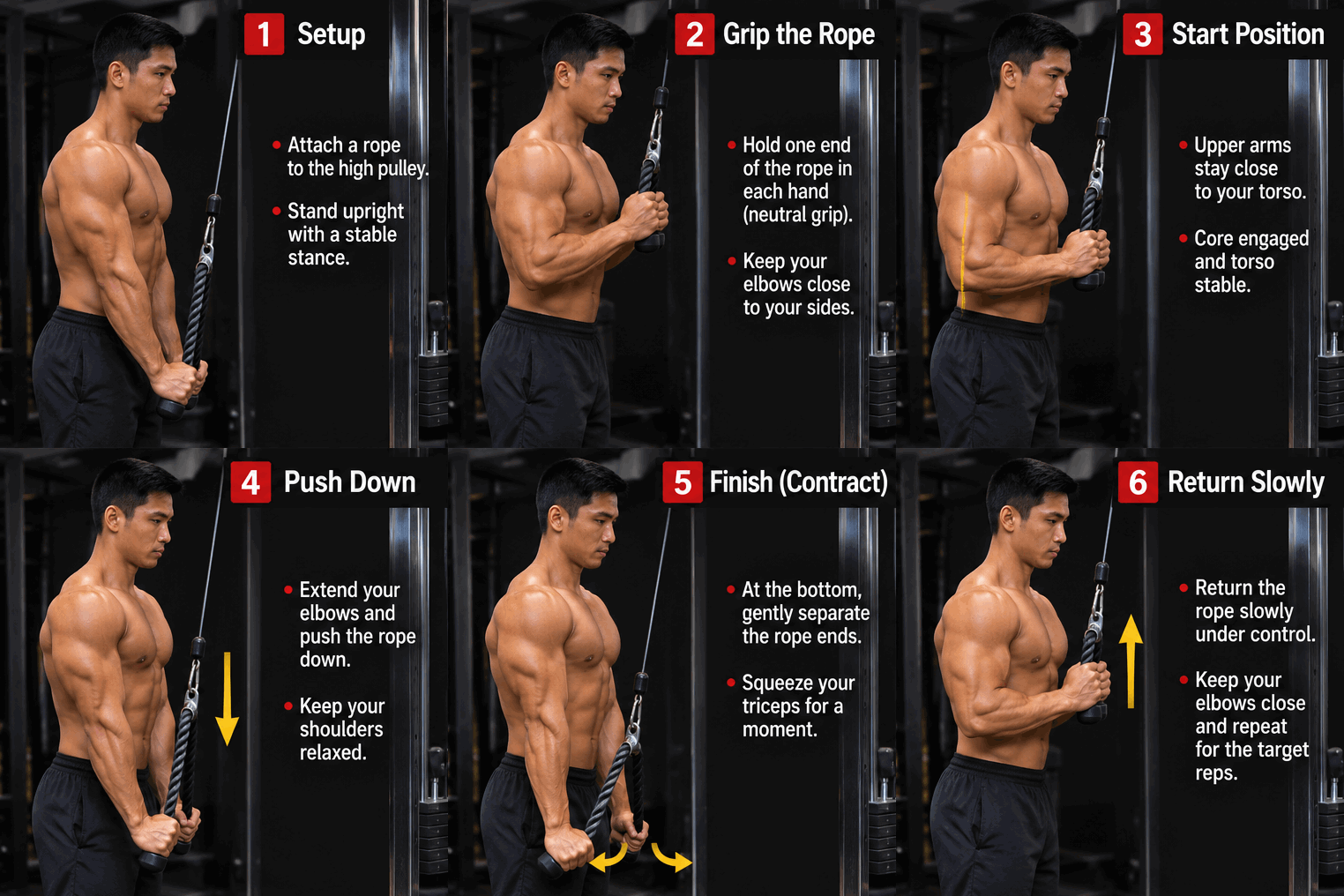
Step 1: Set Up the Cable Machine
Attach a rope handle to the high pulley of a cable machine.
Choose a manageable weight that allows you to perform controlled repetitions without swinging your body.
Stand facing the machine with your feet approximately hip-width apart. A slightly staggered stance is also fine.
Step 2: Grip the Rope
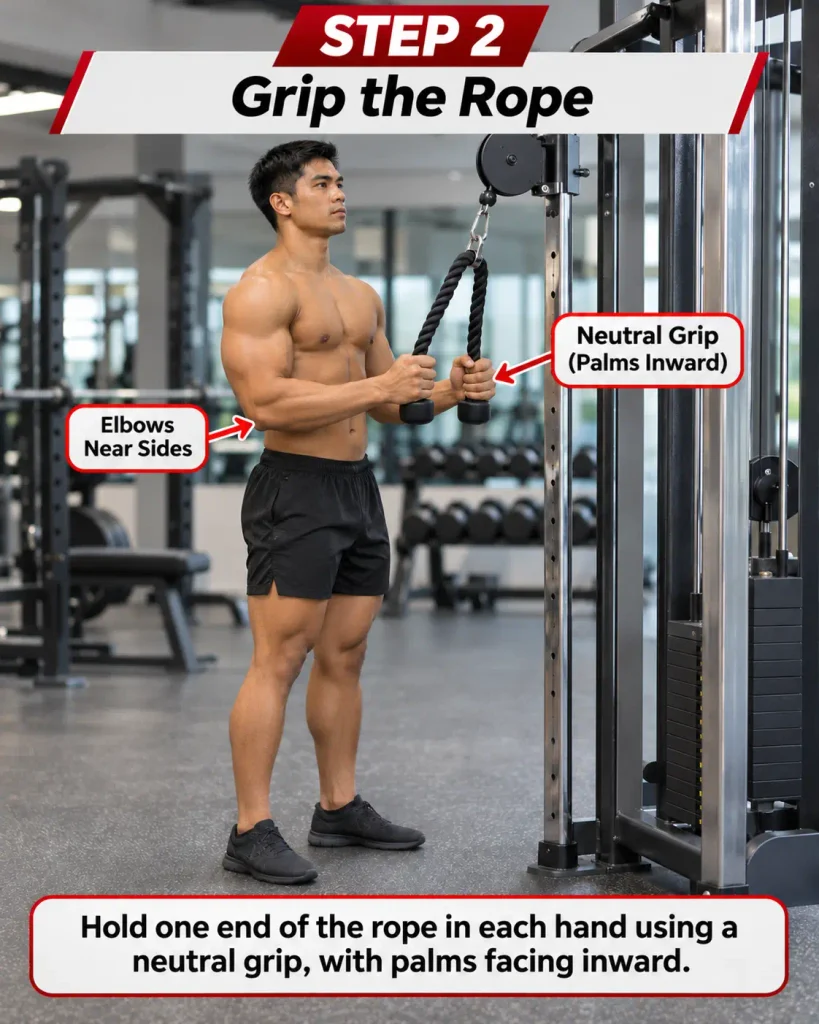
Hold one end of the rope in each hand using a neutral grip, with your palms facing inward.
Keep your wrists relatively straight and your grip comfortable.
Step 3: Position Your Elbows
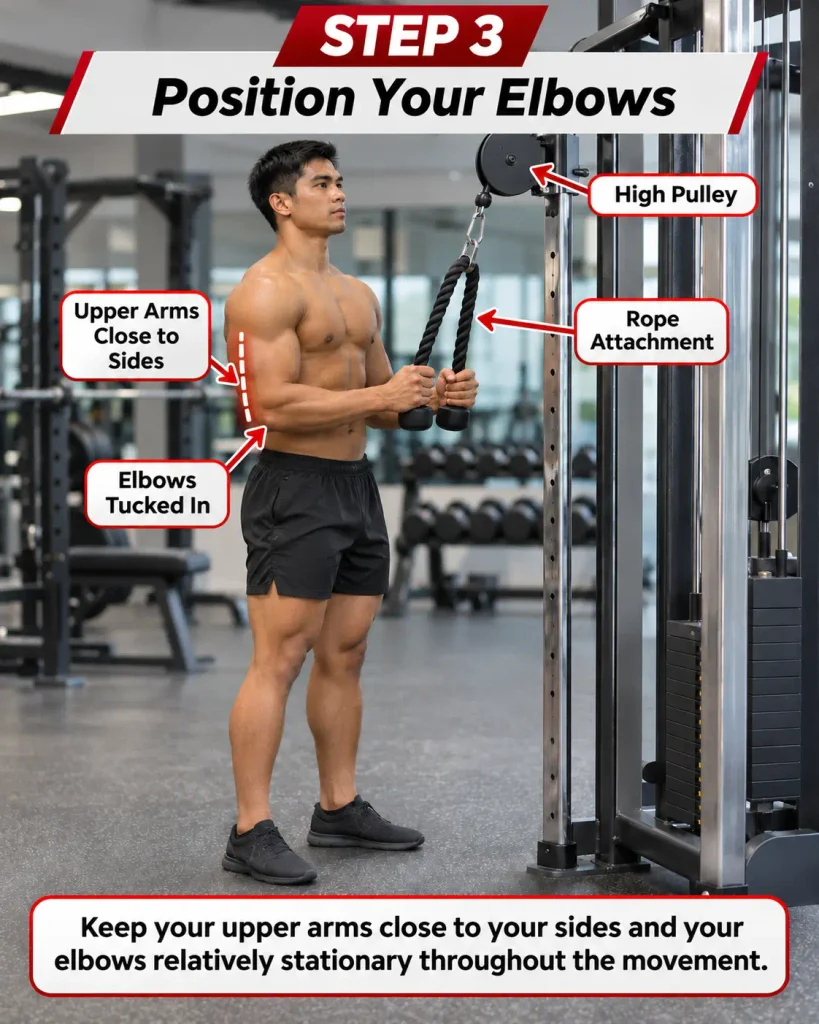
Bring your upper arms close to your sides.
Allow your elbows to bend naturally, keeping your shoulders relaxed and your torso stable.
Your elbows should remain relatively stationary throughout each repetition.
Step 4: Push the Rope Down
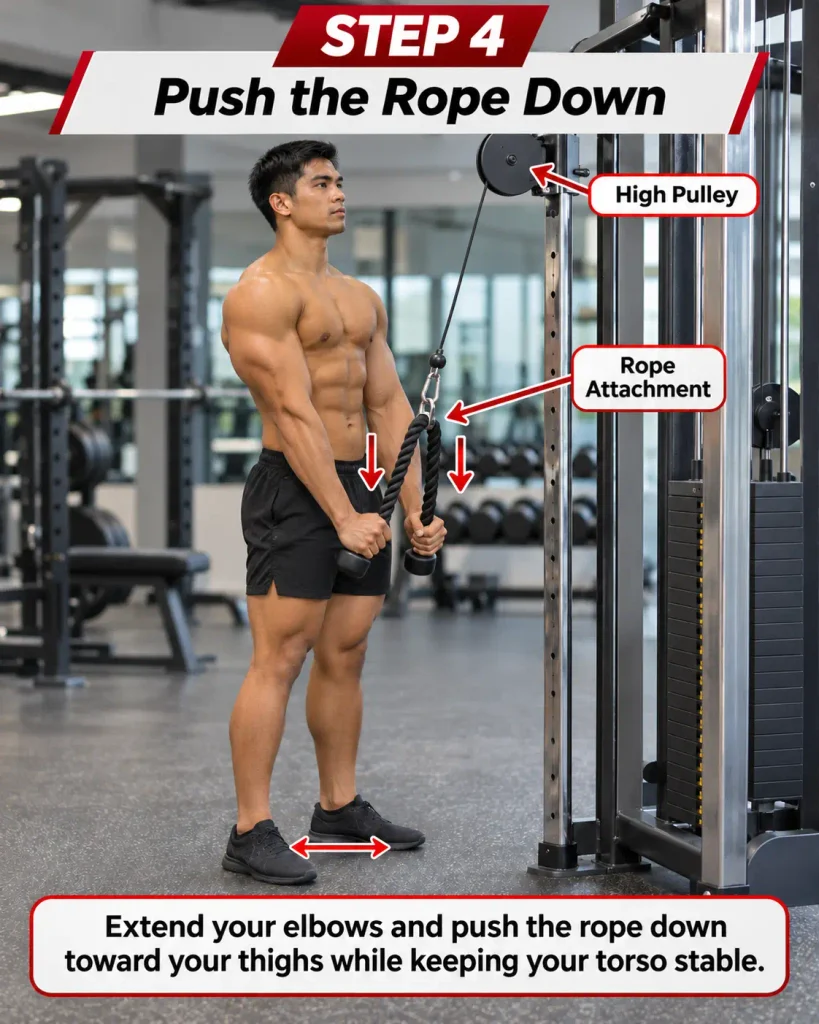
Exhale as you extend your elbows and move the rope toward your thighs.
Concentrate on straightening your arms rather than moving your shoulders or leaning your body into the weight.
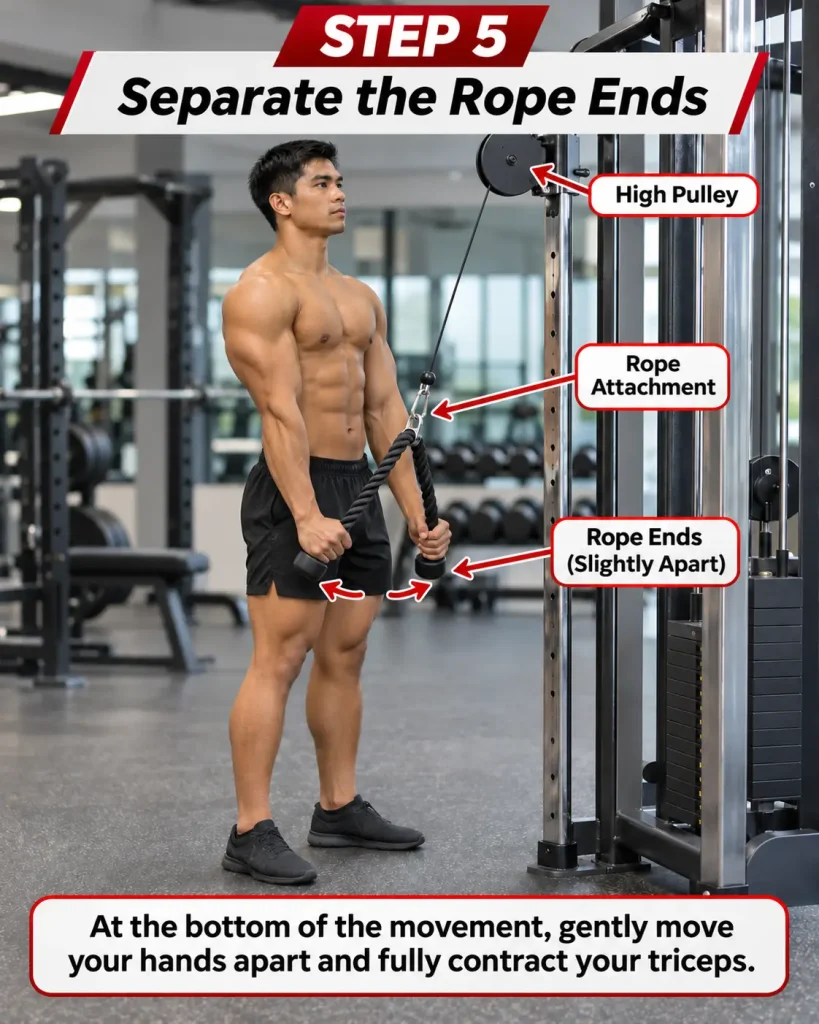
Step 5: Separate the Rope Ends
Near the bottom of the movement, gently move your hands apart if your range of motion and the attachment allow it comfortably.
Finish with your elbows extended without forcefully snapping or hyperextending the joints.
You should feel your triceps working, not sharp discomfort in your elbows.
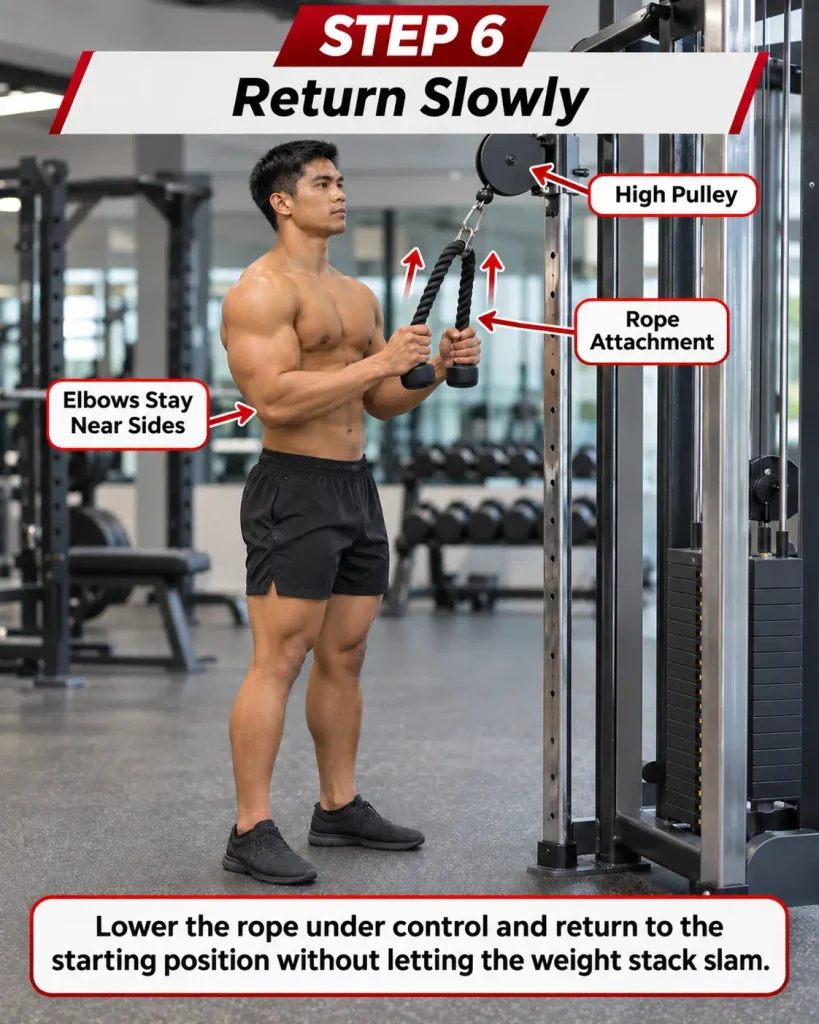
Step 6: Return Slowly
Inhale as you allow the rope to rise.
Bend your elbows under control while keeping your upper arms near your sides.
Return to a comfortable starting position that allows a useful range of motion without losing shoulder stability.
Step 7: Repeat
Complete your planned repetitions with consistent technique.
If you need to swing your upper body or force the rope downward, reduce the weight.
Quick form checklist:
- Keep your torso stable and core engaged.
- Maintain a neutral wrist position.
- Keep your elbows relatively close to your sides.
- Extend your elbows through a comfortable range of motion.
- Avoid swinging or using excessive momentum.
- Control the return phase of every repetition.
Benefits of Rope Triceps Pushdowns
1. Builds Triceps Muscle and Strength
Rope pushdowns provide direct resistance to the triceps, making them useful for hypertrophy-focused training.
Over time, progressively challenging the muscles can support increases in muscle size and strength.
2. Adds Volume Without Heavy Pressing
Exercises such as bench presses and dips involve multiple muscle groups.
Rope pushdowns allow you to add triceps-focused work without the same overall loading demands as heavy pressing exercises.
3. Provides an Adjustable Grip
The rope attachment allows a neutral hand position and independent movement of the hands.
Some lifters find this more comfortable than a fixed straight bar.
4. Supports Pressing Strength
Stronger triceps contribute to elbow extension during exercises such as the bench press.
However, improving a pushdown does not automatically guarantee a larger bench press. Progress also depends on your overall training.
5. Easy to Adjust for Different Fitness Levels
Cable machines allow relatively small resistance changes, making rope pushdowns useful for beginners and advanced lifters.
You can adjust the weight, repetition range, and number of sets to fit your workout.
How Many Sets and Reps Should You Do?
Your ideal sets and reps depend on your training experience, recovery, and how much triceps work you already perform.
| Training goal | Sets | Reps | Rest |
|---|---|---|---|
| Beginner technique | 2–3 | 10–15 | 60–90 seconds |
| Muscle growth | 3–4 | 8–15 | 60–120 seconds |
| Heavier strength-focused accessory work | 3–4 | 6–10 | 90–150 seconds |
| Higher-repetition accessory work | 2–3 | 15–20 | 60–90 seconds |
These are practical starting ranges rather than rigid rules. Muscle growth can occur across a wide range of repetitions when sets are sufficiently challenging and training volume is appropriate.
For hypertrophy, aim to finish most working sets with approximately 1–3 good repetitions remaining before your technique would break down.
How Often Should You Train Triceps?
Training your triceps around twice per week can be a practical starting point.
Remember that chest and shoulder pressing exercises also train your triceps. Count that work when planning recovery and weekly training volume.
For additional guidance, read How Often Should You Train Each Muscle for Growth?.
Common Rope Triceps Pushdown Mistakes
1. Using Too Much Weight
One of the most common mistakes is selecting a weight that requires swinging or leaning heavily into the movement.
Fix: Reduce the resistance until you can complete your repetitions with a stable upper body.
2. Moving Your Elbows Excessively
Large amounts of upper-arm movement can turn a triceps isolation exercise into a movement that involves more shoulder motion.
Fix: Keep your elbows relatively stable without forcing them into an uncomfortable position.
3. Cutting the Repetition Short
Stopping well before elbow extension can unnecessarily limit the range of motion.
Fix: Straighten your elbows through a comfortable, controlled range without forcing the joints.
4. Letting the Weight Snap Back
Allowing the cable to pull your arms upward too quickly reduces your control of the movement.
Fix: Lower the weight under control, then return gradually rather than allowing the stack to slam.
5. Pulling the Rope Too Far Apart
Aggressively separating the rope ends can cause unnecessary wrist movement or discomfort.
Fix: Gently separate your hands only as far as comfortable. The main action remains elbow extension.
6. Leaning Too Far Forward
A slight forward lean is acceptable, but excessive body movement may indicate that the resistance is too heavy.
Fix: Use a stable stance and keep your torso mostly still.
Rope Triceps Pushdown vs. Straight-Bar Pushdown
Both versions train the triceps through elbow extension. The main differences involve grip, hand freedom, and individual comfort.
| Feature | Rope pushdown | Straight-bar pushdown |
|---|---|---|
| Grip | Neutral | Usually pronated |
| Hand movement | Independent | Fixed relative to the bar |
| Wrist position | More adjustable | More restricted |
| Triceps involvement | All three heads | All three heads |
| Best for | Comfortable grip and flexible hand position | Stable, consistent attachment position |
Which is better for muscle growth?
Neither attachment is automatically superior for everyone.
The better option is the one that allows you to train your triceps consistently, comfortably, and with enough effort to stimulate progress.
You can also alternate attachments across your workouts.
For another variation, see Triceps Pushdown with Cable.
Best Rope Triceps Pushdown Variations
1. Single-Arm Cable Triceps Pushdown
Perform the movement using one arm at a time with an appropriate single-handle attachment.
This variation can help you focus on each arm independently and identify differences in strength or control.
2. Reverse-Grip Triceps Pushdown
Use an underhand grip with a suitable bar or single-handle attachment.
This changes your wrist and forearm position while continuing to work the triceps.
Read the Reverse-Grip Triceps Pushdown Guide.
3. Straight-Bar Cable Pushdown
Replace the rope with a straight bar.
This variation provides a fixed grip and may feel more stable for some lifters.
4. Overhead Cable Triceps Extension
Position your arms overhead and extend your elbows against cable resistance.
Overhead extensions train the triceps in a different shoulder position and may be particularly useful for developing the long head.
A 2023 study published in the European Journal of Sport Science found greater triceps hypertrophy with overhead elbow-extension training than with training in a neutral arm position.
This does not make rope pushdowns ineffective. It suggests that including overhead training can be useful in a complete triceps program.
See Standing Triceps Cable Extension.
Sample Triceps Workout for Muscle Growth
Here is a simple triceps-focused workout for someone already comfortable with resistance training.
| Exercise | Sets | Reps |
|---|---|---|
| Close-grip bench press | 3 | 6–10 |
| Rope triceps pushdown | 3 | 10–15 |
| Overhead cable triceps extension | 2–3 | 10–15 |
Rest approximately 60–120 seconds between isolation sets and longer if needed after heavier pressing.
If you already perform several sets of bench presses, shoulder presses, or dips, you may need fewer direct triceps sets.
Increase training volume gradually rather than adding every exercise immediately.
How to Progress
Use a simple double-progression approach.
For example, if your target is 3 sets of 10–15 repetitions:
- Select a weight you can lift for at least 10 controlled repetitions.
- Continue using that weight while building toward 15 repetitions per set.
- Once you can complete all three sets at the top of the range with good form, increase the resistance by the smallest practical amount.
- Repeat the process with the new weight.
Progress does not have to happen every workout. Maintaining better control or completing more quality repetitions also counts as improvement.
Rope Triceps Pushdown Tips for Beginners and Older Lifters
Rope pushdowns can be a useful part of strength training for adults at different ages and experience levels.
Start with moderate resistance, prioritize smooth repetitions, and avoid sudden or forceful elbow extension.
If you experience elbow discomfort, try a lighter load, a more comfortable grip, or a slightly reduced range of motion.
If you have an existing shoulder or elbow injury, follow advice from your healthcare professional or physical therapist before increasing training loads.
The objective is consistent, tolerable resistance training rather than lifting the entire weight stack.
Frequently Asked Questions About Rope Triceps Pushdowns
Are rope triceps pushdowns good for building muscle?
Yes. Rope triceps pushdowns are an effective way to train elbow extension against resistance and can contribute to triceps hypertrophy when combined with sufficient effort, progressive overload, and recovery.
Are rope pushdowns better than straight-bar pushdowns?
Not necessarily. Both train the triceps effectively. Rope attachments allow greater freedom of hand movement, while straight bars provide a fixed grip. Choose based on comfort, technique, and training goals.
Should I go heavy on rope triceps pushdowns?
Use enough weight to make your target repetitions challenging without losing control. Excessively heavy loads that cause swinging or discomfort are unnecessary.
Should my elbows stay tucked in?
Keep your upper arms reasonably close to your torso and your elbows relatively stable. You do not need to force your elbows tightly against your ribs.
Should I spread the rope apart at the bottom?
You can gently separate the rope ends near the bottom if it feels comfortable. However, spreading the rope apart is not required to make the exercise effective.
Can rope pushdowns build the long head of the triceps?
Yes. The long head contributes to elbow extension, so it is trained during pushdowns. However, overhead extensions may produce greater long-head growth because of the different shoulder position and muscle length.
Can beginners do rope triceps pushdowns?
Yes. Beginners can use light resistance, learn controlled elbow extension, and gradually increase repetitions and weight as their technique improves.
Do rope triceps pushdowns reduce arm fat?
No exercise selectively burns fat from one body part. Rope pushdowns can help develop the triceps, but reducing overall body fat depends largely on energy balance, nutrition, and activity.
Final Thoughts
The rope triceps pushdown is a straightforward, effective exercise for building stronger triceps and adding focused arm training to your program.
The most important factors are using a manageable weight, maintaining stable elbow positioning, extending your arms under control, and progressing gradually.
For more complete triceps development, combine rope pushdowns with overhead triceps extensions and pressing exercises suited to your ability and recovery.
Focus on quality repetitions and consistent progress rather than the amount of weight on the cable stack.
References
- American College of Sports Medicine. Resistance Training Prescription for Muscle Function, Hypertrophy, and Physical Performance in Healthy Adults: An Overview of Reviews. Read the position stand.
- Maeo S, et al. Triceps brachii hypertrophy is substantially greater after elbow extension training performed in the overhead versus neutral arm position. European Journal of Sport Science, 2023. Read the study.